The international agricultural workforce conference was held in Cork city on Tuesday 10 July.
The conference, which focuses on labour issues across the dairy sector, had a number of international speakers at the event, including Professor Ruth Nettle of the University of Melbourne, Australia, as well as Dr Priscilla Malanski and Dr Callum Eastwood of New Zealand Dairy.
Teagasc's key speakers Paidi Kelly, Gerry Boyle and John Upton addressed the gathering of over 150 people.
Divided into four sessions, the conference discussed labour efficiency, milking technology and international markets. People management on dairy farms was also discussed in depth.
Speaking with the Irish Farmers Journal, Teagasc director Gerry Boyle said the conference is vital in outlining the challenges and potential solutions to the labour issue.
“It has been universally recognised that we have a massive labour shortage on farms," the Teagasc chief began, referencing last year's Teagasc report forecasting 6,000 workers were needed over the next 10 years, which was broken down into 4,000 farm owners and 2,000 farm employees.
Labour requirements
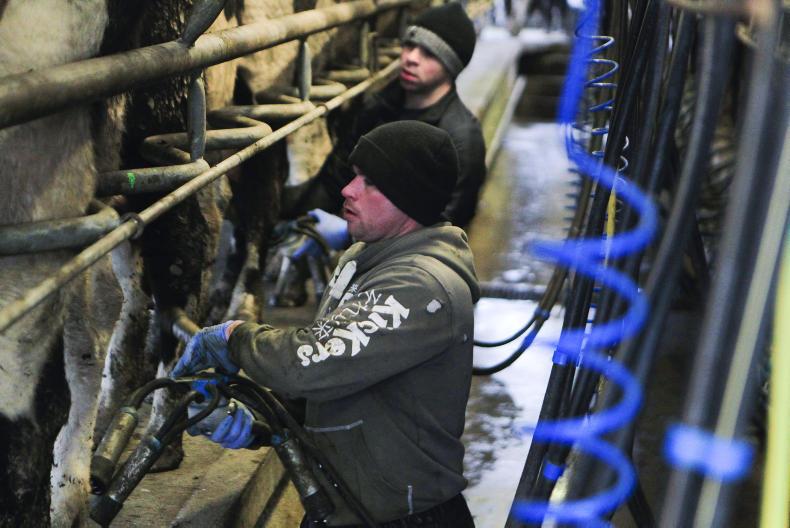
The need for labour on dairy farms can be seasonal, with the spring-calving period highlighted as having one of the highest requirements for labour. Boyle said he was conscience that outside-the-box thinking is required to target this.
“The minister asked us to put together a group to propose actions [for the shortage]. We put together a wide-ranging group featuring representatives of all the players across the industry. Last month, this report was launched proposing six action areas. At the top of this list were proposed actions to deal with the labour shortage on the ground,” Boyle explained.
“We have tried, along with FRS, to identify novel pools of labour, eg women who are living in rural areas, who with a bit of training, would be interested in doing milking on farms of calf rearing. Maybe people from non-dairy backgrounds who may have time on their hands. Different categories that haven’t been considered before,” he said.
“We have targeted those on a pilot scheme and there was some success. Obviously we are looking to import labour from the wider European area but that requires permits.
“We have some success in persuading the relevant departments that agriculture needs to feature in terms of allocation.”
Asylum seekers
Boyle also welcomed the potential of asylum seekers and their ability to work in the agricultural sector.
The conference was jointly organised by ICOS. The event was hosted at the Radisson Blu Hotel in Cork city.
Read more
Cow flow key for expansive dairy unit
Spotlight on dairy sustainability
The international agricultural workforce conference was held in Cork city on Tuesday 10 July.
The conference, which focuses on labour issues across the dairy sector, had a number of international speakers at the event, including Professor Ruth Nettle of the University of Melbourne, Australia, as well as Dr Priscilla Malanski and Dr Callum Eastwood of New Zealand Dairy.
Teagasc's key speakers Paidi Kelly, Gerry Boyle and John Upton addressed the gathering of over 150 people.
Divided into four sessions, the conference discussed labour efficiency, milking technology and international markets. People management on dairy farms was also discussed in depth.
Speaking with the Irish Farmers Journal, Teagasc director Gerry Boyle said the conference is vital in outlining the challenges and potential solutions to the labour issue.
“It has been universally recognised that we have a massive labour shortage on farms," the Teagasc chief began, referencing last year's Teagasc report forecasting 6,000 workers were needed over the next 10 years, which was broken down into 4,000 farm owners and 2,000 farm employees.
Labour requirements
The need for labour on dairy farms can be seasonal, with the spring-calving period highlighted as having one of the highest requirements for labour. Boyle said he was conscience that outside-the-box thinking is required to target this.
“The minister asked us to put together a group to propose actions [for the shortage]. We put together a wide-ranging group featuring representatives of all the players across the industry. Last month, this report was launched proposing six action areas. At the top of this list were proposed actions to deal with the labour shortage on the ground,” Boyle explained.
“We have tried, along with FRS, to identify novel pools of labour, eg women who are living in rural areas, who with a bit of training, would be interested in doing milking on farms of calf rearing. Maybe people from non-dairy backgrounds who may have time on their hands. Different categories that haven’t been considered before,” he said.
“We have targeted those on a pilot scheme and there was some success. Obviously we are looking to import labour from the wider European area but that requires permits.
“We have some success in persuading the relevant departments that agriculture needs to feature in terms of allocation.”
Asylum seekers
Boyle also welcomed the potential of asylum seekers and their ability to work in the agricultural sector.
The conference was jointly organised by ICOS. The event was hosted at the Radisson Blu Hotel in Cork city.
Read more
Cow flow key for expansive dairy unit
Spotlight on dairy sustainability






SHARING OPTIONS