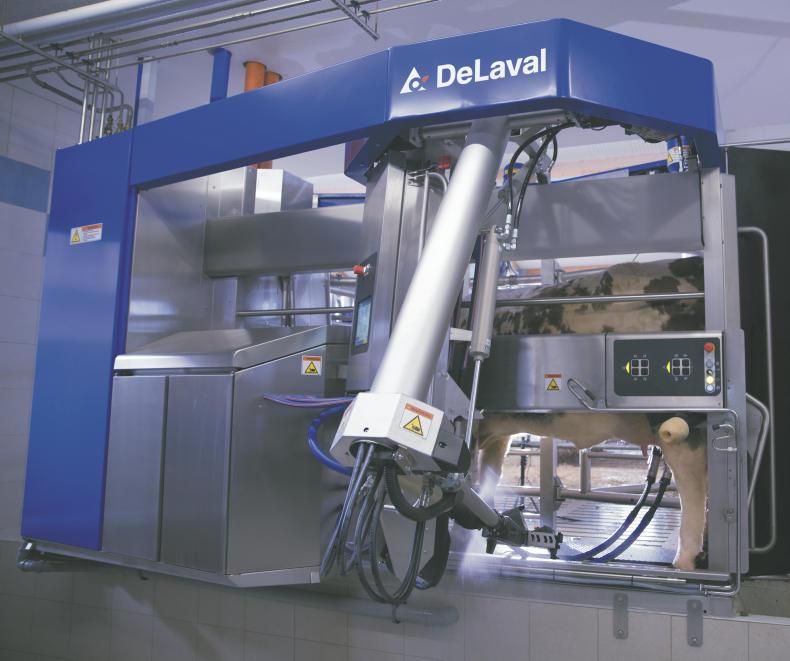
The new DeLaval VMS V300 has been in production for the last four years and was tested on various pilot farms across Europe and the US since January. According to Jonas Hailman executive vice-president of DeLaval, “we have created a totally new platform for voluntary milking systems (VMS). The machine is almost completely brand new”.
“Labour and lifestyle is a big aspect of the new VMS.
‘‘Regardless of what system you run, we must make milking attractive and we have invested heavily in this technology over the last number of years. We really believe in it,” he says.
There are three main developments in the new VMS V300: attachment, milk circulation and user-friendliness.
Attachment
A new 3D camera recognises the individual cows as they come into the robot. The camera adjusts itself during attachment and throughout the lactation period of the cow to maintain fast attachment time.
“The new 3D scanner allows the system to learn on its own and adjust to the cow’s shape as she changes through her lactation,” says market solution manager Andre de Leeuw.
The robot has the ability to detect teats from up to 1m away, which allows a faster and more efficient milking process. The attachment time is now taking 60 to 80 seconds, which is faster than the old robot allowing for an increase in the number of milkings per day.
The arm has undergone some material changes to increase the robustness of the machine. According to Andre, the new robot can milk up to 9.2 cows per hour. This means the machine is capable of potentially milking 70 cows three times a day.
“The increased efficiency and more accurate technology aims to decrease running costs and, in some cases, reduce the need for an extra VMS unit depending on cow numbers and yield,” Andre says.
There are now two spray nozzles on the arm for pre- and post-teat spraying. DeLaval claims a 99% hit rate with the spray hitting the ends of the teats where it needs to be. This is supposed to reduce the amount of teat spray used by up to 20%.
Milk circulation
Milking time has been reduced by one minute with new alterations to the vacuum pump, seals and collection tank.
The exterior of the robot has not changed dramatically aside from repositioning of the touchscreen and new controls for manual attachment of the clusters.
Four International Committee Animal Recording-approved milk flow meters give accurate milk recordings to increase the information returning to the farmer. Water usage in the new system is reduced by up to 18%, while electricity consumption is reduced by up to 15% using 25 kWh/1,000kg of milk harvested.
Service
There is an option for an all-inclusive backup service with the new V300. The changes to the machine allow easier accessibility by service technicians and allow two units to be serviced in one day. The service packages were quoted as starting from 0.9c/l of milk produced.
Jonas Hailman put an emphasis on doing more with less. He says DeLaval realises the importance they play when someone invests in a VMS: “Farmers trust us with their livelihoods. It’s important we deliver.’’
The price of a V300 varies from farm to farm because of the specific requirements of an automated system.
The Irish Farmers Journal understands that the new VMS would cost in the region of €145,000 representing a 10% to 15% increase on the previous model. There is a changeover period where from 2019 the V300 will be the standard robot sold to DeLaval customers.
Existing VMS units cannot be updated to the standard of the new model and the new camera cannot be retrofitted to old machines as the software is not compatible.
What’s new?
Decrease in milking time by one minute.Increased capacity 3,000kg/day to 3,500kg/day – better vacuum stability.50% faster attachment – new 3D camera.Two-spray nozzles for pre- and post-teat spray. Remote operation from tablet or device.New service packages and maintenance deals.
The new DeLaval VMS V300 has been in production for the last four years and was tested on various pilot farms across Europe and the US since January. According to Jonas Hailman executive vice-president of DeLaval, “we have created a totally new platform for voluntary milking systems (VMS). The machine is almost completely brand new”.
“Labour and lifestyle is a big aspect of the new VMS.
‘‘Regardless of what system you run, we must make milking attractive and we have invested heavily in this technology over the last number of years. We really believe in it,” he says.
There are three main developments in the new VMS V300: attachment, milk circulation and user-friendliness.
Attachment
A new 3D camera recognises the individual cows as they come into the robot. The camera adjusts itself during attachment and throughout the lactation period of the cow to maintain fast attachment time.
“The new 3D scanner allows the system to learn on its own and adjust to the cow’s shape as she changes through her lactation,” says market solution manager Andre de Leeuw.
The robot has the ability to detect teats from up to 1m away, which allows a faster and more efficient milking process. The attachment time is now taking 60 to 80 seconds, which is faster than the old robot allowing for an increase in the number of milkings per day.
The arm has undergone some material changes to increase the robustness of the machine. According to Andre, the new robot can milk up to 9.2 cows per hour. This means the machine is capable of potentially milking 70 cows three times a day.
“The increased efficiency and more accurate technology aims to decrease running costs and, in some cases, reduce the need for an extra VMS unit depending on cow numbers and yield,” Andre says.
There are now two spray nozzles on the arm for pre- and post-teat spraying. DeLaval claims a 99% hit rate with the spray hitting the ends of the teats where it needs to be. This is supposed to reduce the amount of teat spray used by up to 20%.
Milk circulation
Milking time has been reduced by one minute with new alterations to the vacuum pump, seals and collection tank.
The exterior of the robot has not changed dramatically aside from repositioning of the touchscreen and new controls for manual attachment of the clusters.
Four International Committee Animal Recording-approved milk flow meters give accurate milk recordings to increase the information returning to the farmer. Water usage in the new system is reduced by up to 18%, while electricity consumption is reduced by up to 15% using 25 kWh/1,000kg of milk harvested.
Service
There is an option for an all-inclusive backup service with the new V300. The changes to the machine allow easier accessibility by service technicians and allow two units to be serviced in one day. The service packages were quoted as starting from 0.9c/l of milk produced.
Jonas Hailman put an emphasis on doing more with less. He says DeLaval realises the importance they play when someone invests in a VMS: “Farmers trust us with their livelihoods. It’s important we deliver.’’
The price of a V300 varies from farm to farm because of the specific requirements of an automated system.
The Irish Farmers Journal understands that the new VMS would cost in the region of €145,000 representing a 10% to 15% increase on the previous model. There is a changeover period where from 2019 the V300 will be the standard robot sold to DeLaval customers.
Existing VMS units cannot be updated to the standard of the new model and the new camera cannot be retrofitted to old machines as the software is not compatible.
What’s new?
Decrease in milking time by one minute.Increased capacity 3,000kg/day to 3,500kg/day – better vacuum stability.50% faster attachment – new 3D camera.Two-spray nozzles for pre- and post-teat spray. Remote operation from tablet or device.New service packages and maintenance deals. 




SHARING OPTIONS