When choosing a bull for natural service or artificial insemination (AI), it is very hard to get any accurate information on gestation length, although some AI catalogues or breed sale brochures will give you a figure of plus or minus a small amount.
This can be very hard to make much sense of. For example, you could have a bull with a figure of minus four, which, on average, should produce calves born three days earlier than a bull with a gestation length of plus two (given that the bull provides half the genetics).
But, seeing as the figures are small, you would think that it won’t make much difference.
A lot of the AI catalogues don’t even mention them at all, and if you enquire about it they will come back with a vague response.
However, I often wonder if gestation length is something we should all be taking more of an interest in.
Calved
To illustrate the point, I had two cows calved at the end of last month (25 August) and one was served with AI on 26 October last year and the other on 23 November.
That is almost one month of difference in the gestation length.
Both calved unassisted, and the one with the longest gestation had a heifer calf, with the short gestation cow having a bull calf.
There is no stock bull on the farm, so I know the figures are accurate.
While perhaps some farmers don’t mind if the cow runs until 13 or 14 months, it is not something I want
You might be inclined to say “so what”, and I can understand that kind of thinking. Does it really matter when both had live calves unassisted?
My problem is that I want all my cows to have a calf every 12 months, and if a cow is pregnant for 10 months then it doesn’t give me much time to get her back in calf.
Given that most advice is not to breed an animal until she is 50 days calved – you can see that time soon runs out.
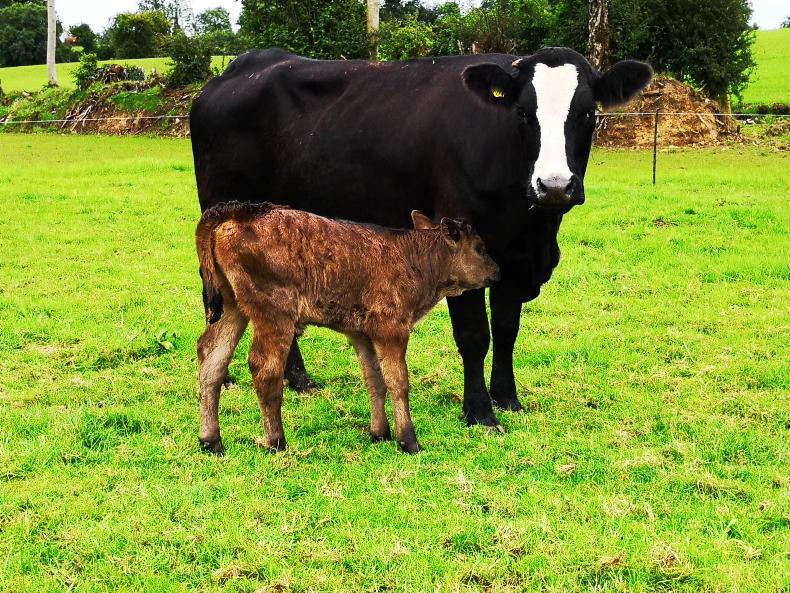
This cow was artificially inseminated on 26 October 2017 and calved on 25 August 2018, a gestation length of 303 days.
You are only left with 10 days to get her to cycle and hold in-calf. It doesn’t take many mistakes until you are over the 12 months.
While perhaps some farmers don’t mind if the cow runs until 13 or 14 months, it is not something I want.
In my opinion, there is little money already in sucklers without carrying passengers. I believe that a suckler cow costs £60/month to keep, so by letting your cow run to 14 months you have just lost £120.
If you ask any farmer to take £120 less for every calf, they would soon tell you where to go.
Some might also think that you will have a better calf if it is longer in the womb, and it will be worth extra money.
But I have been calving cows for a long time and nine times out of 10 the small calf will catch up with the big one, or even overtake it.
I also don’t want big calves at calving, although the two calves that I had born on 25 August were almost identical in size.
I have managed to identify one bull that I have been using that regularly has a gestation length of up to 10 months. The bull produces good calves and they are easily born, but they are not worth £120 more.
I raised this point with the AI company and I was told to use the bull at the start of my breeding period.
Overall, I’m a little disappointed that there is not more accurate information freely given, but I suppose that nobody wants to say anything negative about their bull. I’m reluctant to use this long-gestation bull again.
Read more
From torment to twins: a Salers cow's story
Farmer Writes: reseed turns up a little bit of history
When choosing a bull for natural service or artificial insemination (AI), it is very hard to get any accurate information on gestation length, although some AI catalogues or breed sale brochures will give you a figure of plus or minus a small amount.
This can be very hard to make much sense of. For example, you could have a bull with a figure of minus four, which, on average, should produce calves born three days earlier than a bull with a gestation length of plus two (given that the bull provides half the genetics).
But, seeing as the figures are small, you would think that it won’t make much difference.
A lot of the AI catalogues don’t even mention them at all, and if you enquire about it they will come back with a vague response.
However, I often wonder if gestation length is something we should all be taking more of an interest in.
Calved
To illustrate the point, I had two cows calved at the end of last month (25 August) and one was served with AI on 26 October last year and the other on 23 November.
That is almost one month of difference in the gestation length.
Both calved unassisted, and the one with the longest gestation had a heifer calf, with the short gestation cow having a bull calf.
There is no stock bull on the farm, so I know the figures are accurate.
While perhaps some farmers don’t mind if the cow runs until 13 or 14 months, it is not something I want
You might be inclined to say “so what”, and I can understand that kind of thinking. Does it really matter when both had live calves unassisted?
My problem is that I want all my cows to have a calf every 12 months, and if a cow is pregnant for 10 months then it doesn’t give me much time to get her back in calf.
Given that most advice is not to breed an animal until she is 50 days calved – you can see that time soon runs out.
This cow was artificially inseminated on 26 October 2017 and calved on 25 August 2018, a gestation length of 303 days.
You are only left with 10 days to get her to cycle and hold in-calf. It doesn’t take many mistakes until you are over the 12 months.
While perhaps some farmers don’t mind if the cow runs until 13 or 14 months, it is not something I want.
In my opinion, there is little money already in sucklers without carrying passengers. I believe that a suckler cow costs £60/month to keep, so by letting your cow run to 14 months you have just lost £120.
If you ask any farmer to take £120 less for every calf, they would soon tell you where to go.
Some might also think that you will have a better calf if it is longer in the womb, and it will be worth extra money.
But I have been calving cows for a long time and nine times out of 10 the small calf will catch up with the big one, or even overtake it.
I also don’t want big calves at calving, although the two calves that I had born on 25 August were almost identical in size.
I have managed to identify one bull that I have been using that regularly has a gestation length of up to 10 months. The bull produces good calves and they are easily born, but they are not worth £120 more.
I raised this point with the AI company and I was told to use the bull at the start of my breeding period.
Overall, I’m a little disappointed that there is not more accurate information freely given, but I suppose that nobody wants to say anything negative about their bull. I’m reluctant to use this long-gestation bull again.
Read more
From torment to twins: a Salers cow's story
Farmer Writes: reseed turns up a little bit of history





SHARING OPTIONS