


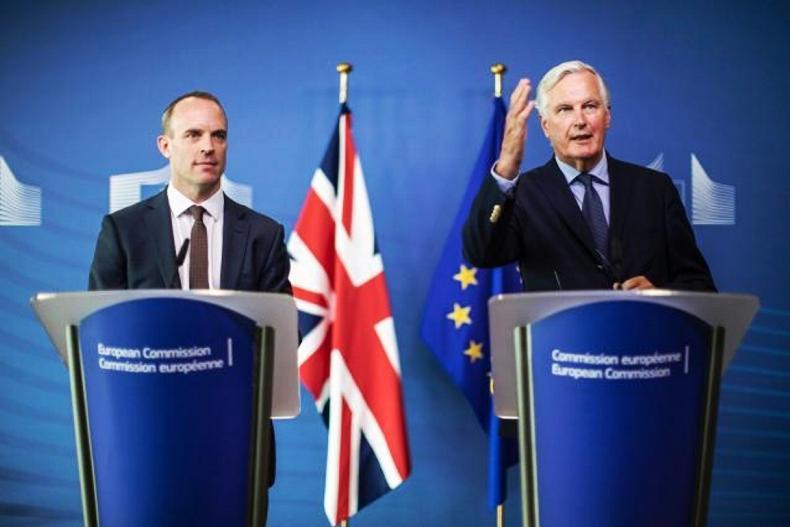
While the Tanaiste emphasised Ireland’s complete alignment with the EU27 and support for chief negotiator Michel Barnier this week, the reality is that for farmers on the island of Ireland acceptance of the British white paper, more commonly known as the Chequers proposals, would solve most problems.
Status quo
It would allow trade continue more or less on the basis that it has, meaning that milk and lambs could continue coming south for processing while pigs could still go north.
Critically, all the Irish produce could continue accessing the British market and not only would there be no new border checks on the island of Ireland, there wouldn’t be one in the Irish sea either.
What’s more it would mean the UK would remain aligned to the EU production systems and the British market couldn’t be devalued by imports from third countries.
Problems
So what’s the problem? There are actually two problems – one in Westminster, the other in Brussels. The one in Westminster is because of the wide division in the governing Conservative Party between members who are for the white paper and those that are bitterly opposed.
It has already caused two ministerial resignations and members who want maximum distance between the UK and EU feel like it dilutes Brexit too much.
With Parliament completely divided, the Prime Minister has a massive challenge getting it passed.
If she has a problem selling the white paper to her own party, what are her chances of selling it to the chief negotiator?
He has all but rejected it at this stage because as he sees it, it is cherry-picking the single market for industrial goods and agricultural produce but excluding services and violating the principle of freedom of movement of people.
UK politics
However, if the UK Prime Minister can survive the Conservative Party conference which takes place in Birmingham starting on 30 September, then expect a major push to sell the Chequers proposals to the EU.
The difficulty for the UK is that the EU is not desperate to conclude a deal because, outside Ireland, the impact of no deal won’t be catastrophic.
However, Ireland and particularly our agriculture is desperate given the extent of our trading relationship with the UK, and the UK, even if it is reluctant to admit it publicly, is equally in need of a deal that maintains much of the status quo.
Room for manoeuvre
On that basis and given the EU’s stated commitment to Ireland, there has to be some room for manoeuvre.
If it wasn’t for Ireland, there is a sense that the EU would walk away, but ultimately the only way to protect Ireland and farming is to come to an arrangement with the UK.
Clever and imaginative language should help find a way and even the thorny issue of freedom of movement for people shouldn’t be an issue in practice given the dependence of the UK economy on migrant labour from the EU and beyond.
Perhaps this is why the Tánaiste is upbeat that a deal will be found.



SHARING OPTIONS