A recent Irish Farm Buildings Association (IFBA) study tour visited the 90-cow suckler herd of Bertie and Karl Williams from Kilmurry, Co Offaly where a new shed had recently been constructed. The 280-acre farm operates a suckling to beef system.
Mark Coyne from Teagasc is the advisor for the farm and organised the visit for the group. He discussed the reasons why such an investment was necessary on the farm: “The beef output on the farm in 2017 was 456/kg which is just not enough to keep the system going. Farm buildings really are the limiting factor when it comes to expansion on this farm.
“This farm is ticking all the boxes when it comes to production targets with a calving interval of 369 days, a six-week spring-calving rate of 88% and 0.97 calves per cow per year,” Mark explains. “What this does mean is that over 75% of the cows calve in the month of March so facilities will be under pressure with everything so tight.”
As Karl works full-time off-farm there is a need to keep the calving period as tight as possible to ensure workload is concentrated to only a few months of the year. Good calving facilities are already in place on the farm, adjoining the new development, so this shed will not be necessary for calving purposes. However, it will be required to hold calves for a month or more before they can get out to grass, hence why the large creep area was seen as vital to the overall design.
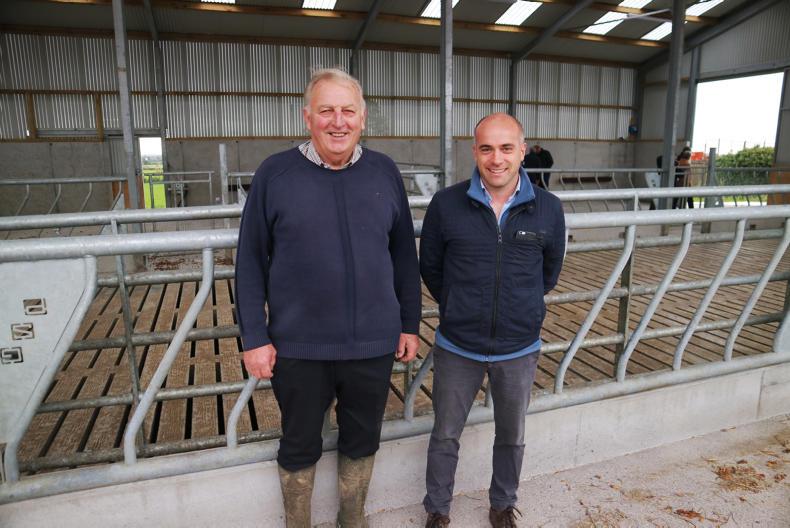
Bertie Williams (left) and Mark Coyne (right) hosted the group from the Irish Farm Buildings Association study tour.
The shed
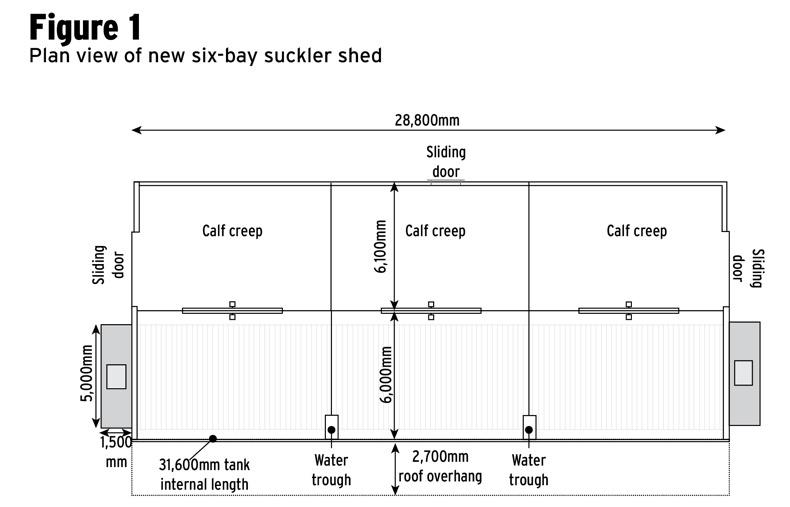
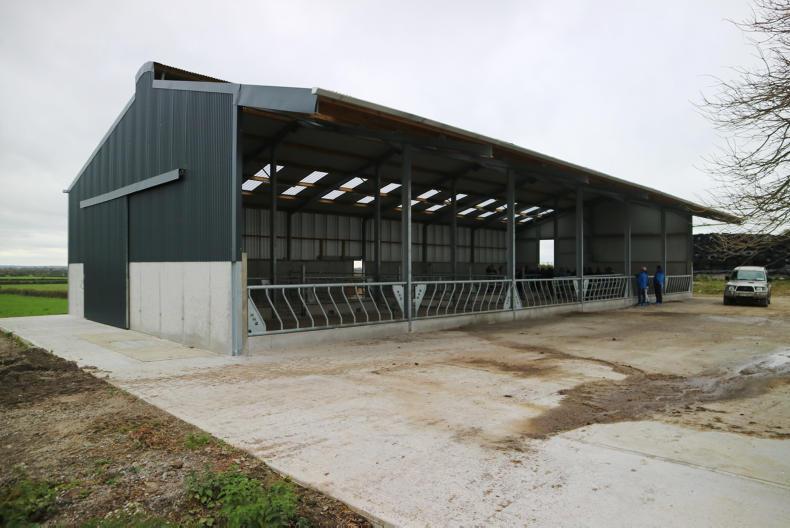
The shed itself is six bays long measuring a total of 28.8m in length. The total width of the shed is 14.8m, including a 2.7m overhang. Due to the width of the shed an A-roof design was chosen. The slatted area is large with a span of six metres. The creep area is also expansive, with a span of 6.1m.
The decision was taken to have three larger double pens as opposed to six single pens as the shed will be used to house suckler cows which can be treated as larger batches. There is the option to feed cows at the front and back of the pens for the majority of the year, up to the point of calving. However, once calved the creep area will be needed for young calves.
Pens
Each double pen is approximately 57.6m2 and with a recommended space of 2.5-3m2/cow, then there is space for approximately 20 cows in each section, or 60 cows in total. With a total feed space along the front of the shed of 28.8m, if 60 cows are in the shed feed space per cow would be 480mm. The recommended width for cows is 300mm if feeding silage ad-lib. However, if all cows are to eat together, if meal or mineral supplementation is being fed then 600mm/cow of feed space is required.
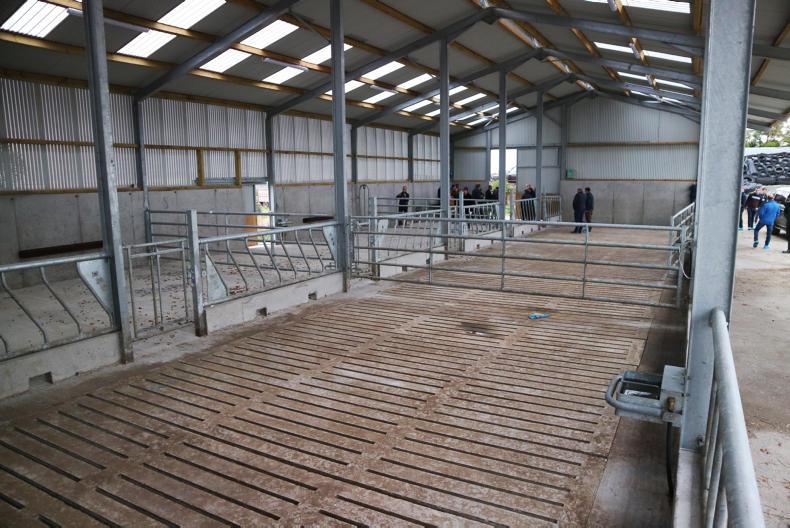
With the smaller feed barrier at the back of each pen there is an additional 6.6m of feed space for each double pen, or approximately 19.8m in total. Therefore, if cattle are being fed front and back then there is feed space of 800mm/cow if all feed space were to be utilised.
The slatted tank is 2.4m deep with an internal width of 4.7m, fitted with a 16’6” slat. There are two external agitation points, one at either end of the shed to give the total tank capacity of 356m3. When 200mm of freeboard is excluded it gives net storage capacity of 326m3.
Creep
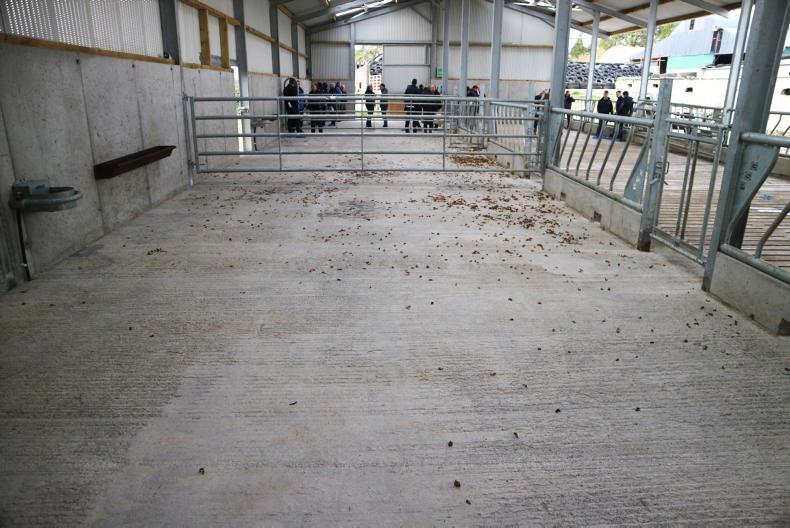
The creep area has a span of 6.1m which is large, but it was discussed at length with their agricultural advisor and planners.One key driver of the larger creep was the fact that a diet feeder would be moving through the creep area regularly, while also allowing ample room for cleaning out of soiled bedding with the tractor and loader in the springtime. With such a wide span it is vital to ensure that there is a good fall on the floor to carry moisture towards the slats quickly to keep the area for calves as dry as possible.
The fall must be at least one in 30 which for a span of 6.1m this would see a difference of 200mm in the height of the floor from the back wall to the slats. The recommended fall is one in 20 which would see a height difference of 305mm.
Small openings were left in the stub wall underneath the feed barriers between the creep area and the slats to allow moisture to flow easily onto the slats. All creep pens are fitted with water troughs on the back wall.
The Department specifications outline that all creep pens must be accessible without passing through another animal pen, for this reason an access door was needed at the back of the middle creep pen.
If there were six individual creep pens at the back of the shed it would have meant that four access doors would have been needed along the back wall in conjunction with the two sliding doors at either end of the creep which would have added considerably to the costs.
Ventilation
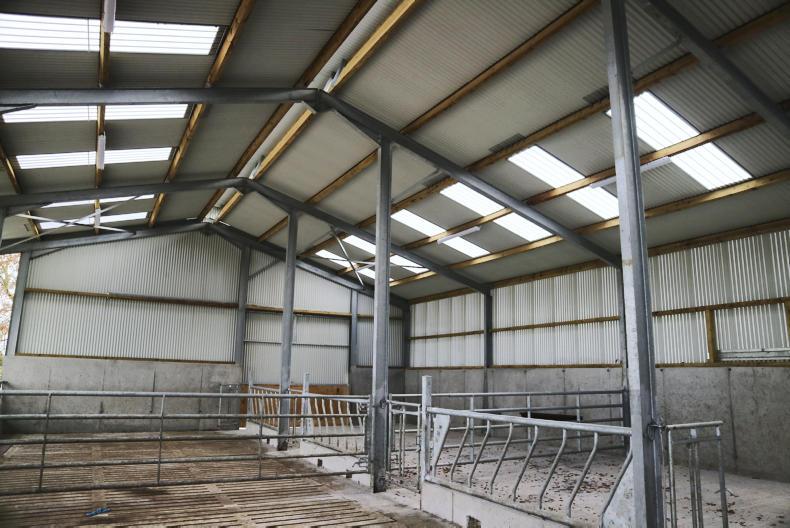
The shed stands at 4.2m at the eaves, rising to 6.8m at the apex of the ridge cap. Vented sheeting is in place along the back of the shed to provide inlet ventilation. As the shed was under 15m wide there was no requirement to have a continuous opening directly under the eave. Outlet ventilation is provided at the apex of the shed by a 450mm-wide opening as per the specifications.
As the middle stanchion of the shed is off-centre apex braces were required to ensure strength of the structure. Roof cross bracing also provides strength to the structure and is in place at both end bays. Additionally angle braces join the rafter to the centre stanchion. All roof lights in the shed are fitted with safety cages also. A slatted shed is a corrosive environment and having the structure completely galvanised will help to ensure its long life.
Cost
Gross output on the farm is currently €984/ha with the aim to get this to €1,300-€1,400/ha over the coming years.
“If the farm didn’t make the investment then it wouldn’t be able to increase gross output which would lead to the farm going backwards over the coming years,” Mark explained.
The total cost of the development came to €95,638, excluding the VAT. Bertie and Karl Williams entered into a partnership in 2017 which gave them a €160,000 investment ceiling for TAMS. Both applicants qualified as a general applicant and so were eligible for a 40% grant. The grant aid received came to €38,255 leaving the net cost of the investment at €57,383. This works out at a cost of €956/cow. The mantra of the farm is to keep things as simple as possible and this investment is seen as vital to minimising workload and improving output on the farm as it moves forward.
“The advice we got from Mark Coyne, Paul Fox and Tom Ryan with Teagasc was invaluable,” according to Karl Williams. “We would never have put it where it is if it wasn’t for the advice we got. Now it is beside the calving pens which will make life easier.”
Karl continued: “It really helps to get a fresh set of eyes around the yard, they can spot things that you would never see working on it every day. We would have been lost without the shed last spring.”
Derek and Matthew McMahon of Halls Farm were the main contractors for the project completing all work on the shed. The shed itself was supplied by Donaghy Steel in Kilbeggan. Scally precast supplied the slats. Gibney Steel supplied barriers and fittings.
Word of thanks
On behalf of all the IFBA members, I would like to sincerely thank Philip O’Dwyer, JJ Lenehan, Damien O’Donovan and Tom Ryan for organising an informative and engaging study tour. Also a word of thanks to Mark Coyne and Jim Myles, Teagasc advisors, who organised farm visits and the farmers who hosted us over the few days. The IFBA would also like to show their appreciation to Kilsaran and Banagher Concrete for hosting the group over the week.
A recent Irish Farm Buildings Association (IFBA) study tour visited the 90-cow suckler herd of Bertie and Karl Williams from Kilmurry, Co Offaly where a new shed had recently been constructed. The 280-acre farm operates a suckling to beef system.
Mark Coyne from Teagasc is the advisor for the farm and organised the visit for the group. He discussed the reasons why such an investment was necessary on the farm: “The beef output on the farm in 2017 was 456/kg which is just not enough to keep the system going. Farm buildings really are the limiting factor when it comes to expansion on this farm.
“This farm is ticking all the boxes when it comes to production targets with a calving interval of 369 days, a six-week spring-calving rate of 88% and 0.97 calves per cow per year,” Mark explains. “What this does mean is that over 75% of the cows calve in the month of March so facilities will be under pressure with everything so tight.”
As Karl works full-time off-farm there is a need to keep the calving period as tight as possible to ensure workload is concentrated to only a few months of the year. Good calving facilities are already in place on the farm, adjoining the new development, so this shed will not be necessary for calving purposes. However, it will be required to hold calves for a month or more before they can get out to grass, hence why the large creep area was seen as vital to the overall design.
Bertie Williams (left) and Mark Coyne (right) hosted the group from the Irish Farm Buildings Association study tour.
The shed
The shed itself is six bays long measuring a total of 28.8m in length. The total width of the shed is 14.8m, including a 2.7m overhang. Due to the width of the shed an A-roof design was chosen. The slatted area is large with a span of six metres. The creep area is also expansive, with a span of 6.1m.
The decision was taken to have three larger double pens as opposed to six single pens as the shed will be used to house suckler cows which can be treated as larger batches. There is the option to feed cows at the front and back of the pens for the majority of the year, up to the point of calving. However, once calved the creep area will be needed for young calves.
Pens
Each double pen is approximately 57.6m2 and with a recommended space of 2.5-3m2/cow, then there is space for approximately 20 cows in each section, or 60 cows in total. With a total feed space along the front of the shed of 28.8m, if 60 cows are in the shed feed space per cow would be 480mm. The recommended width for cows is 300mm if feeding silage ad-lib. However, if all cows are to eat together, if meal or mineral supplementation is being fed then 600mm/cow of feed space is required.
With the smaller feed barrier at the back of each pen there is an additional 6.6m of feed space for each double pen, or approximately 19.8m in total. Therefore, if cattle are being fed front and back then there is feed space of 800mm/cow if all feed space were to be utilised.
The slatted tank is 2.4m deep with an internal width of 4.7m, fitted with a 16’6” slat. There are two external agitation points, one at either end of the shed to give the total tank capacity of 356m3. When 200mm of freeboard is excluded it gives net storage capacity of 326m3.
Creep
The creep area has a span of 6.1m which is large, but it was discussed at length with their agricultural advisor and planners.One key driver of the larger creep was the fact that a diet feeder would be moving through the creep area regularly, while also allowing ample room for cleaning out of soiled bedding with the tractor and loader in the springtime. With such a wide span it is vital to ensure that there is a good fall on the floor to carry moisture towards the slats quickly to keep the area for calves as dry as possible.
The fall must be at least one in 30 which for a span of 6.1m this would see a difference of 200mm in the height of the floor from the back wall to the slats. The recommended fall is one in 20 which would see a height difference of 305mm.
Small openings were left in the stub wall underneath the feed barriers between the creep area and the slats to allow moisture to flow easily onto the slats. All creep pens are fitted with water troughs on the back wall.
The Department specifications outline that all creep pens must be accessible without passing through another animal pen, for this reason an access door was needed at the back of the middle creep pen.
If there were six individual creep pens at the back of the shed it would have meant that four access doors would have been needed along the back wall in conjunction with the two sliding doors at either end of the creep which would have added considerably to the costs.
Ventilation
The shed stands at 4.2m at the eaves, rising to 6.8m at the apex of the ridge cap. Vented sheeting is in place along the back of the shed to provide inlet ventilation. As the shed was under 15m wide there was no requirement to have a continuous opening directly under the eave. Outlet ventilation is provided at the apex of the shed by a 450mm-wide opening as per the specifications.
As the middle stanchion of the shed is off-centre apex braces were required to ensure strength of the structure. Roof cross bracing also provides strength to the structure and is in place at both end bays. Additionally angle braces join the rafter to the centre stanchion. All roof lights in the shed are fitted with safety cages also. A slatted shed is a corrosive environment and having the structure completely galvanised will help to ensure its long life.
Cost
Gross output on the farm is currently €984/ha with the aim to get this to €1,300-€1,400/ha over the coming years.
“If the farm didn’t make the investment then it wouldn’t be able to increase gross output which would lead to the farm going backwards over the coming years,” Mark explained.
The total cost of the development came to €95,638, excluding the VAT. Bertie and Karl Williams entered into a partnership in 2017 which gave them a €160,000 investment ceiling for TAMS. Both applicants qualified as a general applicant and so were eligible for a 40% grant. The grant aid received came to €38,255 leaving the net cost of the investment at €57,383. This works out at a cost of €956/cow. The mantra of the farm is to keep things as simple as possible and this investment is seen as vital to minimising workload and improving output on the farm as it moves forward.
“The advice we got from Mark Coyne, Paul Fox and Tom Ryan with Teagasc was invaluable,” according to Karl Williams. “We would never have put it where it is if it wasn’t for the advice we got. Now it is beside the calving pens which will make life easier.”
Karl continued: “It really helps to get a fresh set of eyes around the yard, they can spot things that you would never see working on it every day. We would have been lost without the shed last spring.”
Derek and Matthew McMahon of Halls Farm were the main contractors for the project completing all work on the shed. The shed itself was supplied by Donaghy Steel in Kilbeggan. Scally precast supplied the slats. Gibney Steel supplied barriers and fittings.
Word of thanks
On behalf of all the IFBA members, I would like to sincerely thank Philip O’Dwyer, JJ Lenehan, Damien O’Donovan and Tom Ryan for organising an informative and engaging study tour. Also a word of thanks to Mark Coyne and Jim Myles, Teagasc advisors, who organised farm visits and the farmers who hosted us over the few days. The IFBA would also like to show their appreciation to Kilsaran and Banagher Concrete for hosting the group over the week.






SHARING OPTIONS