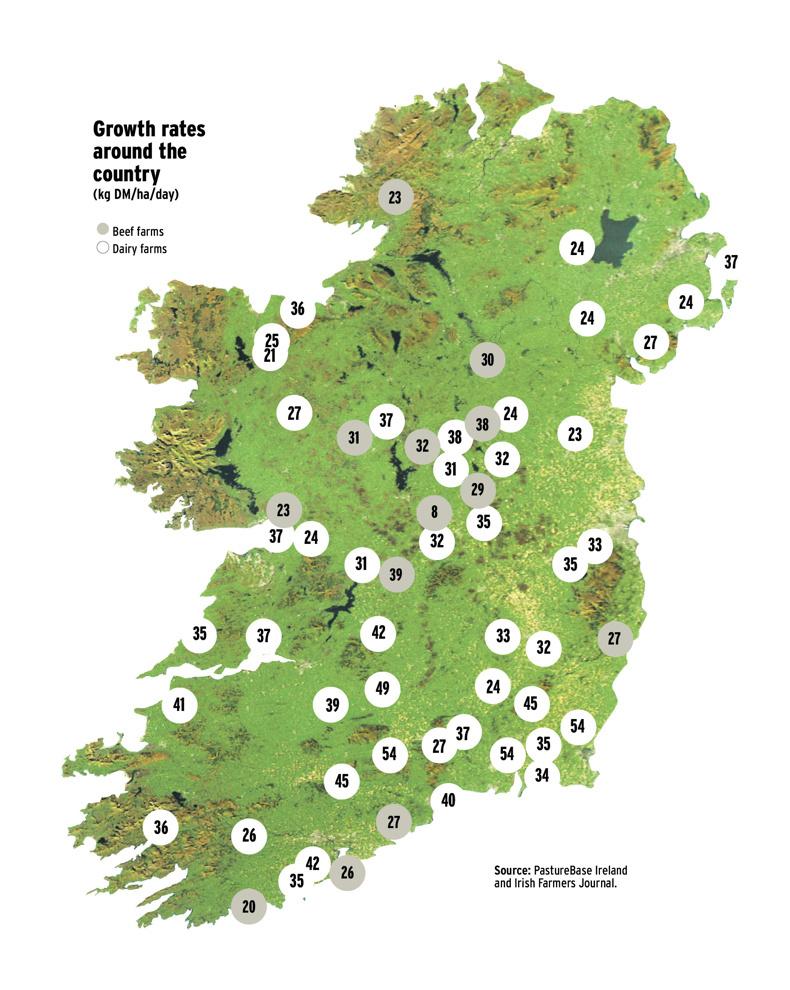
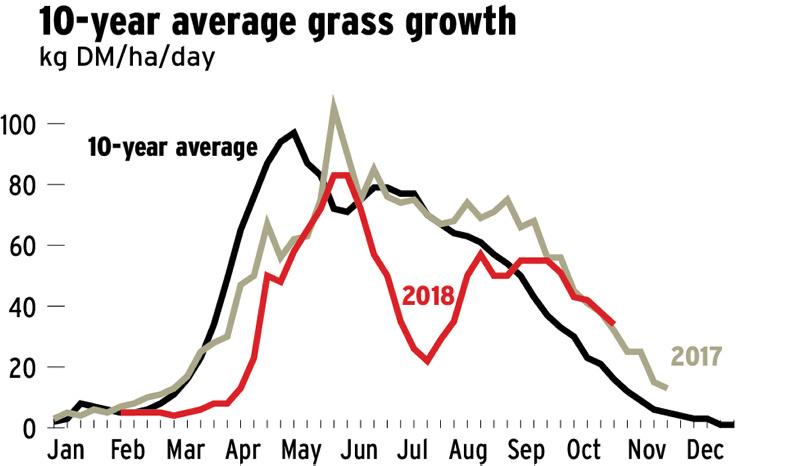
Growth is declining steadily now. This day last week, growth was 38kg DM/ha/day. This week, it’s down to 32kg DM/ha/day. Significantly, this is still well above the 10-year average which is in or around 20kg DM/ha/day. The higher-than-normal growth is largely due to soil temperatures remaining high. Soils across the country are ranging between 9°C and 11°C. Growth in the autumn stops once temperatures go below 8°C. This may be the case by this time next week as Met Éireann forecasts the coming days to turn progressively colder, with mean air values 2°C to 5°C below average for the time of year. A northerly airflow will become established, bringing with it a risk of heavy frost on Friday, Saturday and Sunday nights also. If growth does stop, I don’t think it will worry too many farmers at this stage. The last two months have offered excellent conditions to build up grass covers for grazing and silage making.
In a striking example of the good conditions, Cork beef farmer John McSweeney (profiled below) had only 17% of his fodder requirements on 1 August. Now, just over 10 weeks later, with the same number of stock he has 100%.
ADVERTISEMENT
Monitor performance
Extended grazing is something that every farmer wants to capitalise on. However, be mindful of grass quality at this time of year and for certain groups of stock, consider if they are getting the feed they need in order to maintain performance. Weanling bulls are one group of stock, for example, that most want to leave outdoors for as long as possible, particularly if destined for an under 16-month system. However, these animals also can’t afford to suffer any dip in performance. Bearing in mind grass quality at this time of the year has only about 0.85 UFL – nearly 20% less than that of spring grass – it might be worth considering adding concentrates to the diets of animals you think may need it. Keep a close eye on stock but remember: by the time you realise animals are losing condition, a lot of damage may already be done.
This content is available to digital subscribers and loyalty code users only. Sign in to your account, use the code or subscribe to get unlimited access.
The reader loyalty code gives you full access to the site from when you enter it until the following Wednesday at 9pm. Find your unique code on the back page of Irish Country Living every week.
CODE ACCEPTED
You have full access to the site until next Wednesday at 9pm.
CODE NOT VALID
Please try again or contact support.
Growth is declining steadily now. This day last week, growth was 38kg DM/ha/day. This week, it’s down to 32kg DM/ha/day. Significantly, this is still well above the 10-year average which is in or around 20kg DM/ha/day. The higher-than-normal growth is largely due to soil temperatures remaining high. Soils across the country are ranging between 9°C and 11°C. Growth in the autumn stops once temperatures go below 8°C. This may be the case by this time next week as Met Éireann forecasts the coming days to turn progressively colder, with mean air values 2°C to 5°C below average for the time of year. A northerly airflow will become established, bringing with it a risk of heavy frost on Friday, Saturday and Sunday nights also. If growth does stop, I don’t think it will worry too many farmers at this stage. The last two months have offered excellent conditions to build up grass covers for grazing and silage making.
In a striking example of the good conditions, Cork beef farmer John McSweeney (profiled below) had only 17% of his fodder requirements on 1 August. Now, just over 10 weeks later, with the same number of stock he has 100%.
Monitor performance
Extended grazing is something that every farmer wants to capitalise on. However, be mindful of grass quality at this time of year and for certain groups of stock, consider if they are getting the feed they need in order to maintain performance. Weanling bulls are one group of stock, for example, that most want to leave outdoors for as long as possible, particularly if destined for an under 16-month system. However, these animals also can’t afford to suffer any dip in performance. Bearing in mind grass quality at this time of the year has only about 0.85 UFL – nearly 20% less than that of spring grass – it might be worth considering adding concentrates to the diets of animals you think may need it. Keep a close eye on stock but remember: by the time you realise animals are losing condition, a lot of damage may already be done.
If you would like to speak to a member of our team, please call us on 01-4199525.
Link sent to your email address
We have sent an email to your address. Please click on the link in this email to reset your password. If you can't find it in your inbox, please check your spam folder. If you can't find the email, please call us on 01-4199525.
ENTER YOUR LOYALTY CODE:
The reader loyalty code gives you full access to the site from when you enter it until the following Wednesday at 9pm. Find your unique code on the back page of Irish Country Living every week.





SHARING OPTIONS