


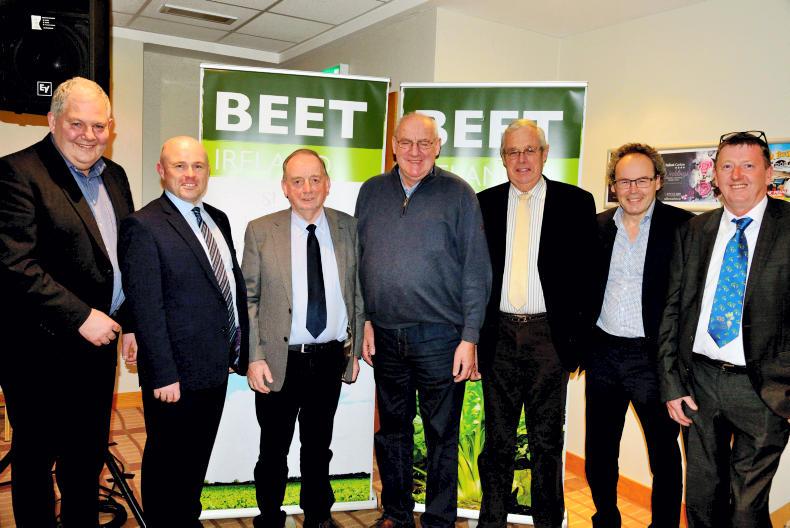
Farmers around the country are being asked to state their intention with regard to the possible reestablishment of a sugar beet processing industry. If there is not sufficient support, then Beet Ireland will end its efforts to restart the industry.
“2018 is the make or break year for sugar. If we do not find sufficient support amongst farmers to make this happen then we will end our efforts and concentrate on another venture.” This was the message from all Beet Ireland representatives at the meeting with ITLUS members last week. If there are no growers there can be no sugar industry so now it is time for growers to decide and Beet Ireland is looking for collateral from growers to the tune of €1,000 from 1,000 growers.
Beet Ireland has purchased a site on which to build a processing plant at Ballyburn, near Castledermot. Brian Arnold of Beet Ireland said the selection of the site was time-consuming and complex, as was the purchase process. But the site is there now and it will be developed for some use, beet processing being the primary objective.
Beet Ireland chair Michael Hoey said this venture represents an opportunity for farmers to get access to the added-value chain. Growers have been price takers for too long and this is leaving the sector in decline. The opportunity to get up the value chain by participating in this co-operative venture may be just the start of what a tillage-based processing business can do for the sector.
A modern plant
A beet processing plant can deliver sugar, pulp and bioethanol, but it also has the potential to produce a range of chemical compounds needed in a range of other industries such as biodegradable plastics.
The planned plant will have capacity to process 1.4m tonnes of beet annually. If 1,000 growers wanted to grow beet, this would mean 1,400t each, representing between 45 and 50 acres of beet each depending on land and yield. But this is unlikely and some growers may want less while others will want to grow more. But only those who invest in the next stage will get the opportunity to grow beet if the project is oversubscribed.
This beet tonnage will produce around 210,000t of sugar plus 19m litres of bioethanol and pulp. In doing this it can contribute to the national climate change and carbon targets. But the output of the different products will inevitably vary depending on relative price and profitability.
At farm level there will be changes relative to the past regime. Production may be broadly similar, but it seems inevitable that harvesting, cleaning and delivery will be handled differently. Initial production will be concentrated within 50km-60km of the factory site and beet may have to be washed before leaving the farm. It seems likely that harvesting, loading and cleaning may become a contractor operation.
€1,000 from first movers
Beet Ireland has invested significant amounts of money over the past six years to get the project to where it is today. Now it is attempting to get 1,000 growers to pay €1,000 each to generate a €1m fund to push the project to the next phase. This means planning permission, licences, plans etc.
However, it is not just about the €1m – it also about having 1,000 people stating their willingness to back the project and this is hugely important in terms of organising funding for the project.
A previous effort to get the project going proposed production contracts but this did not fly well with farmers. This time around the model is calling for a low initial level of support from what Chris Harmon of Beet Ireland called “first-movers”. These people get an initial share in a new co-operative which is to be established by these grower investors putting in cash and Beet Ireland putting in the site value in conjunction with the knowledge gained to date (another €1m).
Some individuals already want to make a higher commitment than the €1,000. But individuals can only hold one vote and the big number of investors is seen as important to the success of the project. I also hear of people willing to be first-movers who are not farmers and also farmers who are unlikely to grow beet themselves. But they want the option to be there for those who are willing.
While the money is being gathered ahead of knowing if the project will move forward or not, the money will not actually go into the new venture unless there is sufficient commitment from growers. While money can be lodged with Beet Ireland directly, it may also be possible to lodge money with farmer groups where it will remain until the necessary commitment and money is there to proceed.
If there is insufficient interest, the project will not progress and this money will be returned. It must also be noted that this initial money is tax allowable so it is only a cost of around €500 for anyone paying the high rate of tax.
Proposed structure
If and when this capital equity is gathered, the next phase involves forming a company or co-op to press forward with the development. Then comes planning permission, licences, plans, contractors etc and funding. It is estimated the project would cost around €300m and it is suggested that up to €200m may be borrowed. The remaining capital will come from some combination of farmers and investors.
The Beet Ireland team is confident it can secure the funding but they stress that growers are essential and Hoey said the project will only be of benefit to growers if they maintain significant control in the project. That means investing further in the project.
So while the €1,000 secures first-mover status, the profitability share-out from processing will mainly go to those who invest further equity in the project. As with any project, it is those who invest the money who will control the direction of travel.
Hoey was very strong on this topic. He believes the tillage sector needs a central pillar from which to support future development. He sees huge power in collaboration that would go far beyond this project. These benefits could extend to farm inputs and outputs and beyond.
When asked about beet price and practices, Chris Harmon said all such issues become the responsibility and decisions of the new co-operative. This will decide how the business will operate. The price of sugar will dictate the value of beet and it is up to the co-operative to decide how profitability will be distributed between grower, investor and processor. It will be the people around this table who will decide the operating policy and they will be influenced by those who hold the equity.
There is no doubt but that further equity will be required for the project. If €200m can be borrowed, that leaves €100m odd for equity investment by others. The first-movers will have first call on this and the dividend income will depend on decisions made by the co-op and the level of equity invested.
This investment might be made even more attractive if it could be channelled through a pension vehicle.
There are still many bridges to be crossed but it would be a shame if this project fell even before the first hurdle. The amount of money involved initially is small but this is essential to send a signal of intent and a recognition that people want the industry to return. It is my feeling that the delivery of the industry in the proposed format is likely to have a profound impact across the entire tillage sector in time. This must be seen as an opportunity to begin to change things for the better.
The next meeting that Beet Ireland will address is being organised by the IGGG and this is open to anyone to attend. This will take place in the Talbot Hotel in Carlow on Thursday 15 November at 7.00pm.




SHARING OPTIONS