Companies selling robotic milking equipment were out in force at last weeks’ RUAS Winter Fair, reflecting the fact that the NI dairy industry is still very much a target market for future growth.
Since their introduction into NI in the early 2000s, robotic milking systems have continually evolved.
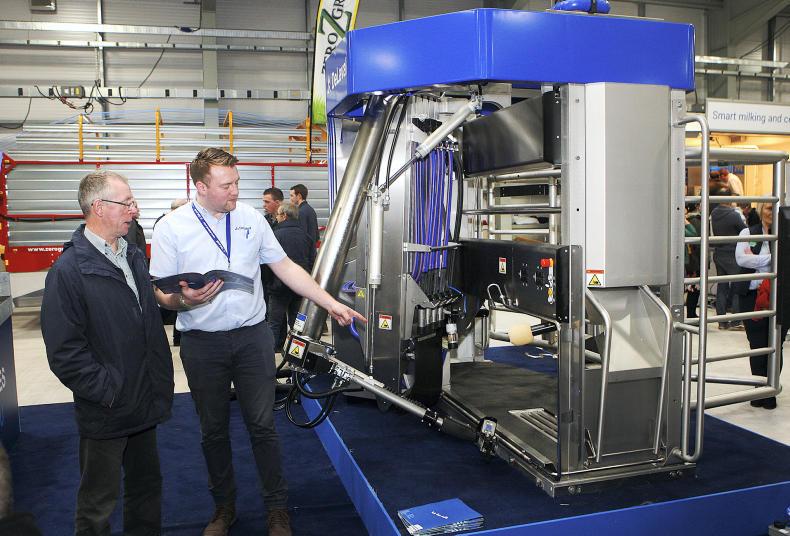
As well as milking the cow, the machines now undertake routine management tasks, such as heat detection, and are able to monitor rumination function and changes in cow body condition.
However, the biggest selling point of any robot is the saving on labour.

Tommy Armstrong Lely with Ellie and Wesley Jordan from Armagh at the Winter Fair.
Across NI farms, access to labour is a growing problem, and as dairy herds expand, additional labour is still required.
Advantages
The main advantage of installing a robot is it relieves the farmer from the traditional milking routine and being tied to the farm both morning and evening. This frees up farmers to focus on other tasks, such as breeding, feeding and calf-rearing.
There are also the social benefits, with a much better work-life balance to be had for those with young families.
Milk yield
However, all robot manufacturers also claim that milk yields are increased by approximately 20% when milking through a robot, as cows are usually milked three times per day.
Taking a cow yielding 8,000l in a conventional parlour, this would increase milk yield by 1,600l, worth £448/cow at a milk price of 28p/l.
Over 60 cows per unit, this increases milk sales by £26,880 and assuming a profit margin of 6p/l, then net profit margin is increased by £5,760 over the 60 cows.

Samuel Lyttle Poyntzpass talking to Stewart Fulton DeLaval at the Winter Fair.
Milk quality is also improved through better hygiene, further improving milk price.
In addition, by feeding-to-yield through a robot, it ensures cows are being properly supplemented with concentrates.
Cow body condition can also be monitored daily through laser-operated cameras, which could help prevent rapid weight loss in underfed cows.
Heat detection can also be carried out through the machine, offering an alternative to existing systems already on the market.
Downside
The main downside is that the system normally locks producers into all-year-round calving (to ensure the robot is used efficiently) and into higher cost-containment systems to ensure cows have easy access to the equipment.
A small number of farmers do still graze cows, but in most cases they are kept inside.
So effectively, robot systems require producers to opt for high input:high output cows, which invariably require a high standard of management.
Increased robot sales throughout 2018
Those selling robots report strong sales in 2018. Across all suppliers, agents indicate there were more than 150 robots purchased over the last 12 months by NI dairy farmers, and that growth is expected to continue in 2019.
Depending on the brand of robot being purchased, farmers could face a delay of 12-24 weeks before a new robot is installed on-farm and operational.
Demand is coming from two main directions.
Firstly, there have been a considerable number of new entrants into dairying in 2017 and 2018.
Most of these are converting from suckler beef, sheep and arable farming, and many do not want to spend their time putting clusters onto cows.
Flexibility
The second reason for increased sales comes from herd expansion. Where existing parlours cannot be extended to cope, robots offer a solution to facilitate extra cows.
On such units, there is the option to use a robot to milk the high-yielding cows, managed as a rolling group through the period of peak production.
Manufacturers
Speaking to several manufacturers at last week’s Winter Fair, Lely remains the market leader in NI and has sold over 100 units this year.
The company has recently launched its new A5 Astronaut, which is priced around £120,000, depending on euro to sterling exchange rates and sales incentives.
Lely indicates that the new technology in the robot ensures faster milking and is 20% more energy efficient, putting running costs between 0.5p to 1p/l.
The machine also uses less water in cleaning cycles and has an extended interval period between servicing.
Like many of its competitors, the A5 is geared towards 180 milkings per day.
Over a three times per day milking routine, the A5 is suitable for 60 cows yielding 2,000l/day, or an average of 33l/cow.
DeLaval
DeLaval also has significant market share in NI, with over 40 units sold in 2018.
Earlier this year, it launched a new version of its VMS robot, the V300.
The manufacturer claims that the new model is also much more efficient in terms of energy use and milking speed.
The redesigned milking arms have new laser cameras, which speed up cluster attachment and increases through flow, especially in herds milking a high percentage of heifers.
With reduced milking times, sales agents claim that the robot can comfortably handle 70 cows yielding a total of 3,500l daily.
Prices for the V300 are also close on £120,000, with additional service packages similar to competitors, running from £3,000 to £6,000/annum.
Fullwood
As a company based in the UK, Fullwood is less exposed to currency fluctuations compared with its competitors. The Merlin 2 robotic unit is priced from £100,000 to £110,000, before fitting costs are factored in.
The Merlin 2 uses milking systems consisting entirely of electrical parts, whereas other manufactures use a combination of compressed air and electric to operate the robotic milking arm.
The manufacturer states that this increases precision when milking, and with lower noise levels cow comfort is improved.
Sales into NI have been gaining momentum, with over 30 units sold this year.
The unit requires four services annually, which can be included in the maintenance package which costs up to £5,000/annum and includes all break-down repairs, chemicals and parts.
The company also indicates that all parts used to operate the milking unit, vacuum and pulsators are the same as those used in conventional parlours and are stocked by all agents.
GEA
New to the robot milking market is GEA, which launched its new automated unit in April 2018.
With less than eight months on the market, the company has sold eight units across five farms in NI, mostly located in the northwest.
It has an additional six orders to complete before the end of March and interest in the unit is growing.
Like many competitors, the GEA robot will accommodate 60 cows on 180 milkings daily, or a maximum of 2,000l/day.
Costs of the unit range from £100,000 to £120,000, depending on the specifications chosen.
Financing
While installing a robot is a significant outlay, there are several financial institutions willing to offer hire purchase and leasing arrangements.
Many farmers are opting for a seven-year hire purchase arrangement, with others opting for 10 years.
The major cost comes with installing the first unit, as power, pipe lines and compressors are required.
A second or third robot does not require this expenditure, and can generally be installed for £90,000 to £110,000, depending on exchange rates.
The lifespan of robots is estimated at 15 years, but manufacturers state that there are currently models in use which, with regular maintenance, have now exceeded this timeframe and are still working effectively.
Read more
Dairy Day: the milking revolution has begun - the robots are taking over
New entrant in the milking robot market
Companies selling robotic milking equipment were out in force at last weeks’ RUAS Winter Fair, reflecting the fact that the NI dairy industry is still very much a target market for future growth.
Since their introduction into NI in the early 2000s, robotic milking systems have continually evolved.
As well as milking the cow, the machines now undertake routine management tasks, such as heat detection, and are able to monitor rumination function and changes in cow body condition.
However, the biggest selling point of any robot is the saving on labour.
Tommy Armstrong Lely with Ellie and Wesley Jordan from Armagh at the Winter Fair.
Across NI farms, access to labour is a growing problem, and as dairy herds expand, additional labour is still required.
Advantages
The main advantage of installing a robot is it relieves the farmer from the traditional milking routine and being tied to the farm both morning and evening. This frees up farmers to focus on other tasks, such as breeding, feeding and calf-rearing.
There are also the social benefits, with a much better work-life balance to be had for those with young families.
Milk yield
However, all robot manufacturers also claim that milk yields are increased by approximately 20% when milking through a robot, as cows are usually milked three times per day.
Taking a cow yielding 8,000l in a conventional parlour, this would increase milk yield by 1,600l, worth £448/cow at a milk price of 28p/l.
Over 60 cows per unit, this increases milk sales by £26,880 and assuming a profit margin of 6p/l, then net profit margin is increased by £5,760 over the 60 cows.
Samuel Lyttle Poyntzpass talking to Stewart Fulton DeLaval at the Winter Fair.
Milk quality is also improved through better hygiene, further improving milk price.
In addition, by feeding-to-yield through a robot, it ensures cows are being properly supplemented with concentrates.
Cow body condition can also be monitored daily through laser-operated cameras, which could help prevent rapid weight loss in underfed cows.
Heat detection can also be carried out through the machine, offering an alternative to existing systems already on the market.
Downside
The main downside is that the system normally locks producers into all-year-round calving (to ensure the robot is used efficiently) and into higher cost-containment systems to ensure cows have easy access to the equipment.
A small number of farmers do still graze cows, but in most cases they are kept inside.
So effectively, robot systems require producers to opt for high input:high output cows, which invariably require a high standard of management.
Increased robot sales throughout 2018
Those selling robots report strong sales in 2018. Across all suppliers, agents indicate there were more than 150 robots purchased over the last 12 months by NI dairy farmers, and that growth is expected to continue in 2019.
Depending on the brand of robot being purchased, farmers could face a delay of 12-24 weeks before a new robot is installed on-farm and operational.
Demand is coming from two main directions.
Firstly, there have been a considerable number of new entrants into dairying in 2017 and 2018.
Most of these are converting from suckler beef, sheep and arable farming, and many do not want to spend their time putting clusters onto cows.
Flexibility
The second reason for increased sales comes from herd expansion. Where existing parlours cannot be extended to cope, robots offer a solution to facilitate extra cows.
On such units, there is the option to use a robot to milk the high-yielding cows, managed as a rolling group through the period of peak production.
Manufacturers
Speaking to several manufacturers at last week’s Winter Fair, Lely remains the market leader in NI and has sold over 100 units this year.
The company has recently launched its new A5 Astronaut, which is priced around £120,000, depending on euro to sterling exchange rates and sales incentives.
Lely indicates that the new technology in the robot ensures faster milking and is 20% more energy efficient, putting running costs between 0.5p to 1p/l.
The machine also uses less water in cleaning cycles and has an extended interval period between servicing.
Like many of its competitors, the A5 is geared towards 180 milkings per day.
Over a three times per day milking routine, the A5 is suitable for 60 cows yielding 2,000l/day, or an average of 33l/cow.
DeLaval
DeLaval also has significant market share in NI, with over 40 units sold in 2018.
Earlier this year, it launched a new version of its VMS robot, the V300.
The manufacturer claims that the new model is also much more efficient in terms of energy use and milking speed.
The redesigned milking arms have new laser cameras, which speed up cluster attachment and increases through flow, especially in herds milking a high percentage of heifers.
With reduced milking times, sales agents claim that the robot can comfortably handle 70 cows yielding a total of 3,500l daily.
Prices for the V300 are also close on £120,000, with additional service packages similar to competitors, running from £3,000 to £6,000/annum.
Fullwood
As a company based in the UK, Fullwood is less exposed to currency fluctuations compared with its competitors. The Merlin 2 robotic unit is priced from £100,000 to £110,000, before fitting costs are factored in.
The Merlin 2 uses milking systems consisting entirely of electrical parts, whereas other manufactures use a combination of compressed air and electric to operate the robotic milking arm.
The manufacturer states that this increases precision when milking, and with lower noise levels cow comfort is improved.
Sales into NI have been gaining momentum, with over 30 units sold this year.
The unit requires four services annually, which can be included in the maintenance package which costs up to £5,000/annum and includes all break-down repairs, chemicals and parts.
The company also indicates that all parts used to operate the milking unit, vacuum and pulsators are the same as those used in conventional parlours and are stocked by all agents.
GEA
New to the robot milking market is GEA, which launched its new automated unit in April 2018.
With less than eight months on the market, the company has sold eight units across five farms in NI, mostly located in the northwest.
It has an additional six orders to complete before the end of March and interest in the unit is growing.
Like many competitors, the GEA robot will accommodate 60 cows on 180 milkings daily, or a maximum of 2,000l/day.
Costs of the unit range from £100,000 to £120,000, depending on the specifications chosen.
Financing
While installing a robot is a significant outlay, there are several financial institutions willing to offer hire purchase and leasing arrangements.
Many farmers are opting for a seven-year hire purchase arrangement, with others opting for 10 years.
The major cost comes with installing the first unit, as power, pipe lines and compressors are required.
A second or third robot does not require this expenditure, and can generally be installed for £90,000 to £110,000, depending on exchange rates.
The lifespan of robots is estimated at 15 years, but manufacturers state that there are currently models in use which, with regular maintenance, have now exceeded this timeframe and are still working effectively.
Read more
Dairy Day: the milking revolution has begun - the robots are taking over
New entrant in the milking robot market






SHARING OPTIONS