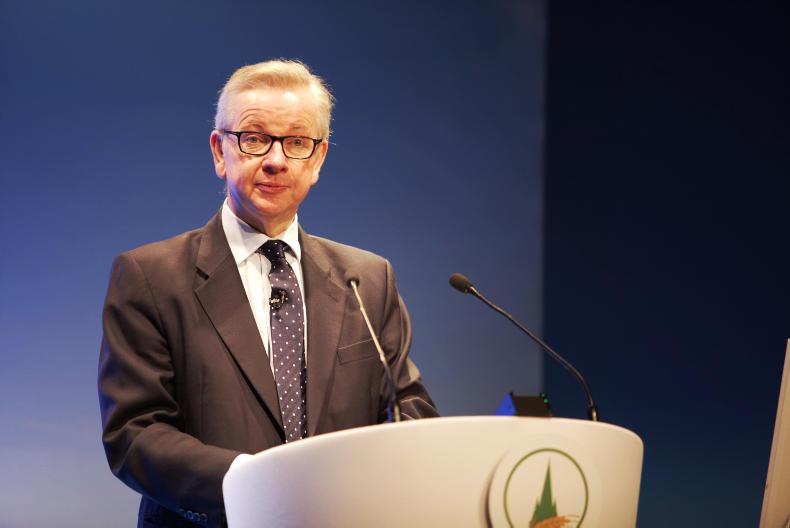
Defra Secretary of State Michael Gove resisted pressure to establish a longer-term funding commitment for UK agriculture policy at the Oxford Farming Conference on Thursday.
“The Treasury very rarely, before a spending review, wants to make any sort of commitment which could be interpreted as having its own hands tied,” he said at the event at Oxford University.
A spending review will be conducted by the Treasury during 2019 which reviews allocations of funds across Government departments.
Current levels of funding from the EU’s CAP have been guaranteed to UK farmers by the government until the end of the current parliament, which is expected in 2022.
Long-term support payments
Although resisting calls during the discussion to include a funding commitment for agriculture in legislation, Gove indicated that a multi-annual framework would be developed to give UK farmers more certainty on long-term support payments.
“As well as making the argument to the Treasury, we need to have a broader conversation to ensure that whatever political party is in power, or whoever is Chancellor of the Exchequer, that the public would not accept a dilution is support to the countryside, environment and food production,” he said.
Food production
The address on Thursday had a stronger focus on food production compared with previous speeches by Gove where public goods, such as environmental management, was a key aspect of his vision for post-Brexit agricultural policy in the UK.
“Climate change is going to have an impact on the resilience and range of food production in other countries, so countries like our own will have to play an even more important role in world food production,” he said.
Gove maintained the UK would not import food from countries with lower environmental and animal welfare standards after Brexit, particularly countries where food is produced inefficiently or as a result of deforestation.
Gene editing
During the Defra Secretary’s speech, he re-stated that gene-edited crops could be permitted for use in the UK after Brexit.
Climate change is going to have an impact on the resilience and range of food production in other countries
The technology is not approved for widespread use in the EU after the European Court of Justice ruled in July 2018 that gene-edited crops should be subject to the same regulations as genetically modified crops.
“The ability to give mother nature a helping hand to drive the process at a higher speed, should allow us to develop plant varieties and crops which are more resistant to disease and pests and less reliant on chemical protection and chemical fertiliser,” he said.
Read more
Pressure on Gove to secure funding for UK farming
Mindset change needed when it comes to land tenancy
Defra Secretary of State Michael Gove resisted pressure to establish a longer-term funding commitment for UK agriculture policy at the Oxford Farming Conference on Thursday.
“The Treasury very rarely, before a spending review, wants to make any sort of commitment which could be interpreted as having its own hands tied,” he said at the event at Oxford University.
A spending review will be conducted by the Treasury during 2019 which reviews allocations of funds across Government departments.
Current levels of funding from the EU’s CAP have been guaranteed to UK farmers by the government until the end of the current parliament, which is expected in 2022.
Long-term support payments
Although resisting calls during the discussion to include a funding commitment for agriculture in legislation, Gove indicated that a multi-annual framework would be developed to give UK farmers more certainty on long-term support payments.
“As well as making the argument to the Treasury, we need to have a broader conversation to ensure that whatever political party is in power, or whoever is Chancellor of the Exchequer, that the public would not accept a dilution is support to the countryside, environment and food production,” he said.
Food production
The address on Thursday had a stronger focus on food production compared with previous speeches by Gove where public goods, such as environmental management, was a key aspect of his vision for post-Brexit agricultural policy in the UK.
“Climate change is going to have an impact on the resilience and range of food production in other countries, so countries like our own will have to play an even more important role in world food production,” he said.
Gove maintained the UK would not import food from countries with lower environmental and animal welfare standards after Brexit, particularly countries where food is produced inefficiently or as a result of deforestation.
Gene editing
During the Defra Secretary’s speech, he re-stated that gene-edited crops could be permitted for use in the UK after Brexit.
Climate change is going to have an impact on the resilience and range of food production in other countries
The technology is not approved for widespread use in the EU after the European Court of Justice ruled in July 2018 that gene-edited crops should be subject to the same regulations as genetically modified crops.
“The ability to give mother nature a helping hand to drive the process at a higher speed, should allow us to develop plant varieties and crops which are more resistant to disease and pests and less reliant on chemical protection and chemical fertiliser,” he said.
Read more
Pressure on Gove to secure funding for UK farming
Mindset change needed when it comes to land tenancy






SHARING OPTIONS