The important role of good-quality silage in dairy cow diets was outlined at a series of farm walks last week, hosted by Dale Farm and United Feeds.
With late autumn and early winter-calving cows now moving towards peak production, farmers were told that making good use of high-quality forage will have a positive effect on peak milk yield – and potentially also on cow fertility and conception rates.
Ultimately, making good-quality silage will make the business more profitable, as it means less concentrate supplementation is required to ensure cows receive adequate dry matter energy in their diet – thereby reducing feed costs.
Based on CAFRE benchmarking data, the average dairy farm is feeding 2.47t/cow of concentrate, which equates to 0.32kg/l of milk produced.
Total annual yield is 7,400l/cow, with approximately 1,903 litres of milk produced from forage.
In contrast, the top 10% of benchmarked farms fed 2.5t/cow, with an annual yield of 8,376l/cow and 2,635l produced from forage.
Margin
Putting these figures into a monetary context, the average farm has a margin over concentrate of £1,587/cow, which increases to £1,900 for the top 10% of farms.
With a number of processors removing their winter bonus payment from January onwards, milk price automatically falls by 2p to 3p/l, a 10% reduction in output value. Therefore, completing a simple margin over concentrate feed calculation every month can quickly identify if cows are being fed effectively.
Targeted feed
For Dale Farm suppliers, concentrate use in early autumn averaged 0.27kg/l of milk produced, with milk from forage at 10.9l/day.
This equates to an average margin over concentrate of 24.4p/l, or £5.53/cow/day.
In contrast, concentrate levels during November increased to 0.39kg/l of milk produced, as the proportion of freshly calved cows increased.
This means milk from forage reduced to 6.1l/cow giving a margin over concentrate of £4.86/cow/day, or 19.4p/l.
Margin over concentrate is calculated as total milk sales per month, minus the cost of concentrate feeding.
Milk from forage
So what effect does increasing the percentage of milk from forage have on controlling costs? Nutritionists with United Feeds outlined how improving milk from forage by 1,000l adds £120/cow to gross margin annually, or 0.12p/l.
Good-quality forage
Taking good-quality silage at 72 D-Value and 11.8 ME, a cow eating 12kg DM of forage will consume 142MJ of energy.
Deducting a maintenance value of 80 MJ ME and allowing 5.2 MJ ME to produce one litre of milk, good-quality silage at the outlined feed value will produce 12l of milk from forage.
Average-quality forage
Applying similar principles to average-quality silage at 66 D-Value and 10.5 MJ ME, the cow will consume approximately 10.5kg DM/day of silage.
Due to the lower feed value and higher fibre intake, the cow is consuming 110.25 MJ ME/day.
After deducting the maintenance allowance, the remaining dry matter energy consumed from average-quality silage will only produce 5.8l of milk from forage.
Therefore, an additional 3kg/day of concentrates are required to bridge the energy gap in the cow’s diet and produce the same volume of milk.
At current ration prices, this would add an additional 78p/cow/day to daily feed costs.
Reducing silage quality further to 62 D-Value and an ME of 10 MJ, milk from forage is reduced to 3.8l/day, meaning an additional 4kg/day is required to bridge the energy gap when compared with high-quality silage.
Impact on income
If we take the three silages (72, 66 and 62 D-Value) each producing 12l, 5.8l and 3.8l/day of milk from forage, and fed to a 100-cow herd with an average daily yield of 30l/day, margin over concentrate for the good-quality silage is £5.97/cow/day. This reduces to £5.16/cow/day for average-quality silage, and £4.89/cow/day when poor-quality forage is offered.
Total cost savings from feeding good-quality silage when compared with poor-quality silage is worth £108/day over the 100 cows, or £3,240/month.
Over a six-month winter period the potential cost savings from feeding the higher-quality silage amounts to £19,440 across the whole herd.
Additional benefits
Other benefits from feeding higher-quality silage are improved rumen function due to better forage intakes, and less risk of acidosis from high levels of concentrate feeding required when offering lower-quality fodder.
For healthy rumen function, a minimum of 40% of dry matter intake should be in the form of forage. Better rumen function will also improve longevity of cows, reducing replacement costs.
Management of the silage clamp
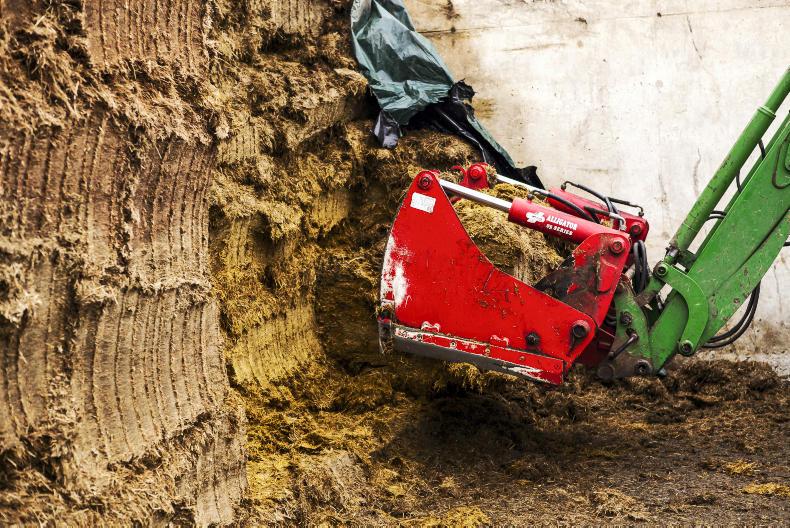
At the event last week, Dave Davies of Silage Solutions gave an insight into managing the silage pit to minimise wastage and to get a consistent feed.
According to Davies, around 25% of the total silage ensiled in a clamp is in contact with perimeter walls, as well as along the top of the pit, so poor clamp management can lead to a significant level of waste.
Potential losses can be reduced in bales with a standard four-ply plastic wrap, but there is a cost balance in making bales.
Davies estimated that based on typical contracting costs, a silage yield of greater than six bales per acre would be more cost effective if ensiled in a clamp. When it comes to preservation on the silage face, silage density is important as well – compacted grass will expel air and lead to stable fermentation and reduced spoilage. When feeding out silage, Davies recommended cutting blocks in columns from top to bottom to have less variation in the daily feed offered to cows.
Should a pit face start heating due to high dry matter silage, he advised cutting a shallower blocks so that the shear grab moves across the pit face faster.
Read more
Vet's corner: check your tyres
Smart investment in multi-purpose silage pit
Targeting meal to freshly calved cows
The important role of good-quality silage in dairy cow diets was outlined at a series of farm walks last week, hosted by Dale Farm and United Feeds.
With late autumn and early winter-calving cows now moving towards peak production, farmers were told that making good use of high-quality forage will have a positive effect on peak milk yield – and potentially also on cow fertility and conception rates.
Ultimately, making good-quality silage will make the business more profitable, as it means less concentrate supplementation is required to ensure cows receive adequate dry matter energy in their diet – thereby reducing feed costs.
Based on CAFRE benchmarking data, the average dairy farm is feeding 2.47t/cow of concentrate, which equates to 0.32kg/l of milk produced.
Total annual yield is 7,400l/cow, with approximately 1,903 litres of milk produced from forage.
In contrast, the top 10% of benchmarked farms fed 2.5t/cow, with an annual yield of 8,376l/cow and 2,635l produced from forage.
Margin
Putting these figures into a monetary context, the average farm has a margin over concentrate of £1,587/cow, which increases to £1,900 for the top 10% of farms.
With a number of processors removing their winter bonus payment from January onwards, milk price automatically falls by 2p to 3p/l, a 10% reduction in output value. Therefore, completing a simple margin over concentrate feed calculation every month can quickly identify if cows are being fed effectively.
Targeted feed
For Dale Farm suppliers, concentrate use in early autumn averaged 0.27kg/l of milk produced, with milk from forage at 10.9l/day.
This equates to an average margin over concentrate of 24.4p/l, or £5.53/cow/day.
In contrast, concentrate levels during November increased to 0.39kg/l of milk produced, as the proportion of freshly calved cows increased.
This means milk from forage reduced to 6.1l/cow giving a margin over concentrate of £4.86/cow/day, or 19.4p/l.
Margin over concentrate is calculated as total milk sales per month, minus the cost of concentrate feeding.
Milk from forage
So what effect does increasing the percentage of milk from forage have on controlling costs? Nutritionists with United Feeds outlined how improving milk from forage by 1,000l adds £120/cow to gross margin annually, or 0.12p/l.
Good-quality forage
Taking good-quality silage at 72 D-Value and 11.8 ME, a cow eating 12kg DM of forage will consume 142MJ of energy.
Deducting a maintenance value of 80 MJ ME and allowing 5.2 MJ ME to produce one litre of milk, good-quality silage at the outlined feed value will produce 12l of milk from forage.
Average-quality forage
Applying similar principles to average-quality silage at 66 D-Value and 10.5 MJ ME, the cow will consume approximately 10.5kg DM/day of silage.
Due to the lower feed value and higher fibre intake, the cow is consuming 110.25 MJ ME/day.
After deducting the maintenance allowance, the remaining dry matter energy consumed from average-quality silage will only produce 5.8l of milk from forage.
Therefore, an additional 3kg/day of concentrates are required to bridge the energy gap in the cow’s diet and produce the same volume of milk.
At current ration prices, this would add an additional 78p/cow/day to daily feed costs.
Reducing silage quality further to 62 D-Value and an ME of 10 MJ, milk from forage is reduced to 3.8l/day, meaning an additional 4kg/day is required to bridge the energy gap when compared with high-quality silage.
Impact on income
If we take the three silages (72, 66 and 62 D-Value) each producing 12l, 5.8l and 3.8l/day of milk from forage, and fed to a 100-cow herd with an average daily yield of 30l/day, margin over concentrate for the good-quality silage is £5.97/cow/day. This reduces to £5.16/cow/day for average-quality silage, and £4.89/cow/day when poor-quality forage is offered.
Total cost savings from feeding good-quality silage when compared with poor-quality silage is worth £108/day over the 100 cows, or £3,240/month.
Over a six-month winter period the potential cost savings from feeding the higher-quality silage amounts to £19,440 across the whole herd.
Additional benefits
Other benefits from feeding higher-quality silage are improved rumen function due to better forage intakes, and less risk of acidosis from high levels of concentrate feeding required when offering lower-quality fodder.
For healthy rumen function, a minimum of 40% of dry matter intake should be in the form of forage. Better rumen function will also improve longevity of cows, reducing replacement costs.
Management of the silage clamp
At the event last week, Dave Davies of Silage Solutions gave an insight into managing the silage pit to minimise wastage and to get a consistent feed.
According to Davies, around 25% of the total silage ensiled in a clamp is in contact with perimeter walls, as well as along the top of the pit, so poor clamp management can lead to a significant level of waste.
Potential losses can be reduced in bales with a standard four-ply plastic wrap, but there is a cost balance in making bales.
Davies estimated that based on typical contracting costs, a silage yield of greater than six bales per acre would be more cost effective if ensiled in a clamp. When it comes to preservation on the silage face, silage density is important as well – compacted grass will expel air and lead to stable fermentation and reduced spoilage. When feeding out silage, Davies recommended cutting blocks in columns from top to bottom to have less variation in the daily feed offered to cows.
Should a pit face start heating due to high dry matter silage, he advised cutting a shallower blocks so that the shear grab moves across the pit face faster.
Read more
Vet's corner: check your tyres
Smart investment in multi-purpose silage pit
Targeting meal to freshly calved cows






SHARING OPTIONS