


I cannot decide whether the acronym for our Less Favoured Areas Support Scheme (LFASS) in Scotland should actually be LFAASS, (Let’s Forget About Agricultural Support in Scotland).
With regard to funding, it appears we have had a stay of execution for one year – with the first cut to the budget of 20% coming next year and a 60% cut the following year.
It is better than the initial proposals, but unfortunately while the financial performance of hill farms stays at current levels, it will not stop the demise of hill farming in these areas.
The UK government and the devolved assemblies in Scotland and Wales demand that food has to be as cheap as possible for the consumer. In order for that to happen, most seem to accept that the production of food has to be supported in order to allow producers to be profitable and invest in their businesses to maintain efficient food production.
I know that current support mechanisms have to be decoupled and HLCA was a form of coupled support
This being the case, it is time that farmers are given support mechanisms that do what ‘it says on the tin’.
Prior to LFASS, hill farmers received HLCA (Hill Livestock Compensatory Allowance) as a means of support to maintain hill sheep flocks and hill cow herds.
I am not saying it was the perfect support mechanism, but because it was paid per head of livestock it did mean that support was directed to active producers.
I know that current support mechanisms have to be decoupled and HLCA was a form of coupled support.
But surely the rate of hill farms disappearing is evidence enough that decoupled support does not work in less favoured areas, and the system has to change very soon.
The loss of hill farms is at a critical level in some areas, and unfortunately in other areas it is gone past the critical point.
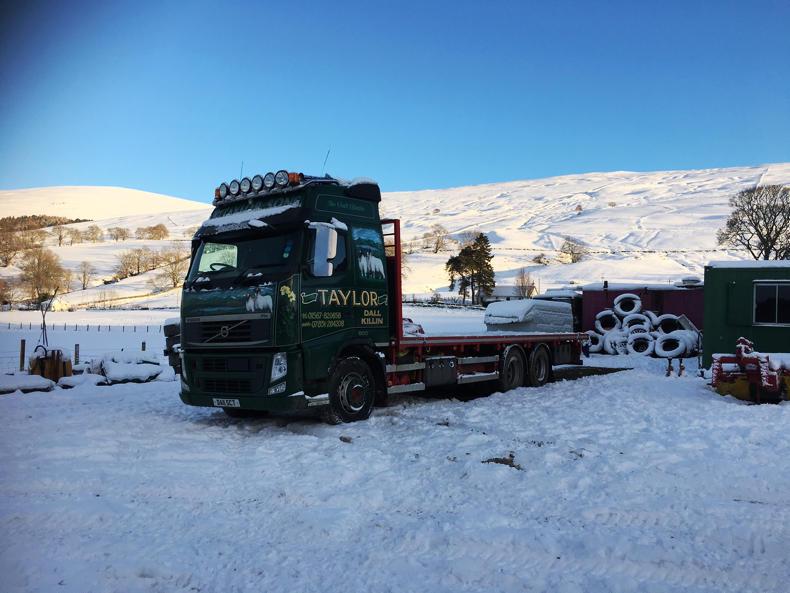
I know this at a practical level from my own livestock haulage and fodder supply business, which has been running for nearly 30 years.
When I started 75% of my work was on the west coast of Scotland, now it will hardly be 30%.
Home farm
Back on the farm, most of the tups are back in. The weather at tupping time, although wet at the start, was very kind to stock.
Ewes are in as good condition as I’ve seen for many years.
Mother Nature has a way of resolving the problems that beset us all last year.
Up until now we’ve had very little snow, with cows out until the turn of the year, which is saving a fair bit on straw and fodder consumption.
Hopefully as time progresses more hay and straw will appear on the market this spring, at a price livestock farmers can afford.
Scanning
January has flown by very quickly. Next month we will be scanning and before we know it lambing will be upon us – it goes in a never-ending circle.
The production cycle in all forms of agriculture, be it hill farming, dairying, crop production, etc, cannot be switched off and then at a moments’ notice switched back on again.
Before a lamb chop, a steak, a pint of milk, potatoes or a loaf of bread can appear on a dining room table there is a lot of time and huge effort put in to get it there.
This simple fact is something that politicians, the general public, and especially the media, need to remember.




SHARING OPTIONS