


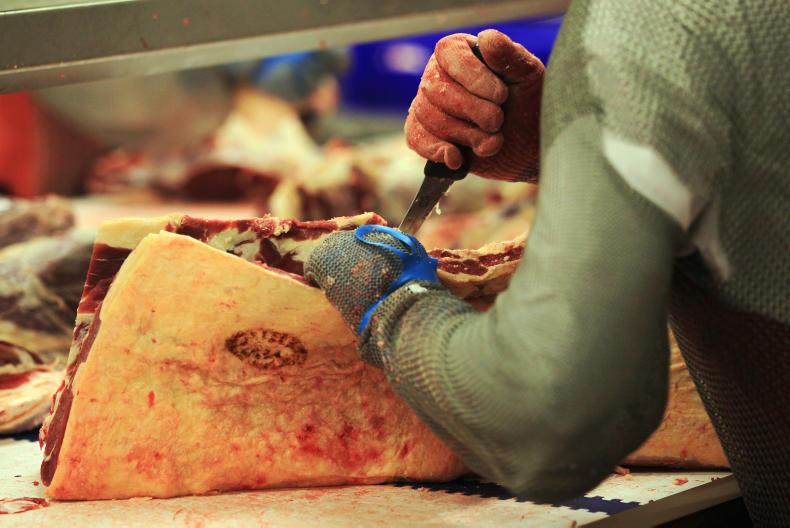
The last few days have witnessed factory buyers significantly increasing purchasing activity, something that has been largely absent from the trade since last October. Numbers are beginning to tighten and factories are taking steps to try to maintain throughput at current levels. Last week’s kill reduced 4,071 head to 31,580, with many plants operating on a four-day-week.
Factories have been keen to get throughput back to higher levels to compensate for last week’s dip in throughput and a day’s less processing this week. While agents are much more active, they are still trying to curtail upward movement in price. Cracks are appearing in this stance, however. Producers with greater purchasing power in particular are not willing to move cattle at a starting base in negotiations of €3.75/kg for steers and €3.85/kg for heifers.
There are more deals being reported at a base of €3.78/kg to €3.80/kg for steers and €3.88/kg to €3.90/kg for heifers. Some plants are reluctant to pay higher but are willing to forego penalties on cattle that were previously deemed out-of-spec. This is especially the case for bulls, with plants working their way through overage and overweight animals. While throughput of bulls aged less than 24 months reduced by 862 head to 3,723 head last week, the number of bulls aged over 24 months remains unusually high, only reducing by 155 head to 1,124.
Regular sellers have also been in a better position to command higher prices. There are more U grading bulls securing returns of €3.65/kg to €3.70/kg and, while hard to secure, there are producers at the top of the market negotiating €3.75/kg. R grades are trading on average from €3.50/kg to €3.60/kg, with O grades from €3.25/kg to €3.40/kg.
Penalties for bulls aged over 24 months of age have eased from upwards of 50c/kg to 15/kg to 20c/kg in some cases, while there is more scope for producers to get heavy carcase weight bulls (up to 470kg to 480kg) away without penalties where they make up a small component of a larger batch of in-spec bulls. Bulls less than 16 months and trading on the grid are moving at a base of €3.75/kg on average.
The cow trade seems to be improving at a faster rate in marts, with increased demand a good sign that there is more life entering the overall trade. Factory prices are also creeping upwards, with P+3 grading cows trading from €2.75/kg to €2.90/kg, while a higher percentage of O grading cows are securing a price of €2.90/kg to €2.95/kg with top prices rising to €3.00/kg and higher. R grading cows are trading anywhere from €3.05/kg to €3.20/kg with a similarly wide differential for U grades of €3.25/kg to €3.40/kg or even higher.
Two-tiered pricing
The trade in Northern Ireland is also seeing producers with greater negotiating power opening up a greater price differential to those with reduced trading power.
U-3 base quotes have lifted by 2p/kg in many cases and range from £3.32/kg to £3.36/kg. This is the equivalent of €3.84/kg to €3.91/kg at Wednesday afternoon’s exchange rate of 86.5p to the euro and €4.05/kg to €4.12/kg including VAT at 5.4%. Regular sellers are securing returns into the mid-to-high £3.40s.
The latest AHDB price report shows average steer and heifer prices rising 2p/kg to 3p/kg on the back of tighter throughput. This follows a similar increase in the previous week with R4L steers and heifers trading for £3.52/kg and £3.53/kg (€4.29/kg to €4.30/kg including VAT), respectively. Bulls have increased by 4.7p (£3.40/kg for R3s) with average cow prices rising 6.5p/kg.



SHARING OPTIONS