


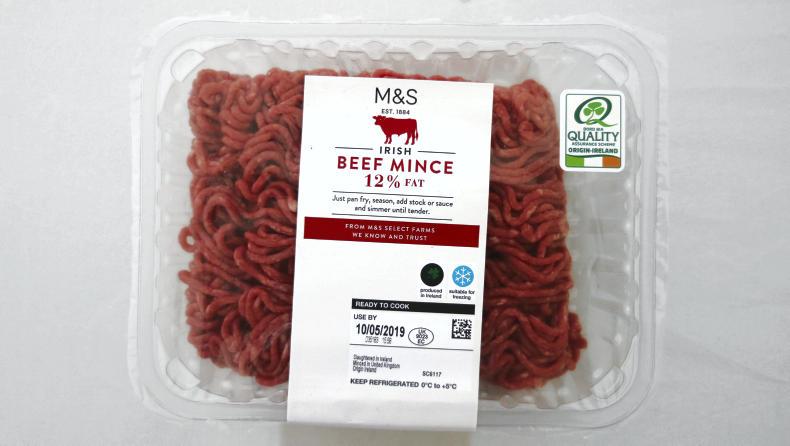
The departure of the UK from the EU has created a particular focus on the impact for trade and business on the island of Ireland. The Irish Government and business both sides of the border have been consistent in saying that the UK departure must not have the effect of recreating a border for trade. It disappeared with the creation of the single market for EU member states in 1993.
Country-of-origin labelling
It is therefore ironic that another piece of subsequent EU legislation should have the effect of undermining the single market for beef originally and subsequently all meats.
Labelling legislation was introduced with very specific conditions on what was required
This is the country-of-origin labelling legislation, which originally was developed in response to consumer loss of confidence in beef following the discovery of BSE in mainland EU countries in 2000.
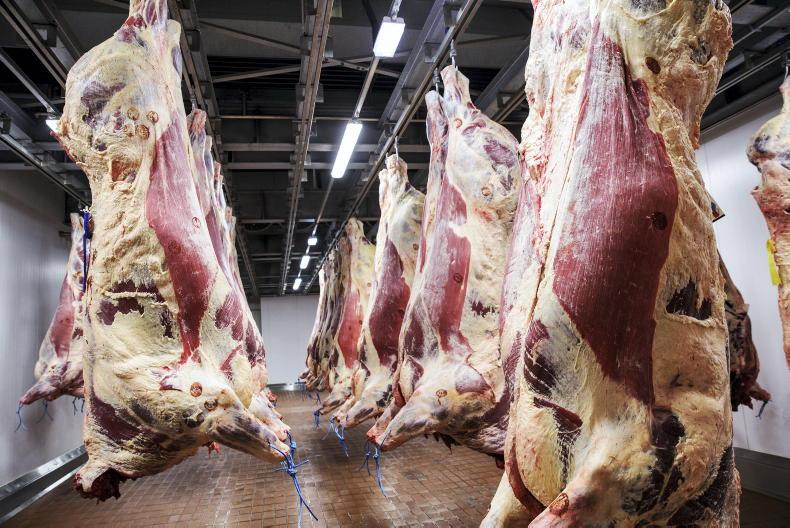
Labelling legislation was introduced with very specific conditions on what was required. In order for beef to carry a particular country as its origin, it had to come from cattle that were born, reared and slaughtered in that country. This has subsequently been extended to all meat.
How it works
When an animal is for example born in the Republic of Ireland, spends its entire life here and is slaughtered in an Irish factory then it carries “origin Ireland” on the beef label.
If a calf born in Ireland is exported to Spain, it cannot carry either origin Ireland or origin Spain
The problem arises when any one part of the born, reared or slaughter process occurs outside the country. For example, if a calf born in Ireland is exported to Spain, it cannot carry either origin Ireland or origin Spain. However, as beef labelling is compulsory, then the label clumsily becomes: born Ireland, reared in Ireland/Spain and slaughtered in Spain assuming it went into a Spanish factory.
More flexibility in mainland Europe
Labelling hasn’t been much of an issue in mainland Europe where there is a long history of animals travelling between countries.
It has proved a problem for Ireland, however, largely driven by UK retail and burger chain policy of restricting their ranges to two countries of origin, namely Ireland and the UK. That means traditional island of Ireland business of cattle being bought in the west by finishers from the north has almost ceased. These animals became neither Irish nor British and market opportunities are restricted for mixed-origin cattle. The same applies for store cattle exports from Ireland to Britain for finishing.
Interestingly, if a Northern Irish processor comes south and buys carcase beef, it can continue to carry an origin label even though it is deboned and retail-packed in Northern Ireland. This product will also be eligible to carry the Bord Bia quality mark provided of course that the factory in Northern Ireland is part of the Bord Bia processor scheme.
Pigs and sheep
Country-of-origin labelling also applies to pig meat and sheep meat but has had little visible impact on crossborder trade.
Labelling hasn’t been such an issue as most of Irish sheepmeat exports are to EU countries excluding the UK
In 2018, 466,000 pigs went from south to north for processing while 420,000 Northern Ireland lambs and hoggets came the other way for processing in southern factories.
Labelling hasn’t been such an issue as most of Irish sheepmeat exports are to EU countries excluding the UK and there is a strong pig meat market in Ireland as well as globally. This trade in particular is affected by country-of-origin rules.
Because Irish pigs are slaughtered in Cookstown, Co Tyrone, part of the UK jurisdiction, even though the pig meat is returned south of the border within days to retailers for consumer sale, it isn’t recognised as origin Irish. People involved in the trade estimate that this makes pigs going north for slaughter worth a few cent per kilo less.
The solution
In the Brexit negotiations, a backstop that preserves borderless, single market trade on the island of Ireland is a key component. This was insisted on by the EU in negotiating a withdrawal agreement with the UK.
If the EU, encouraged by the Irish Government can devise a solution to prevent a hard border for general trade on the island of Ireland, they should surely have sufficient creativity to do the same with country-of-origin labelling for the island of Ireland as well.



SHARING OPTIONS