



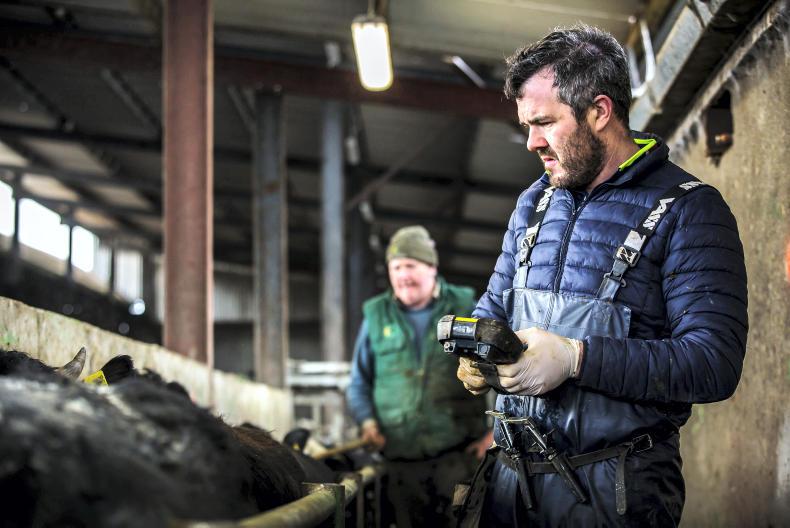
If Irish agriculture is to make progress on eradicating TB there are no more easy options, only hard choices according to a senior vet in the Department of Agriculture.
Eoin Ryan from the ruminant animal health division told farmers at an Irish Cattle and Sheep Farmers Association (ICSA) meeting in Co Monaghan that progress had been made but it was stalling.
He said without further measures there would continue to be around 3,800 breakdowns every year.
Ryan said two clear tests did not guarantee that farmer had no TB, it meant he probably did not: “The difference between probably and definitely are where problems our lie. The 60 days apart rule was written in 1964. It is still a good rule but it was designed in 1964.”
Risks
He explained after a breakdown and two subsequently clear tests, herds were still at a higher risk of a re-occurrence of TB. For the first year after a breakdown the odds of another breakdown were three times higher.
While the risk decreased gradually year after year, it took 10 years for it to fully decrease.
ICSA general secretary Eddie Punch said the Department had been floating the idea of risk-based trading with a farm’s TB history displayed on mart boards. Punch said this would be unacceptable to farmers as it would devalue herds.
Ryan believed without introducing risk-based trading or a pre-movement test it was hard to see what else could be done.
Testing
Farmer frustration was evident on the night with one farmer saying “TB is a business”. Many farmers also expressed concerns about the testing process.
Ryan spent a large portion of the night explaining the science behind TB testing. He said it was not like BVD with a single test detecting all infected animals immediately.
The skin test detects eight out of every 10 animals but is very reliable with only a one in 5,000 chance of a false positive.
The blood test used to test for TB can detect it at an earlier stage and identifies nine out of 10 animals. However, if every animal was blood tested there would be 280,000 false positives every year.


SHARING OPTIONS