There is significant support among industry stakeholders for a programme to be introduced in NI to eradicate sheep scab.
Representatives from the veterinary profession, agricultural retailers and farm groups are involved in plans which are expected to begin this summer.
According to Association of Veterinary Surgeons Practising in NI (AVSPNI) president Paul Crawford, the initial phase of the programme will be information-based, to help farmers to avoid buying and selling infected sheep ahead of sales beginning later this year.
It will also have a surveillance element, to develop an understanding of the extent of sheep scab outbreaks in NI.
Although a notifiable disease, it is widely accepted that sheep scab cases are under-reported to DAERA and anecdotal evidence suggests that the prevalence of the disease in NI has increased significantly in recent years.
The highly contagious disease is caused by a mite and can lead to wool loss, reduced animal performance and welfare issues.
Although always present in Ireland, sheep scab was previously eradicated in Britain
Crawford said that the long-term aim is to apply for government funding when a minister is in place at DAERA to allow testing, treatment and monitoring of the disease in NI.
Although always present in Ireland, sheep scab was previously eradicated in Britain, but became re-established following the import of infected stock. An eradication scheme in Wales has secured almost £9m in funding and is due to begin in the autumn.
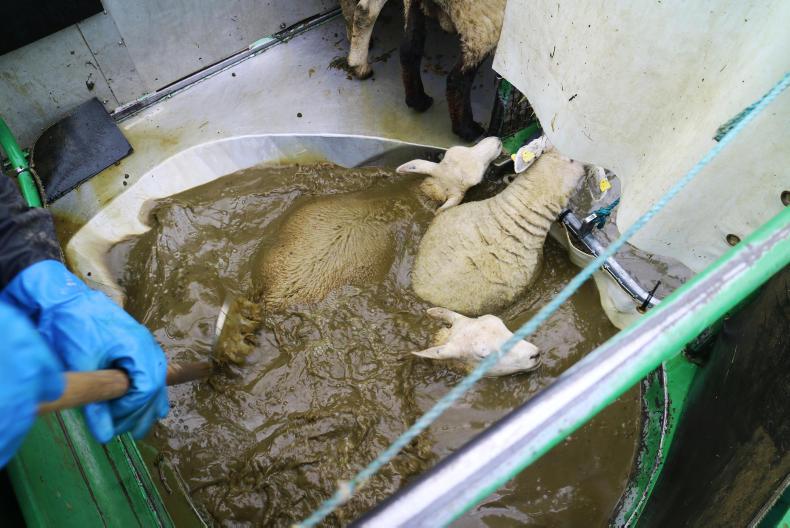
Treatment can be in the form of sheep dipping (by immersion), or injectable avermectins
Crawford said that a similar scheme could operate in NI, where individual treatment plans are put in place for infected flocks, and neighbouring farms are monitored to stop the spread of the disease.
Treatment can be in the form of sheep dipping (by immersion), or injectable avermectins. However, persistence can be an issue with injectable products, as sheep can become re-infected by mites from the environment and other untreated sheep.
Regulations surrounding the safe use of sheep dip mean that future treatment plans as part of an eradication scheme will probably require the use of accredited contractors with mobile dipping units.
Read more
Sheep scab: serious form of mange which can lead to animal welfare problems
In pictures: sheep dipping on your doorstep
There is significant support among industry stakeholders for a programme to be introduced in NI to eradicate sheep scab.
Representatives from the veterinary profession, agricultural retailers and farm groups are involved in plans which are expected to begin this summer.
According to Association of Veterinary Surgeons Practising in NI (AVSPNI) president Paul Crawford, the initial phase of the programme will be information-based, to help farmers to avoid buying and selling infected sheep ahead of sales beginning later this year.
It will also have a surveillance element, to develop an understanding of the extent of sheep scab outbreaks in NI.
Although a notifiable disease, it is widely accepted that sheep scab cases are under-reported to DAERA and anecdotal evidence suggests that the prevalence of the disease in NI has increased significantly in recent years.
The highly contagious disease is caused by a mite and can lead to wool loss, reduced animal performance and welfare issues.
Although always present in Ireland, sheep scab was previously eradicated in Britain
Crawford said that the long-term aim is to apply for government funding when a minister is in place at DAERA to allow testing, treatment and monitoring of the disease in NI.
Although always present in Ireland, sheep scab was previously eradicated in Britain, but became re-established following the import of infected stock. An eradication scheme in Wales has secured almost £9m in funding and is due to begin in the autumn.
Treatment can be in the form of sheep dipping (by immersion), or injectable avermectins
Crawford said that a similar scheme could operate in NI, where individual treatment plans are put in place for infected flocks, and neighbouring farms are monitored to stop the spread of the disease.
Treatment can be in the form of sheep dipping (by immersion), or injectable avermectins. However, persistence can be an issue with injectable products, as sheep can become re-infected by mites from the environment and other untreated sheep.
Regulations surrounding the safe use of sheep dip mean that future treatment plans as part of an eradication scheme will probably require the use of accredited contractors with mobile dipping units.
Read more
Sheep scab: serious form of mange which can lead to animal welfare problems
In pictures: sheep dipping on your doorstep
SHARING OPTIONS