The Irish dairy sector is a huge contributor to growth in economic activity across the rural Irish economy supporting over 60,000 jobs from dairy farming (19,000) to milk processing/distribution, export marketing and research.
The overall economic contribution of dairying to the Irish economy has increased significantly in recent years (as illustrated on the facing page). Hugely important as detailed in the piece below, Irish economy expenditure by the dairy sector also doubled since quota abolition to €3.8bn in 2018.
Crucially in terms of Irish economy impact, every €1 of exports of dairy products represents a 90c spend within the Irish economy. In contrast, for the multi-national sector, the corresponding figure per €1 of exports is a 10c spend in the Irish economy. Moreover, dairy’s huge Irish economy spend on raw materials, wages and services now accounts for almost 10% of spending by all industry (DJEBI, Annual Survey of Expenditure 2017 published in February 2019).
Expenditure in the Irish economy is a much more real assessment of the impact of industry in the Irish economy than the standard economic accounting figures such as gross domestic product (GDP) or gross value add (GVA).
In terms of economic activity, GDP is a completely distorted figure in Ireland’s case because of the requirement under GDP convention rules that multinational profits and transfer pricing transactions are included in Ireland’s GDP figure. Purchases of milk and other inputs in the Irish economy by the dairy sector, for example, are excluded. In gross terms, €130bn of private multinational company profits annually are included in Ireland’s GDP figure, while €3.8bn worth of Irish economy inputs purchased by the dairy sector (€16bn by the broad agri-food sector annually) are excluded. So, clearly, GDP does not measure Irish economy performance.
The Central Statistics Office (CSO), the Department of Jobs, Enterprise and Innovation and Eurostat provide annual analyses that create a much clearer picture.
The Eurostat report shows that while Ireland is ranked second in the EU in GDP terms, when transfer pricing is removed, we fall to ninth in the EU (Eurostat AIC V GDP 2017). Irish income levels are 181% of EU average under GDP figures but only 93% of EU average when transfer pricing distortions are removed.
The CSO and the Department of Jobs, Enterprise and Innovation produce annual reports detailing the Irish economy spend on raw materials, people/salaries and services in Ireland (CSO Census of industrial production, Department of Jobs Annual survey of Irish Economy Expenditure February 2019).
The following statistics provide a clearer picture of the relative economic contributions of various sectors in 2017:
Multinational exports were valued at €200bn while Irish economy expenditure by multinationals was €20bn, a 10c spend in the Irish economy per euro exported.Irish economy expenditure by all Irish indigenous companies was €24bn while total exports from these companies were €40bn: a 60c spend per euro export. Irish economy expenditure by the agri-food sector was €15bn, while exports were valued at €13bn: €1.20 expenditure per euro exported.Dairy industry exports were €4.2bn, while Irish economy expenditure was €3.8bn: 91c expenditure in the Irish economy per euro export. The Irish dairy sector is a key contributor to growth in economic activity across the rural and regional Irish economy. At the same time, dairy output growth has been extremely climate change efficient. A recent Teagasc report shows that the expansion in the sector has been achieved while reducing the emissions intensity of dairy production to levels well below that of other countries (Figure 1).
Dairy economy growth comes from a combination of a major surge in global demand for dairy products, particularly in emerging economies, and the ending of supply controls in the EU with the abolition of milk quotas in 2015. Since 2015, Irish dairy output has increased in value by over €2bn annually and by 60% by volume.
There are 19,000 dairy farmers in the Republic of Ireland (DAFM) producing over 7.5bn litres of milk annually (CSO, 2018).Imports of milk from Northern Ireland represent an additional 800m litres,There are approximately 7,500 employed in milk processing (CSO, 2018). There are an additional 30,000 jobs across the dairy sector in farm supplies and agri inputs/wholesaling transport, distribution, research and development (CSO, 2018).Total milk processed in the Republic of Ireland is almost 8.3bn litres. This represents 60% increase on pre-quota levels of an average five billion litres annually.The turnover value of the milk processing industry is €4.8bn. Exports in 2018 were valued at €4.2bn.The unit value of milk production has increased from an average of 42c/l to 45c/l in the last years of milk quota to just over 56c/l in 2018.Irish economy expenditure by the dairy sector was €3.8bn in 2018. The Irish dairy sector buys 90% of its inputs and raw materials in the Irish economy.The dairy industry accounted for almost 10% of spending by all industry in the Irish economy in 2018. The sector additionally provides around 50% of the raw material for the beef processing sector to a value of €1.2bn annually.Since EU milk quotas were abolished in 2015, Irish milk production has increased to 7.6bn litres in what was a really challenging year for farmers in 2018.
Moreover, not only has the volume of milk production increased by almost 50%, the €2bn in increased expenditure in the Irish economy has ranged from increased farm inputs and services through investment in new processing facilities and in support of an additional 10,000 jobs across the economy from dairy farming right through to manufacturing distribution and research.
Resilience: fixed-price schemes v price volatility and return on investment
The transition from a milk quota plus EU market supports-based regime to a more, open and volatile world market-driven scenario has presented huge challenges in terms of dealing with price and income volatility.
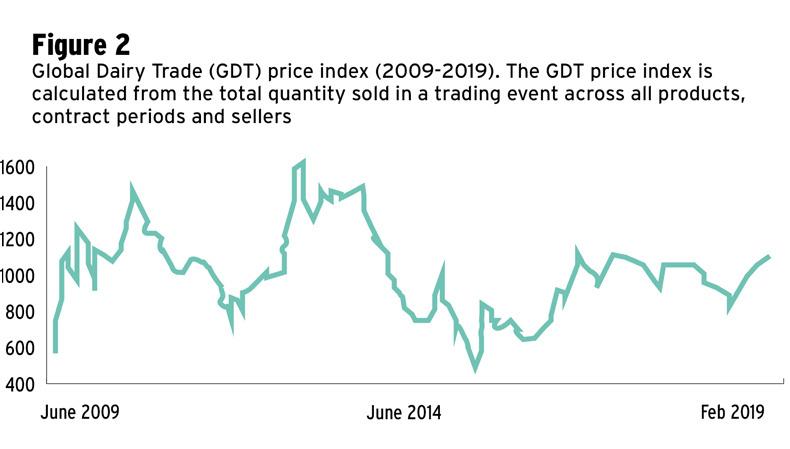
It is a testament to the resilience of farmers and the innovation of Irish milk processors, led initially by Glanbia, with the introduction of robust fixed milk price and business finance schemes, that both the volume growth trajectory and the increase in unit value were sustained throughout the ups and downs of the global milk price cycles (Figure 2).
While some element of the increase in the unit value of dairy output has come from an increase in the price of butter since the middle of 2016, the bigger factor driving the growth in value-added would seem to be the move to higher income returns from the infant formula and sports nutrition sectors. In addition to the increased value within the sector, figures from Enterprise Ireland from 2015 showed that, in the two years pre-quota abolition (2013 and 2014), Irish dairy processors invested in 36 projects across the dairy product spectrum, spending €770m, with a state grant support of €79m.
Dairy expansion in Ireland has been hugely positive for dairy farmers, dairy processors and rural Ireland. Irish dairy production is among the most welfare friendly, environmentally sustainable, and resilient in the world.
Ciaran Fitzgerald will be speaking at the Forum at 3pm.
The Irish dairy sector is a huge contributor to growth in economic activity across the rural Irish economy supporting over 60,000 jobs from dairy farming (19,000) to milk processing/distribution, export marketing and research.
The overall economic contribution of dairying to the Irish economy has increased significantly in recent years (as illustrated on the facing page). Hugely important as detailed in the piece below, Irish economy expenditure by the dairy sector also doubled since quota abolition to €3.8bn in 2018.
Crucially in terms of Irish economy impact, every €1 of exports of dairy products represents a 90c spend within the Irish economy. In contrast, for the multi-national sector, the corresponding figure per €1 of exports is a 10c spend in the Irish economy. Moreover, dairy’s huge Irish economy spend on raw materials, wages and services now accounts for almost 10% of spending by all industry (DJEBI, Annual Survey of Expenditure 2017 published in February 2019).
Expenditure in the Irish economy is a much more real assessment of the impact of industry in the Irish economy than the standard economic accounting figures such as gross domestic product (GDP) or gross value add (GVA).
In terms of economic activity, GDP is a completely distorted figure in Ireland’s case because of the requirement under GDP convention rules that multinational profits and transfer pricing transactions are included in Ireland’s GDP figure. Purchases of milk and other inputs in the Irish economy by the dairy sector, for example, are excluded. In gross terms, €130bn of private multinational company profits annually are included in Ireland’s GDP figure, while €3.8bn worth of Irish economy inputs purchased by the dairy sector (€16bn by the broad agri-food sector annually) are excluded. So, clearly, GDP does not measure Irish economy performance.
The Central Statistics Office (CSO), the Department of Jobs, Enterprise and Innovation and Eurostat provide annual analyses that create a much clearer picture.
The Eurostat report shows that while Ireland is ranked second in the EU in GDP terms, when transfer pricing is removed, we fall to ninth in the EU (Eurostat AIC V GDP 2017). Irish income levels are 181% of EU average under GDP figures but only 93% of EU average when transfer pricing distortions are removed.
The CSO and the Department of Jobs, Enterprise and Innovation produce annual reports detailing the Irish economy spend on raw materials, people/salaries and services in Ireland (CSO Census of industrial production, Department of Jobs Annual survey of Irish Economy Expenditure February 2019).
The following statistics provide a clearer picture of the relative economic contributions of various sectors in 2017:
Multinational exports were valued at €200bn while Irish economy expenditure by multinationals was €20bn, a 10c spend in the Irish economy per euro exported.Irish economy expenditure by all Irish indigenous companies was €24bn while total exports from these companies were €40bn: a 60c spend per euro export. Irish economy expenditure by the agri-food sector was €15bn, while exports were valued at €13bn: €1.20 expenditure per euro exported.Dairy industry exports were €4.2bn, while Irish economy expenditure was €3.8bn: 91c expenditure in the Irish economy per euro export. The Irish dairy sector is a key contributor to growth in economic activity across the rural and regional Irish economy. At the same time, dairy output growth has been extremely climate change efficient. A recent Teagasc report shows that the expansion in the sector has been achieved while reducing the emissions intensity of dairy production to levels well below that of other countries (Figure 1).
Dairy economy growth comes from a combination of a major surge in global demand for dairy products, particularly in emerging economies, and the ending of supply controls in the EU with the abolition of milk quotas in 2015. Since 2015, Irish dairy output has increased in value by over €2bn annually and by 60% by volume.
There are 19,000 dairy farmers in the Republic of Ireland (DAFM) producing over 7.5bn litres of milk annually (CSO, 2018).Imports of milk from Northern Ireland represent an additional 800m litres,There are approximately 7,500 employed in milk processing (CSO, 2018). There are an additional 30,000 jobs across the dairy sector in farm supplies and agri inputs/wholesaling transport, distribution, research and development (CSO, 2018).Total milk processed in the Republic of Ireland is almost 8.3bn litres. This represents 60% increase on pre-quota levels of an average five billion litres annually.The turnover value of the milk processing industry is €4.8bn. Exports in 2018 were valued at €4.2bn.The unit value of milk production has increased from an average of 42c/l to 45c/l in the last years of milk quota to just over 56c/l in 2018.Irish economy expenditure by the dairy sector was €3.8bn in 2018. The Irish dairy sector buys 90% of its inputs and raw materials in the Irish economy.The dairy industry accounted for almost 10% of spending by all industry in the Irish economy in 2018. The sector additionally provides around 50% of the raw material for the beef processing sector to a value of €1.2bn annually.Since EU milk quotas were abolished in 2015, Irish milk production has increased to 7.6bn litres in what was a really challenging year for farmers in 2018.
Moreover, not only has the volume of milk production increased by almost 50%, the €2bn in increased expenditure in the Irish economy has ranged from increased farm inputs and services through investment in new processing facilities and in support of an additional 10,000 jobs across the economy from dairy farming right through to manufacturing distribution and research.
Resilience: fixed-price schemes v price volatility and return on investment
The transition from a milk quota plus EU market supports-based regime to a more, open and volatile world market-driven scenario has presented huge challenges in terms of dealing with price and income volatility.
It is a testament to the resilience of farmers and the innovation of Irish milk processors, led initially by Glanbia, with the introduction of robust fixed milk price and business finance schemes, that both the volume growth trajectory and the increase in unit value were sustained throughout the ups and downs of the global milk price cycles (Figure 2).
While some element of the increase in the unit value of dairy output has come from an increase in the price of butter since the middle of 2016, the bigger factor driving the growth in value-added would seem to be the move to higher income returns from the infant formula and sports nutrition sectors. In addition to the increased value within the sector, figures from Enterprise Ireland from 2015 showed that, in the two years pre-quota abolition (2013 and 2014), Irish dairy processors invested in 36 projects across the dairy product spectrum, spending €770m, with a state grant support of €79m.
Dairy expansion in Ireland has been hugely positive for dairy farmers, dairy processors and rural Ireland. Irish dairy production is among the most welfare friendly, environmentally sustainable, and resilient in the world.
Ciaran Fitzgerald will be speaking at the Forum at 3pm. 




SHARING OPTIONS