


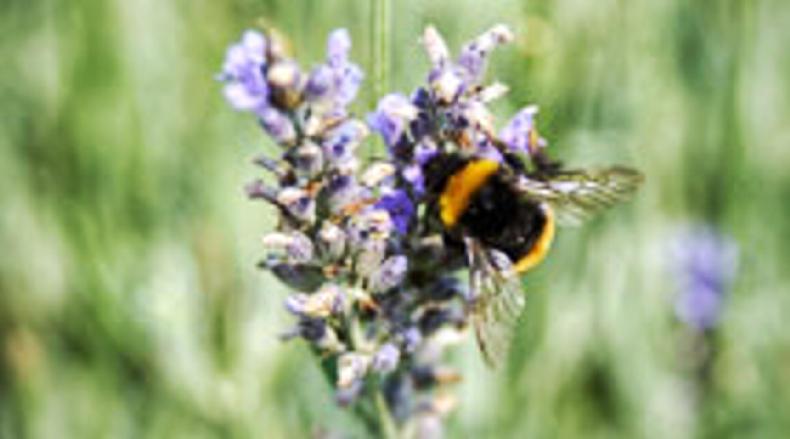
Derogation farmers must comply with the All-Ireland Pollinator Plan (AIPP), under new nitrates derogation rules. Derogation farmers will have to undertake at least one measure to comply with the AIPP.
There are five actions “bee friendly” farmers can adopt in the AIPP.
1. Hedgerows: Native flowering hedgerows can be maintained by trimming them in an A-shape, allowing them to grow over 8ft (2.5m) high, and leave at least one mature whitethorn or blackthorn tree within each hedgerow. A 6.5ft (1.5-2m) border should be protected from fertiliser and pesticides.
2. Wildflowers: Wildflowers can be allowed to grow from spring to autumn in “non-farmed” areas such as farmyards, laneways and field margins. However, these areas have to be cut once a year after flowering and toppings removed to avoid soil enrichment. Noxious weeds in these areas are to be controlled by pulling or using spot treatment.
3. Bee habitats: Nesting habitats for bumblebees can be created by leaving long grass along the base of hedgerows. For mining solitary bees, bare earth on south- or east-facing banks can be created. For cavity-nesting bees, holes (10cm deep, 4mm to 8mm diameter and 1.5m to 2m high) can be drilled in south- or east-facing walls, wooden fences or concrete structures. All of these areas need to be free from pesticides.
4. Minimise fertiliser use: Fertiliser use can be minimised by avoiding spreading unnecessarily in awkward corners or within 6.5ft (1.5-2m) of the base of hedges. Use clovers, peas/beans or other herbal leys in some areas of the farm instead of chemical fertilisers. Other options include the use of species-rich herbal leys.
5. Reduce pesticide inputs:Reducing pesticide inputs is recommended to avoid killing bees. Again, avoid spreading herbicides close to the base of hedgerows. Strim or mow these areas instead. Also avoid wildflower areas and nesting sites. Reduce the number and frequency of pesticide applications, only spray in calm weather and use low-drift nozzles.



SHARING OPTIONS