



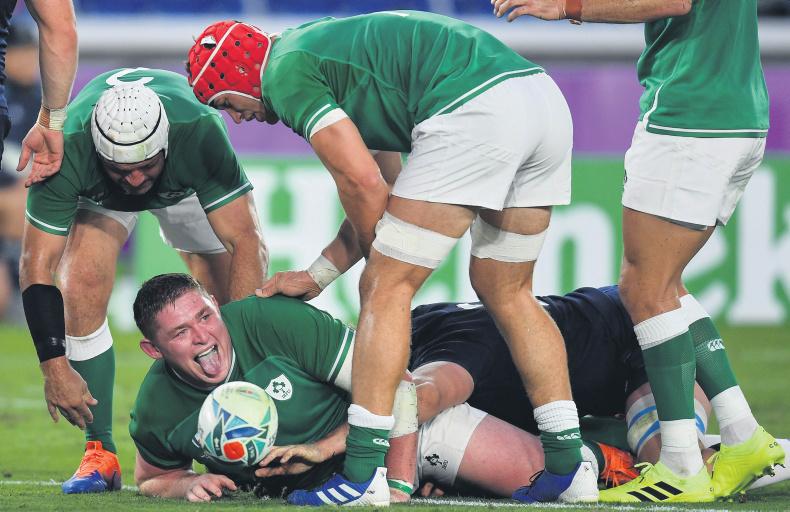
In terms of achieving objectives, Ireland could scarcely have done much better in Yokohama last Sunday morning.
As the whole country enjoyed a fry in front of the television, Ireland knew that a win was essential against the second-best side in Pool A or the spectre of a quarter-final against New Zealand would loom large.
Ireland do generally beat Scotland, but there have been exceptions in recent times, most notably the opening game of the 2017 Six Nations Championship, and World Cups can do strange things to players, as we can well remember from 2007.
To that end, the job was carried out to the letter. A good start put Ireland in control and Scotland on the back foot and the pressure was maintained as tries two and three followed to ensure a commanding half-time lead. All that was left was to add was the fourth try and the bonus point and it too duly arrived. Mission accomplished and key players could be rested.
And yet, amazingly, there were gripes from some quarters – Scotland were terrible so we still don’t know how good Ireland are, apparently.
It’s always the way, of course – some people are afraid to be too positive, lest it come back to haunt them. When it comes to Ireland at World Cups, the memories of 2011 and 2015, when topping the group was followed by failure in the quarter-finals, means that there will always be an element of caution until that glass ceiling is broken. But we should still praise excellence where it exists.
Scotland were bad, that’s very true, but if their 15 were out there walking through moves with no opposition, they would have been a lot better – they failed to perform largely because Ireland ensured they couldn’t.
Tactics-wise, Schmidt and co got things right and the pressure put on the Scots meant they couldn’t execute. Trailing from the off put them in greater trouble and Ireland dealt well with being front-runners – something that hasn’t always been the case.
Obviously, playing the toughest game first is a positive when you win it and Japan, Russia and Samoa will almost certainly be seen off without too much fuss (we hope), allowing management to give game-time to all of the travelling party and ease back those players that are injured. Being under-cooked against South Africa isn’t likely to be a problem but, in any case, Rassie Erasmus’s side face Namibia, Italy and Canada in their remaining games, none of whom are likely to put them to pins of their collars either.
And speaking of the injuries? Thankfully, Schmidt said afterwards that the withdrawals of Bundee Aki and Peter O’Mahony were precautions, decisions which were obviously made easier by the fact that Ireland were well on top. Four years ago, a lack of squad depth was costly in the quarter-final against Argentina and the time since has been used to build a proper squad, ensuring that one man’s crisis is the opportunity for the next in line.
Jack Conan certainly didn’t weaken the pack when he came on, while Chris Farrell made a favourable impression and, similarly, Jack Carty did well when he came on for Jonathan Sexton.
When Josh van der Flier had to come off in the second half, Niall Scannell was the only option left and, after Tadhg Berine’s late yellow card, the fact that Ireland didn’t concede a try despite being down a man will definitely have given Schmidt a special kind of satisfaction.
It was notable that the post-match interviews, while full of levity, were underpinned with a conviction that nobody was getting carried away and the fact that Ireland must turn around to face the hosts on Saturday will ensure focus remains strong.
There is a chance that Japan will now identify the Scotland game as their must-win and take it easier against Ireland as a result, but that is largely a moot point. Ireland have to focus on themselves and, going on last Sunday, it’s an approach that suits them.
As mentioned in the main piece, all things going to plan we will see Ireland face South Africa in the quarter-finals. While that is good from a planning point of view for management, it doesn’t speak to a hugely competitive global competition.
From start to finish, the World Cup lasts 44 days and, while obviously there have to be considerations made for recovery between games, it is too long a time period, especially when there are so many dead rubber games in the pool stages.
In the opening eight games – two in each pool – there was an average winning margin of 20 points and that was despite the fact that three matches were between sides ranked in the world’s top 11, while Italy, the Six Nations’ whipping boys, were 25-point winners against Namibia.
It would be a big surprise if the current world top eight were not the eight quarter-finalists and such a level of near-certainty isn’t a good thing with three weeks of rugby to be played between now and then.
The standard of play around the world is too top heavy to make a 20-team World Cup a truly viable option. Going back to a 16-team event would almost certainly make for a better spectacle, but unfortunately may not curry favour with commercial interests of World Rugby.




SHARING OPTIONS