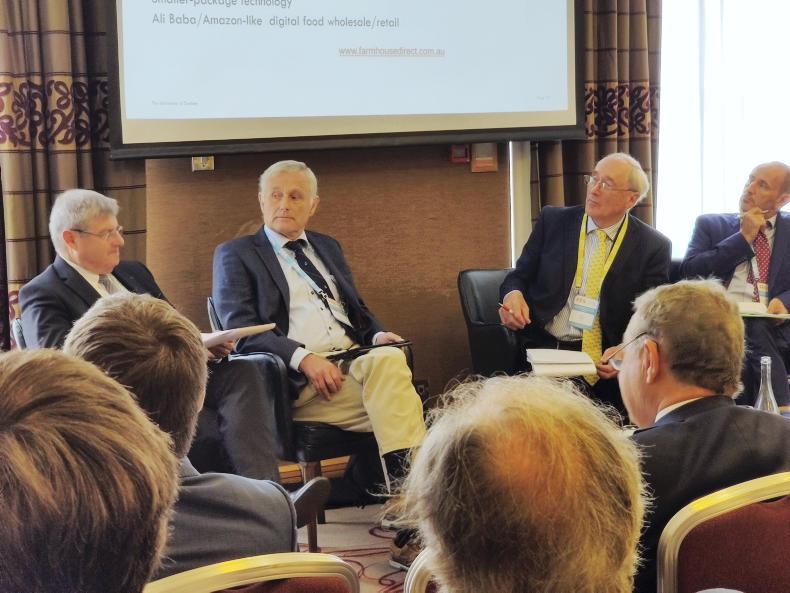
The Forum for the future of Agriculture (FFA) held a regional meeting in Dublin on Thursday, hosted by the European Landowners Organisation (ELO) and the local Irish Landowners organisation (ILO). FFA describes itself as an organisation which facilitates “agriculture and environment to meet for an open dialogue” and the event attracted a range of academics, landowners, farmers, environmentalists and NGOs from across Europe, the USA and Australia.
The half-day conference was divided into three sections, with Matt Dempsey, chair of the Agricultural Trust, as moderator. The first session focused on the theme of climate change and agricultural production, followed by a session titled "EU new reality" on the Green deal, and the final session was themed "innovation and science for agriculture".
Climate change and agriculture production
The keynote speaker for this session was Prof emeritus Allan Buckwell from the RISE foundation. RISE is a Brussels-based think tank set up by former European Commissioner for Agriculture Frans Fischler in 2006, and is supported by the ELO and Friends of the Countryside. Their ambition is to drive innovation in agriculture, rural areas and the environment through research.
Professor Buckwell spoke about the UK ambitions and how the last act of Theresa May’s leadership was to emphasise the strong commitment of the UK to address emissions from agriculture (which is just 10% of UK emissions) and aviation.
Red meat
He was an advocate of reduction but not elimination of red meat consumption and reduction of food waste. He does not foresee increased UK beef imports post-Brexit because of reduction in consumption and advocates the use of land released from production for forestry, energy crops, agro forestry and peatland restoration.
He does not foresee increased UK beef imports post-Brexit because of reduction in consumption
Marta Zuluaga-Zilbermann, director of policy relations for Cargill, pointed out that the world would require a 68% increase in animal protein from 2010 levels by 2050 to meet the demand of growing population. She said this would have to be achieved in a sustainable way.
Inputs
James Reilly, a tillage farmer from Co Kilkenny, described himself as a custodian of the land and highlighted how he farms in a less invasive way than he did 20 years ago with the use of technology, minimising inputs.
A lively discussion followed, with a strong focus by participants with a farming interest on how agricultural produce had become devalued, reflected by the huge level of waste and there was an inconclusive debate on how the value should be set for farm produce delivered to the standards demanded by the EU that are based on the precautionary principle rather than science.
Green Deal – EU new reality
The second session had a particularly strong environmental priority, with presentations from Professor Peter Thorne, co-author of the IPCC's report on land use, Oonagh Duggan from Birdwatch Ireland and Pierre Olivier Dredge, ELO president.
Oonagh Duggan shared an interesting anecdote from her dairy farming childhood when a bull calf was worth over IR£200 compared with recent times when the value was just €10, a reflection of farming type and how it has changed.
The ELO president cautioned delegates to expect that 40% of the next CAP payments would be environment-based.
Innovation and science for agriculture
Use of water was a recurring theme among presenters and delegates and one of the most pertinent points was made by a delegate from the floor highlighting how expensive high-quality drinking water is used for flushing toilets and washing cars.
This was highlighted as a waste and it should be preserved for human consumption, with rainwater collected from rooves used for cleaning.
John Gilliland from Devenish explained how LiDAR technology, engaged originally by them for their site at Dowth Hall to scan for ancient monuments, was also able to accurately measure the volume of hedges. The cost of LiDAR scanning has fallen from €11/acre to €5/acre, with drones able to replace more expensive helicopters.
The value of using hedges as a carbon sink can only be properly realised when they are accurately measured to reflect change over time in size and area and this is identified as a way in which the Dowth farm aims to move towards carbon neutrality.
The Forum for the future of Agriculture (FFA) held a regional meeting in Dublin on Thursday, hosted by the European Landowners Organisation (ELO) and the local Irish Landowners organisation (ILO). FFA describes itself as an organisation which facilitates “agriculture and environment to meet for an open dialogue” and the event attracted a range of academics, landowners, farmers, environmentalists and NGOs from across Europe, the USA and Australia.
The half-day conference was divided into three sections, with Matt Dempsey, chair of the Agricultural Trust, as moderator. The first session focused on the theme of climate change and agricultural production, followed by a session titled "EU new reality" on the Green deal, and the final session was themed "innovation and science for agriculture".
Climate change and agriculture production
The keynote speaker for this session was Prof emeritus Allan Buckwell from the RISE foundation. RISE is a Brussels-based think tank set up by former European Commissioner for Agriculture Frans Fischler in 2006, and is supported by the ELO and Friends of the Countryside. Their ambition is to drive innovation in agriculture, rural areas and the environment through research.
Professor Buckwell spoke about the UK ambitions and how the last act of Theresa May’s leadership was to emphasise the strong commitment of the UK to address emissions from agriculture (which is just 10% of UK emissions) and aviation.
Red meat
He was an advocate of reduction but not elimination of red meat consumption and reduction of food waste. He does not foresee increased UK beef imports post-Brexit because of reduction in consumption and advocates the use of land released from production for forestry, energy crops, agro forestry and peatland restoration.
He does not foresee increased UK beef imports post-Brexit because of reduction in consumption
Marta Zuluaga-Zilbermann, director of policy relations for Cargill, pointed out that the world would require a 68% increase in animal protein from 2010 levels by 2050 to meet the demand of growing population. She said this would have to be achieved in a sustainable way.
Inputs
James Reilly, a tillage farmer from Co Kilkenny, described himself as a custodian of the land and highlighted how he farms in a less invasive way than he did 20 years ago with the use of technology, minimising inputs.
A lively discussion followed, with a strong focus by participants with a farming interest on how agricultural produce had become devalued, reflected by the huge level of waste and there was an inconclusive debate on how the value should be set for farm produce delivered to the standards demanded by the EU that are based on the precautionary principle rather than science.
Green Deal – EU new reality
The second session had a particularly strong environmental priority, with presentations from Professor Peter Thorne, co-author of the IPCC's report on land use, Oonagh Duggan from Birdwatch Ireland and Pierre Olivier Dredge, ELO president.
Oonagh Duggan shared an interesting anecdote from her dairy farming childhood when a bull calf was worth over IR£200 compared with recent times when the value was just €10, a reflection of farming type and how it has changed.
The ELO president cautioned delegates to expect that 40% of the next CAP payments would be environment-based.
Innovation and science for agriculture
Use of water was a recurring theme among presenters and delegates and one of the most pertinent points was made by a delegate from the floor highlighting how expensive high-quality drinking water is used for flushing toilets and washing cars.
This was highlighted as a waste and it should be preserved for human consumption, with rainwater collected from rooves used for cleaning.
John Gilliland from Devenish explained how LiDAR technology, engaged originally by them for their site at Dowth Hall to scan for ancient monuments, was also able to accurately measure the volume of hedges. The cost of LiDAR scanning has fallen from €11/acre to €5/acre, with drones able to replace more expensive helicopters.
The value of using hedges as a carbon sink can only be properly realised when they are accurately measured to reflect change over time in size and area and this is identified as a way in which the Dowth farm aims to move towards carbon neutrality.








SHARING OPTIONS