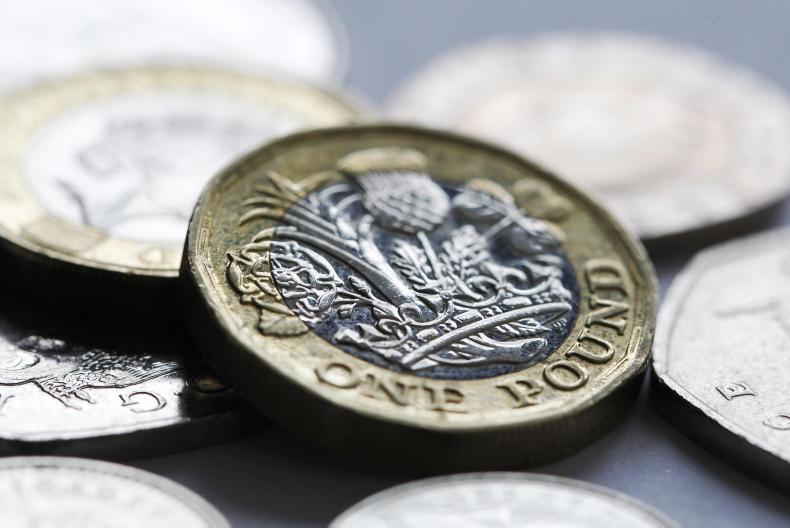
The rate used to convert 2019 direct payments from euro into sterling will be €1 = £0.89092.
The figure, which is based on the average European Central Bank conversion rate in September, is not as favourable for farmers as once hoped, after the euro climbed to over €1 = £0.92 at the start of August.
That was driven by political uncertainty and heightened fears of a no-deal Brexit, but since then investors have interpreted more recent political moves making a no-deal exit on 31 October less likely.
The result is a conversion rate for 2019 that is actually below that from 2018 (€1 = £0.89281) and 2017 (€1 = £0.89470), although it is still significantly ahead of the 2015 pre-EU referendum rate of €1 = £0.73129. With a total NI direct payment pot of approximately €327m, it means that £291m will be going to farmers, down £0.61m on last year. A 70% advance payment is due from 16 October 2019.
Last year
Assuming the UK does actually leave the EU in the next few weeks, this will be the last year of CAP money coming to farmers, and the last year that payments will be converted from euro to sterling. In their stakeholder engagement exercise from 2018, the Department indicated that the current payment system would remain largely unchanged for 2020 and 2021, so that would require entitlement values to be converted from euro to sterling. However, it all depends on a budget being made available. The UK government has guaranteed the current money going to farmers will be retained to the end of the current parliament.
That was originally to be until 2022, but a general election looks inevitable in the next few months, so it will be up to a new government to decide.
“It is the intention of DAERA to keep existing schemes in operation until such times as a minister is in place to make policy decisions,” confirmed a DAERA spokesperson.
Future
Meanwhile, the future of the euro-sterling exchange rate is largely dependent on whether a Brexit deal is done or not. The euro itself is not a particularly strong currency, but if the UK leaves the EU without a deal, analysists predict that it will move towards parity with sterling. However, if there is a deal (or no Brexit at all) that would see sterling move a lot higher against the euro, potentially back towards pre-EU referendum levels (€1 = £0.73). Normally a strong sterling leads to lower prices to farmers. The reverse is usually also the case, although that has not been the outcome in 2019.
Of the remainder, 4.1% are officially TB suspended and 5.7% are officially TB withdrawn herds.
Read more
70% advanced payments approved for NI farmers
Severely disadvantaged farms top CAP list in Northern Ireland
The rate used to convert 2019 direct payments from euro into sterling will be €1 = £0.89092.
The figure, which is based on the average European Central Bank conversion rate in September, is not as favourable for farmers as once hoped, after the euro climbed to over €1 = £0.92 at the start of August.
That was driven by political uncertainty and heightened fears of a no-deal Brexit, but since then investors have interpreted more recent political moves making a no-deal exit on 31 October less likely.
The result is a conversion rate for 2019 that is actually below that from 2018 (€1 = £0.89281) and 2017 (€1 = £0.89470), although it is still significantly ahead of the 2015 pre-EU referendum rate of €1 = £0.73129. With a total NI direct payment pot of approximately €327m, it means that £291m will be going to farmers, down £0.61m on last year. A 70% advance payment is due from 16 October 2019.
Last year
Assuming the UK does actually leave the EU in the next few weeks, this will be the last year of CAP money coming to farmers, and the last year that payments will be converted from euro to sterling. In their stakeholder engagement exercise from 2018, the Department indicated that the current payment system would remain largely unchanged for 2020 and 2021, so that would require entitlement values to be converted from euro to sterling. However, it all depends on a budget being made available. The UK government has guaranteed the current money going to farmers will be retained to the end of the current parliament.
That was originally to be until 2022, but a general election looks inevitable in the next few months, so it will be up to a new government to decide.
“It is the intention of DAERA to keep existing schemes in operation until such times as a minister is in place to make policy decisions,” confirmed a DAERA spokesperson.
Future
Meanwhile, the future of the euro-sterling exchange rate is largely dependent on whether a Brexit deal is done or not. The euro itself is not a particularly strong currency, but if the UK leaves the EU without a deal, analysists predict that it will move towards parity with sterling. However, if there is a deal (or no Brexit at all) that would see sterling move a lot higher against the euro, potentially back towards pre-EU referendum levels (€1 = £0.73). Normally a strong sterling leads to lower prices to farmers. The reverse is usually also the case, although that has not been the outcome in 2019.
Of the remainder, 4.1% are officially TB suspended and 5.7% are officially TB withdrawn herds.
Read more
70% advanced payments approved for NI farmers
Severely disadvantaged farms top CAP list in Northern Ireland







SHARING OPTIONS