The rate of TB incidence in Irish herds increased in the third quarter of 2019 are similar to the same period last year, figures from the Department of Agriculture show.
As of 29 September 2019, the herd incidence for bovine TB (bTB) stood at 3.46%, marginally higher on the same period last year (3.29%).
This means that of all herds tested for bTB so far in 2019, 3.46% had at least one animal that tested positive for bTB.
Although it is at historically low levels, the Department has warned that current trends suggest herd incidence for 2019 will increase for the third consecutive year.
Testing and restrictions
Some 85,693 herds (76%) of the herds in the country have been TB tested at least once by the end of September 2019.
The number of herds restricted at the end of quarter three was 2,329. This is 7% higher when compared with 2,174 herds restricted at the end of the same period in 2018.
Current trends suggest herd incidence for 2019 will increase for the third consecutive year
The number of reactors fell by 97 (7%) from 13,172 in January to September 2018 to 12,275 in January to September 2019.
However, the Department of Agriculture said that while this is to be welcomed, “it is too early to draw any definitive conclusions on this reduction at this stage”.
Some 98% (109,698 herds) are free of TB currently.
Monaghan and Clare
Once again, Co Monaghan is worst affected.
It has a herd incidence of 6.12% and 991 reactors to date in 2019. This compares to a herd incidence of 7.26% and 1,279 reactors by 30 September 2018.
Some of Co Clare is now also in a high-impact management plan because of an increase in herd incidence.
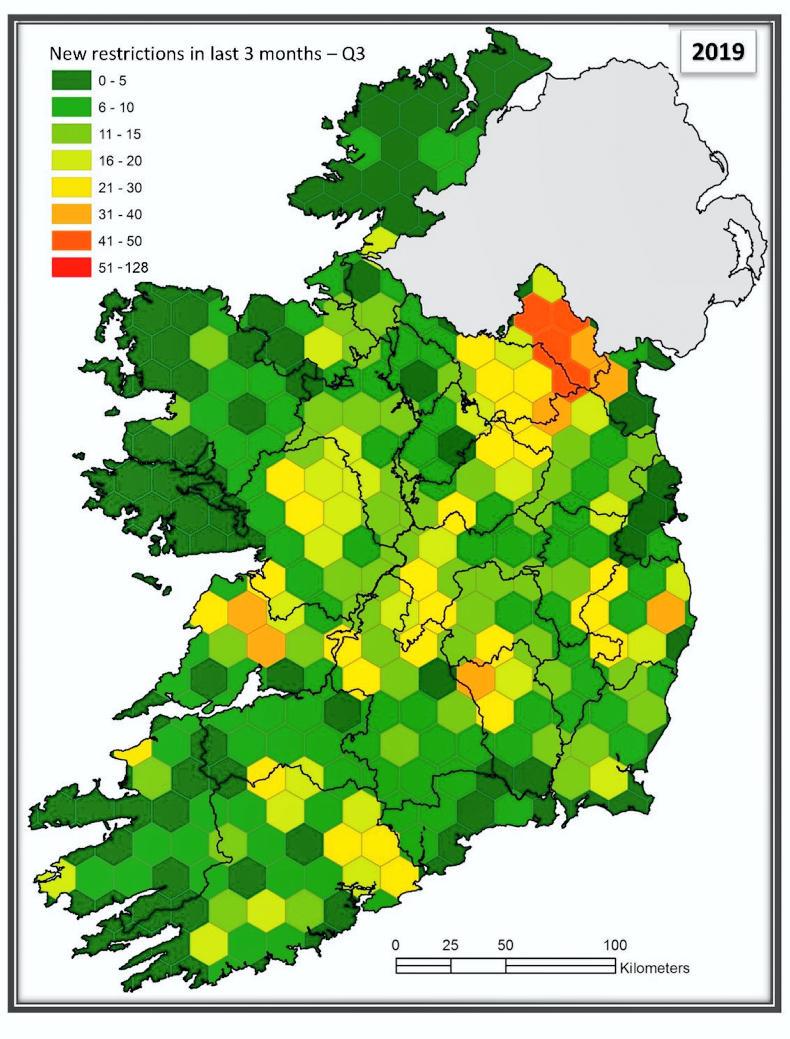
New TB herd restrictions in the three-month period July to September 2019. \ Department of Agriculture
In both Monaghan and Clare, in conjunction with the roll out of the disease management aspects of the plan, a communication strategy has also been implemented. This includes targeted communications with farmers and vets in the affected areas.
The minister is due to shortly publish a strategy mapping a 10-year plan for the eradication of TB.
Read more
Listen: wetter winters, dryer summers and invasive species - climate change
Weanling series: nine tips to reduce stress at weaning time
Coughing cattle and mycoplasma
The rate of TB incidence in Irish herds increased in the third quarter of 2019 are similar to the same period last year, figures from the Department of Agriculture show.
As of 29 September 2019, the herd incidence for bovine TB (bTB) stood at 3.46%, marginally higher on the same period last year (3.29%).
This means that of all herds tested for bTB so far in 2019, 3.46% had at least one animal that tested positive for bTB.
Although it is at historically low levels, the Department has warned that current trends suggest herd incidence for 2019 will increase for the third consecutive year.
Testing and restrictions
Some 85,693 herds (76%) of the herds in the country have been TB tested at least once by the end of September 2019.
The number of herds restricted at the end of quarter three was 2,329. This is 7% higher when compared with 2,174 herds restricted at the end of the same period in 2018.
Current trends suggest herd incidence for 2019 will increase for the third consecutive year
The number of reactors fell by 97 (7%) from 13,172 in January to September 2018 to 12,275 in January to September 2019.
However, the Department of Agriculture said that while this is to be welcomed, “it is too early to draw any definitive conclusions on this reduction at this stage”.
Some 98% (109,698 herds) are free of TB currently.
Monaghan and Clare
Once again, Co Monaghan is worst affected.
It has a herd incidence of 6.12% and 991 reactors to date in 2019. This compares to a herd incidence of 7.26% and 1,279 reactors by 30 September 2018.
Some of Co Clare is now also in a high-impact management plan because of an increase in herd incidence.
New TB herd restrictions in the three-month period July to September 2019. \ Department of Agriculture
In both Monaghan and Clare, in conjunction with the roll out of the disease management aspects of the plan, a communication strategy has also been implemented. This includes targeted communications with farmers and vets in the affected areas.
The minister is due to shortly publish a strategy mapping a 10-year plan for the eradication of TB.
Read more
Listen: wetter winters, dryer summers and invasive species - climate change
Weanling series: nine tips to reduce stress at weaning time
Coughing cattle and mycoplasma









SHARING OPTIONS