Bord Bia quality-assured dairy farms will be prohibited from slaughtering healthy calves on farms, under a new rule to be introduced next week.
An updated version of Sustainable Dairy Assurance Scheme (SDAS) adds seven additional calf welfare criteria, to be applied from 11 November 2019.
Other new criteria include rules on access to water, navel treatment, housing, bedding and treatment of injured calves.
New criteria
The new SDAS additional calf welfare criteria are:
a) The on-farm slaughter of healthy calves is prohibited.
b) Calves must be offered free access to clean water from 5 days of age, or younger if they are being offered solid feed in addition to receiving milk or milk substitute.
c) The calf’s navel must be appropriately treated with a suitable disinfectant as soon as possible after birth to avoid infection.
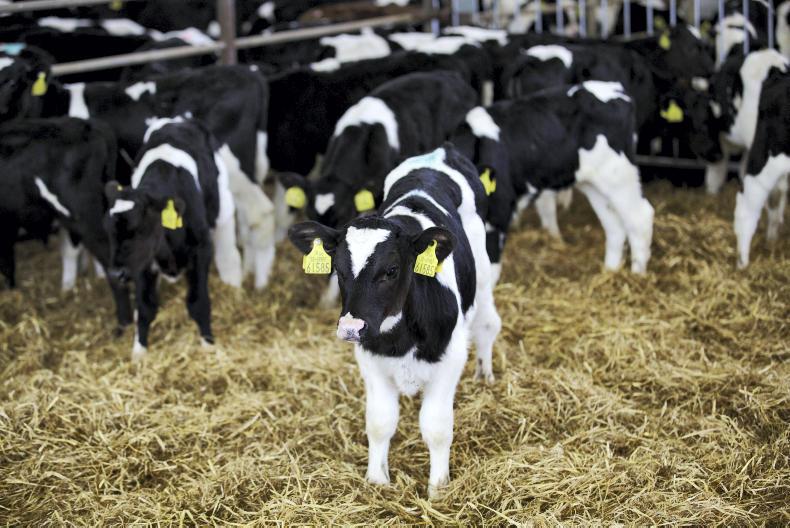
d) Well ventilated, draught free housing must be provided for calves.
e) Dry comfortable bedding must be provided at all times.
f) Calves must be looked after so that they are maintained in a healthy condition.
g) Sick or injured calves must be treated appropriately without delay and where calves are not responding to the stockpersons care then veterinary advice must be sought.
The new criteria will be sent to farmers in the coming days.
Read more
Dairy management: Lameness, drying off and heifer weights
New cubicle and calving shed in Gurteen College
‘Confusion’ around value of dairy calves - Teagasc
Bord Bia quality-assured dairy farms will be prohibited from slaughtering healthy calves on farms, under a new rule to be introduced next week.
An updated version of Sustainable Dairy Assurance Scheme (SDAS) adds seven additional calf welfare criteria, to be applied from 11 November 2019.
Other new criteria include rules on access to water, navel treatment, housing, bedding and treatment of injured calves.
New criteria
The new SDAS additional calf welfare criteria are:
a) The on-farm slaughter of healthy calves is prohibited.
b) Calves must be offered free access to clean water from 5 days of age, or younger if they are being offered solid feed in addition to receiving milk or milk substitute.
c) The calf’s navel must be appropriately treated with a suitable disinfectant as soon as possible after birth to avoid infection.
d) Well ventilated, draught free housing must be provided for calves.
e) Dry comfortable bedding must be provided at all times.
f) Calves must be looked after so that they are maintained in a healthy condition.
g) Sick or injured calves must be treated appropriately without delay and where calves are not responding to the stockpersons care then veterinary advice must be sought.
The new criteria will be sent to farmers in the coming days.
Read more
Dairy management: Lameness, drying off and heifer weights
New cubicle and calving shed in Gurteen College
‘Confusion’ around value of dairy calves - Teagasc






SHARING OPTIONS