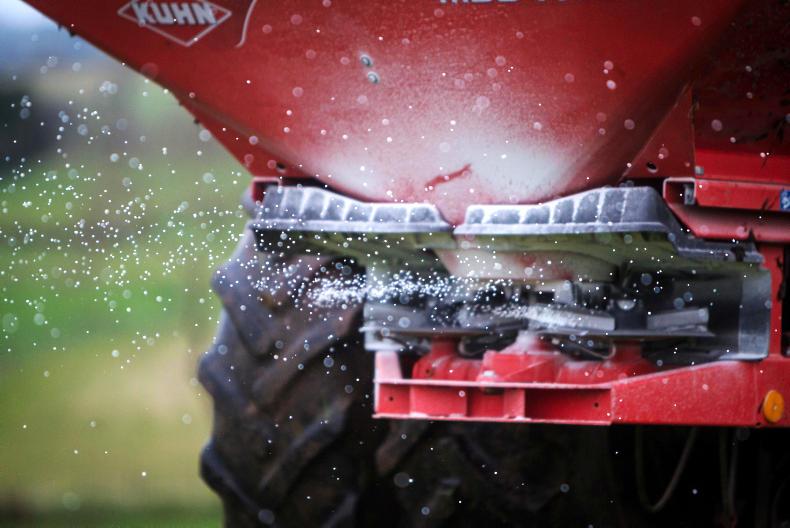
Once ground conditions allow, some nitrogen (N) should be spread to kick-start growth, but hold off on heaver applications until later in the spring, farmers were told at a Yara information event held in Fivemiletown last week.
The advice from Yara agronomist Philip Cosgrove is to initially apply 20 to 25 units of N per acre (slightly under one bag CAN/acre).
In a more extensive system, it might be best to go with an initial 15 to 20 units/ac, he suggested.
With pressure on the farming industry to be environmentally aware, Cosgrove was clear that fertiliser should not be applied to wet ground at any stage.
“If you are marking the fields it is not right – the response will not be there in an anaerobic, saturated soil. There is also a higher risk of leaching and higher greenhouse gas emissions (due to the release of nitrous oxide),” he said.
When it comes to planning for first-cut silage, farmers will often look to put on about 100 units of N per acre.
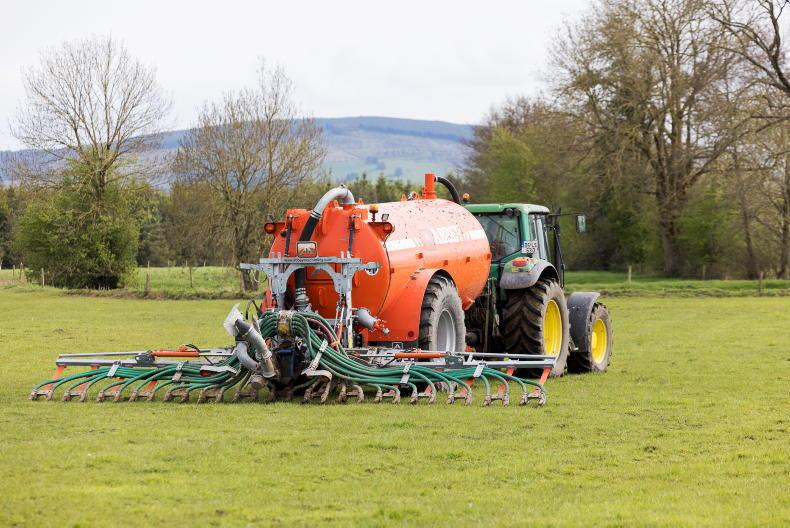
Assuming 2,000 gallons of slurry per acre has also been spread, it supplies about 18 units, although this varies depending on dry matter content of the slurry and the spreading method.
If a splash plate is used, especially in dry conditions, much of the N could be lost to the air.
“But even if you are applying 82 units (three bags/ac of CAN) of N, as opposed to 100 units (3.7 bags/ac of CAN), I would encourage you to consider splitting the dressing – it is quite a lot to go on at one time,” said Cosgrove.
In one application, there is an increased risk of losses. Splitting it probably means going two to three weeks apart.
There is also no point applying 100 units of N to an old sward with weed grasses – “you won’t get an economic response”, suggested Cosgrove.
Grazing
When it comes to fertilising paddocks, blanket-spreading N every three weeks is time-efficient, and probably delivers similar overall grass yields. However, nitrate in the grass tends to peak around four to five days after spreading, and if this grass is eaten, there is a risk of higher N losses in the urine of cows.
“My advice would be to go with fertiliser once every 10 days, and a maximum of 15 days,” said Cosgrove.
Slurry
When slurry is spread, he said that farmers should wait a week to 10 days before applying N. Going in earlier, there is a risk that more N is converted to nitrous oxide.
Sulphur
On sulphur he said that a grass plant requires this nutrient throughout the growing season, but in the spring, because soil temperatures tend to be lower, any sulphur within the soil is slow to mineralise and become available to the plant.
“The spring through to May are critical months, and we see big yield responses to sulphur in first-cut silage, along with higher proteins. In general, it should be put on little and often, and the more N that goes on, the more sulphur you require,” said Cosgrove.
Protected urea
He was also asked about the drive towards protected urea this year as an alternative to CAN. Given that CAN is associated with higher nitrous oxide emissions, there is an environmental argument favouring the use of urea. But urea will increase ammonia emissions, particularly in dry conditions. Coating it with an inhibitor significantly reduces that problem.
Despite having a treated urea product on the market, Cosgrove remains cautious, pointing out that protective equipment should be worn by anyone handling the product.
He also described the potential long-term impact on grazing livestock as “unknown territory”.
Seven-fold return from lime
The key to ensuring a healthy soil and a good uptake of fertiliser and slurry nutrients is to maintain soils at the optimal pH, Andrew Morrison from Yara told farmers in Fivemiletown.
“You should have lime in your budget every year. Soil pH is key, and the return on your investment is sevenfold,” said Morrison.
He said that 58% of soil samples from NI analysed at the Yara lab in Pocklington, Yorkshire are below pH 6.
At pH 5.5, only 77% of the nitrogen, 48% of the phosphorus (P) and 77% of the potassium (K) are available to the plant.
Losing
“If you take 27-4-4 costing £260/t, at pH 5.5 it becomes 21-2-3. You are losing £83.20/t, or in other words, you may as well throw 320kg out of every tonne into the ditch,” said Morrison.
On peat soils the optimal pH is between 5.5 and 5.8, but on mineral soils it is 6 to 6.5 To increase pH by 0.1 requires 0.5t per acre of lime.
CCF v a blend
Yara now has a number of CCF (complex compound fertiliser) products on the market. While most fertiliser is a blend, CCF is designed to ensure that each granule has the identical mix of nutrient (such as N, P, K and sulphur).
According to Alan Turkington from Yara, there are significant benefits to be had.
“P doesn’t move well in soil, and the likes of sulphur is quite a soft product, so you can get a spike in the middle of a field. With a CCF product, more plants get their requirements,” said Turkington.
Read more
Coronavirus to hit Chinese fertiliser production – Rabobank
Weather and cashflow hit fertiliser trade
Once ground conditions allow, some nitrogen (N) should be spread to kick-start growth, but hold off on heaver applications until later in the spring, farmers were told at a Yara information event held in Fivemiletown last week.
The advice from Yara agronomist Philip Cosgrove is to initially apply 20 to 25 units of N per acre (slightly under one bag CAN/acre).
In a more extensive system, it might be best to go with an initial 15 to 20 units/ac, he suggested.
With pressure on the farming industry to be environmentally aware, Cosgrove was clear that fertiliser should not be applied to wet ground at any stage.
“If you are marking the fields it is not right – the response will not be there in an anaerobic, saturated soil. There is also a higher risk of leaching and higher greenhouse gas emissions (due to the release of nitrous oxide),” he said.
When it comes to planning for first-cut silage, farmers will often look to put on about 100 units of N per acre.
Assuming 2,000 gallons of slurry per acre has also been spread, it supplies about 18 units, although this varies depending on dry matter content of the slurry and the spreading method.
If a splash plate is used, especially in dry conditions, much of the N could be lost to the air.
“But even if you are applying 82 units (three bags/ac of CAN) of N, as opposed to 100 units (3.7 bags/ac of CAN), I would encourage you to consider splitting the dressing – it is quite a lot to go on at one time,” said Cosgrove.
In one application, there is an increased risk of losses. Splitting it probably means going two to three weeks apart.
There is also no point applying 100 units of N to an old sward with weed grasses – “you won’t get an economic response”, suggested Cosgrove.
Grazing
When it comes to fertilising paddocks, blanket-spreading N every three weeks is time-efficient, and probably delivers similar overall grass yields. However, nitrate in the grass tends to peak around four to five days after spreading, and if this grass is eaten, there is a risk of higher N losses in the urine of cows.
“My advice would be to go with fertiliser once every 10 days, and a maximum of 15 days,” said Cosgrove.
Slurry
When slurry is spread, he said that farmers should wait a week to 10 days before applying N. Going in earlier, there is a risk that more N is converted to nitrous oxide.
Sulphur
On sulphur he said that a grass plant requires this nutrient throughout the growing season, but in the spring, because soil temperatures tend to be lower, any sulphur within the soil is slow to mineralise and become available to the plant.
“The spring through to May are critical months, and we see big yield responses to sulphur in first-cut silage, along with higher proteins. In general, it should be put on little and often, and the more N that goes on, the more sulphur you require,” said Cosgrove.
Protected urea
He was also asked about the drive towards protected urea this year as an alternative to CAN. Given that CAN is associated with higher nitrous oxide emissions, there is an environmental argument favouring the use of urea. But urea will increase ammonia emissions, particularly in dry conditions. Coating it with an inhibitor significantly reduces that problem.
Despite having a treated urea product on the market, Cosgrove remains cautious, pointing out that protective equipment should be worn by anyone handling the product.
He also described the potential long-term impact on grazing livestock as “unknown territory”.
Seven-fold return from lime
The key to ensuring a healthy soil and a good uptake of fertiliser and slurry nutrients is to maintain soils at the optimal pH, Andrew Morrison from Yara told farmers in Fivemiletown.
“You should have lime in your budget every year. Soil pH is key, and the return on your investment is sevenfold,” said Morrison.
He said that 58% of soil samples from NI analysed at the Yara lab in Pocklington, Yorkshire are below pH 6.
At pH 5.5, only 77% of the nitrogen, 48% of the phosphorus (P) and 77% of the potassium (K) are available to the plant.
Losing
“If you take 27-4-4 costing £260/t, at pH 5.5 it becomes 21-2-3. You are losing £83.20/t, or in other words, you may as well throw 320kg out of every tonne into the ditch,” said Morrison.
On peat soils the optimal pH is between 5.5 and 5.8, but on mineral soils it is 6 to 6.5 To increase pH by 0.1 requires 0.5t per acre of lime.
CCF v a blend
Yara now has a number of CCF (complex compound fertiliser) products on the market. While most fertiliser is a blend, CCF is designed to ensure that each granule has the identical mix of nutrient (such as N, P, K and sulphur).
According to Alan Turkington from Yara, there are significant benefits to be had.
“P doesn’t move well in soil, and the likes of sulphur is quite a soft product, so you can get a spike in the middle of a field. With a CCF product, more plants get their requirements,” said Turkington.

Read more
Coronavirus to hit Chinese fertiliser production – Rabobank
Weather and cashflow hit fertiliser trade
SHARING OPTIONS