The fourth round of negotiations between the UK and EU on a future trading arrangement to take effect from the start of next year are ongoing in Brussels this week.
If the previous three rounds are a barometer for judging progress, expectations of a breakthrough are extremely low. The previous round last month concluded with both sides blaming the other and little appearance of common ground or purpose.
Since then, the UK has published a proposed tariff schedule that broadly mirrors the EU tariffs for external trading partners, with whom there is no special trade deal.
House of Lords report
This week also saw the release of a report by the House of Lords Select Committee on the EU on the future arrangements for Northern Ireland (NI) defined in the Irish protocol.
It notes the concern from businesses in NI about lack of clarity on arrangements for trade after the end of this year when the UK-EU transition period ends.
In theory, there is a cast-iron agreement in place to enable NI continue to participate in the EU single market for goods and agricultural produce.
However, that is contingent on a satisfactory inspection arrangement being in place to deal with trade from Britain into NI, making sure that it doesn’t find its way into the single market via the Irish land border.
Physical infrastructure
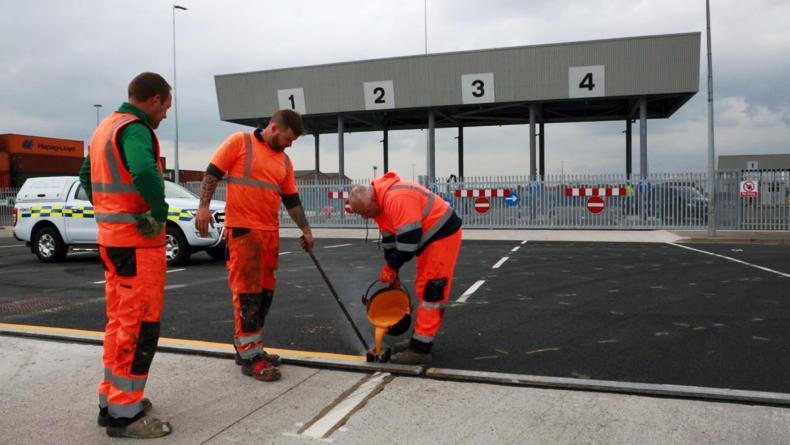
So far, unlike Dublin Port, no physical arrangements have been put in place at NI ports of entry and the Lord’s report raises concerns about the lack of preparation and absence for clear instruction to NI businesses on how the protocol will work in practice.
It isn’t all one-way criticism; the report also admonishes the EU for being rules obsessed as opposed to focusing on what might be a deliverable mutually satisfactory outcome.
This, in many ways, reflects the entire Brexit debate. The UK is of the view that it can negotiate the parts of the EU that it doesn’t mind and exclude the ones it doesn’t like, such as governance by the EU courts and free movement of people into the UK from the EU.
For its part, the EU is determined that there will be no advantage for the UK in leaving the EU and it is also concerned about a powerful, open economy that it shares a border with, having the best of both worlds.
Farmers either side of the Irish border won’t be interested in the complexities of international relations unless they have an impact on the trade of agricultural produce.
If the Irish protocol for whatever reason fails to be implemented, then NI farmers could be in trouble with the milk and lambs they send south for processing. If the EU and UK fail to reach agreement on a future trading relationship and tariffs are introduced, then Irish farmers will take the hit.
Latest negotiation
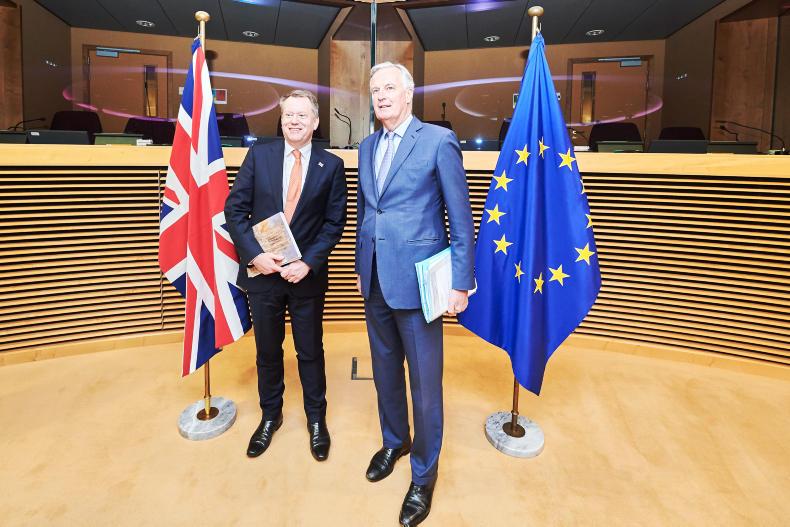
This week, it is expected that the chief negotiators Michel Barnier for the EU and David Frost for the UK will provide an end-of-round briefing on Friday.
Expectations of progress are low and commentators are looking to a review meeting between the EU Commission President Ursula von der Leyen and UK Prime Minister Boris Johnson. This could be the defining moment, as there is anxiety for certainty on the trading basis for 2021.
From a distance it is difficult to see how the conflicting interests of both parties can be satisfied.
However, if we recall last autumn, it was a chat during a walk in a garden in the northwest of England between the Taoiseach and prime minster that created the basis for the withdrawal agreement.
Perhaps a similar walk for Boris and Ursula could do the trick for the longer term agreement, otherwise the uncertainty continues into the autumn, something neither the EU nor UK can afford with the cost of coronavirus devastating both economies.
Read more
Differing UK views on trade
Brexit timeline prevents UK food debate
The fourth round of negotiations between the UK and EU on a future trading arrangement to take effect from the start of next year are ongoing in Brussels this week.
If the previous three rounds are a barometer for judging progress, expectations of a breakthrough are extremely low. The previous round last month concluded with both sides blaming the other and little appearance of common ground or purpose.
Since then, the UK has published a proposed tariff schedule that broadly mirrors the EU tariffs for external trading partners, with whom there is no special trade deal.
House of Lords report
This week also saw the release of a report by the House of Lords Select Committee on the EU on the future arrangements for Northern Ireland (NI) defined in the Irish protocol.
It notes the concern from businesses in NI about lack of clarity on arrangements for trade after the end of this year when the UK-EU transition period ends.
In theory, there is a cast-iron agreement in place to enable NI continue to participate in the EU single market for goods and agricultural produce.
However, that is contingent on a satisfactory inspection arrangement being in place to deal with trade from Britain into NI, making sure that it doesn’t find its way into the single market via the Irish land border.
Physical infrastructure
So far, unlike Dublin Port, no physical arrangements have been put in place at NI ports of entry and the Lord’s report raises concerns about the lack of preparation and absence for clear instruction to NI businesses on how the protocol will work in practice.
It isn’t all one-way criticism; the report also admonishes the EU for being rules obsessed as opposed to focusing on what might be a deliverable mutually satisfactory outcome.
This, in many ways, reflects the entire Brexit debate. The UK is of the view that it can negotiate the parts of the EU that it doesn’t mind and exclude the ones it doesn’t like, such as governance by the EU courts and free movement of people into the UK from the EU.
For its part, the EU is determined that there will be no advantage for the UK in leaving the EU and it is also concerned about a powerful, open economy that it shares a border with, having the best of both worlds.
Farmers either side of the Irish border won’t be interested in the complexities of international relations unless they have an impact on the trade of agricultural produce.
If the Irish protocol for whatever reason fails to be implemented, then NI farmers could be in trouble with the milk and lambs they send south for processing. If the EU and UK fail to reach agreement on a future trading relationship and tariffs are introduced, then Irish farmers will take the hit.
Latest negotiation
This week, it is expected that the chief negotiators Michel Barnier for the EU and David Frost for the UK will provide an end-of-round briefing on Friday.
Expectations of progress are low and commentators are looking to a review meeting between the EU Commission President Ursula von der Leyen and UK Prime Minister Boris Johnson. This could be the defining moment, as there is anxiety for certainty on the trading basis for 2021.
From a distance it is difficult to see how the conflicting interests of both parties can be satisfied.
However, if we recall last autumn, it was a chat during a walk in a garden in the northwest of England between the Taoiseach and prime minster that created the basis for the withdrawal agreement.
Perhaps a similar walk for Boris and Ursula could do the trick for the longer term agreement, otherwise the uncertainty continues into the autumn, something neither the EU nor UK can afford with the cost of coronavirus devastating both economies.
Read more
Differing UK views on trade
Brexit timeline prevents UK food debate








SHARING OPTIONS