



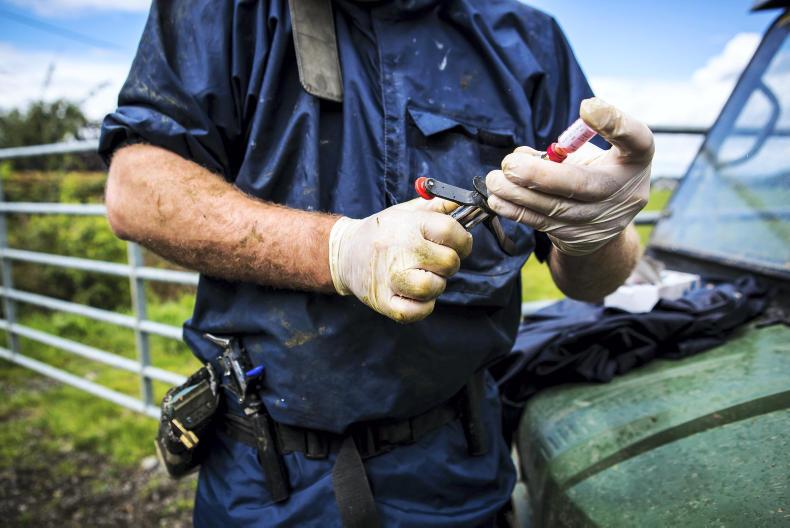
TB reactor numbers jumped by 33% in the first half of 2020, latest figures from the Department of Agriculture have revealed.
The number of cattle with TB in the Republic of Ireland stood at almost 9,500 in the first half of this year, with herd incidence now at its highest level in eight years, according to Department officials.
On 28 June 2020, the rolling 12-month herd incidence for TB in cattle was 4%.
This means that in the previous 12 months, 4,225 herds out of the 105,561 tested had at least one TB positive animal.
This is the highest level of TB in Ireland since 2012.
“While levels are still considerably lower compared to pre-2012, it is clear that significant additional efforts are needed by all stakeholders to arrest and reverse this recent pattern,” according to the Department officials.
Some 9,439 reactors were identified from January to June 2020, an increase of 33% (2,350 reactors) on the same period in 2019.
Regionally, Wicklow west (13.97%), Wicklow east (10.11%) and Louth (7.06%) have the highest herd incidence when compared to the national 12-month rolling average of 4%.
The stark figures also point to a marked increase in herd incidence in the second quarter of 2020 in Meath, Westmeath, Cork north and Tipperary north, when compared to the first quarter.
Cavan, Monaghan and Clare continue to have a high-impact TB control plans in place to try to curb the disease.
Review
Rising herd incidence and reactor numbers are of concern to all stakeholders, the Department has said.
“Senior Department of Agriculture, Food and the Marine officials at policy and operational level are closely reviewing national and regional trends in order to determine the main factors influencing these changes.
“Continuing co-operation between farmers, private veterinary practitioners and Department of Agriculture officials will be required to take action to reduce disease spread and target more effectively the high-risk factors associated with TB transmission in order to bring disease trends back on a downward trajectory,” it said.
Local factors
The Department has said that reasons why TB levels are increasing are multifactorial and often relate to local factors.
The expansion of the dairy herd since 2015 has played a role in this, it said, since dairy herds, larger herds, farm fragmentation and herds which introduce more cattle are all more at risk of TB breakdowns.
Data shows that 52% of all TB reactors in 2019 were in dairy herds, while there were approximately 2.8m farm-to-farm cattle movements last year.


SHARING OPTIONS