


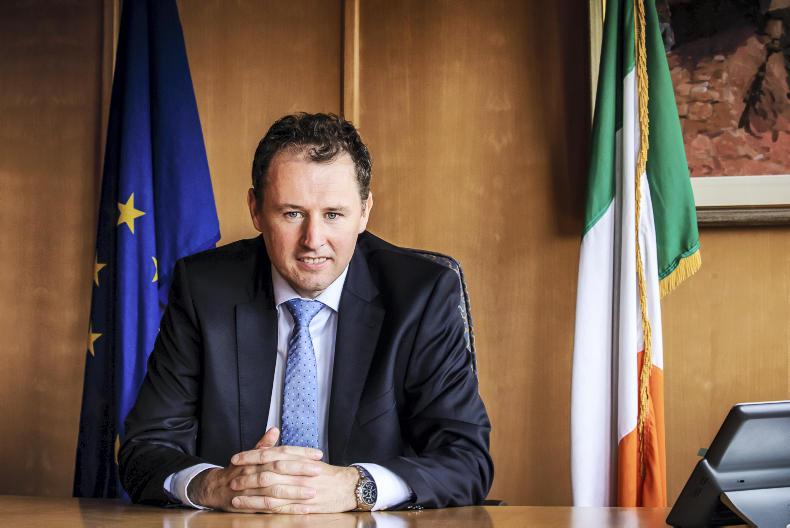
The Government will provide targeted support to farmers should there be an impact on prices as a result of tariffs arising from Brexit, Minister for Agriculture Charlie McConalogue has told the Irish Farmers Journal.
“It would be targeted at farmers to reflect any impact there would be on prices as a result of the disruption to trade from tariffs. It will be directed at farmers and the objective will be to ensure that, in terms of farm incomes, there are measures put in place to protect [farmers from] the impact of Brexit,” he said.
Impact on farm incomes
“In terms of the supports that we’ll be putting in place, we’ll have to be focusing in terms of what the impact will be on farm incomes and putting in place support mechanisms for farm incomes, and then working with industry to try and ensure that we’re doing all we can to maintain the current trade levels and volume levels with the British market.
The Government stands ready to support farmers
“It’s in our interest to work to ensure that we can continue to supply that market, and that there’s a national response in relation to the impact there might be on prices as a result of those tariffs coming into play,” he said.
“The Government stands ready to support farmers, whatever the outcome of Brexit. We have worked with the Minister for Public Expenditure and there is significant planning and contingencies in place.”
But in terms of support, direct support will be targeted at farmers
The minister also said that his Department will work with the industry to put in place supports “to enable them to respond to the challenge of potential market specifications and also in terms of the business challenges that they will be facing”.
“But in terms of support, direct support will be targeted at farmers,” he said.
Modelling
In a no-deal scenario, Minister McConalogue said there is Teagasc modelling which looks at the potential impact on the beef sector.
“I think [the impact is] in the region of up to €400m over the course of the year. It is significant in terms of what that impact would mean in terms of farm incomes and we are preparing to be in position to ensure there is a Government response that protects the sector and protects farmers against potential financial impacts.”
Minister McConalogue said the Government will not be able, under WTO rules, to directly subsidise tariffs.
“So, obviously there’s got to be an effort all round to ensure that we can continue to keep supplying the British market and keep a place on British shelves,” he said.
Brexit fund
The EU has set up a €5bn Brexit adjustment fund and the minister said Ireland has been putting forward a very strong case for funding in Europe, given that Ireland is most exposed, to receive “a significant proportion” of the fund.
Myself, Minister Coveney and Minister McGrath have had significant ongoing engagement in relation to the various outcomes and the supports that will be needed for the agri-food sector
He said there is also a €3.4bn fund at national level in the form of the Brexit and COVID-19 response fund.
“So between both of those I think we are in a strong position. Myself, Minister Coveney and Minister McGrath have had significant ongoing engagement in relation to the various outcomes and the supports that will be needed for the agri-food sector in those scenarios, and also with the Department of Enterprise, Trade and Employment in relation to support for the food industry,” he said.
Level playing field
Minister McConalogue said the issue around the level playing field discussion is important and in that context in terms of protecting the value in the British market into the future too.
“But there is no good outcome, it’s just a matter of trying to manage it and trying to get an outcome that will limit the impact on the Irish agri-food and farming sector.
“Come 1 January, there’s going to be changes and we’re going to require phytosanitary checks on all agri-food exports to Britain which weren’t there before. That’s going to increase the costs and have an impact in relation to the cost base which is something that’s unavoidable.
I remain hopeful in the next few days that we will still see a free-trade agreement and a deal which will avoid those tariffs
“Then at other end if there’s not a free-trade agreement, you could obviously have the very significant impact too of a 70% average tariff on beef and a 40% average tariff on dairy, which would have a very significant impact.
“I remain hopeful in the next few days that we will still see a free-trade agreement and a deal which will avoid those tariffs.
“Either way, in terms of the negotiations between myself and the Minister for Public Expenditure, we are looking at the scenarios in terms of the various types of deal and no deal as they may emerge and standing ready in the Government to be able to step in and support the sector,” he said.



SHARING OPTIONS