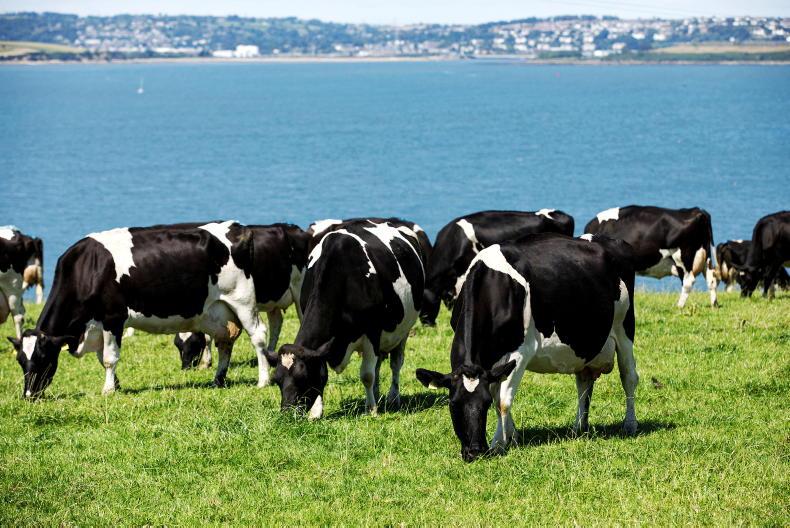
Cows grazing in the sunshine near Roches Point at the entrance to Cork Harbour. / Donal O' Leary
ADVERTISEMENT
Greenhouse gas (GHG) emission intensity per kilogram of milk produced has decreased by 13% between 2000 and 2017.
A joint report by Teagasc, NUIG and the University of California shows that over the last 20 years dairy farmers have made changes to help produce milk with considerably fewer emissions.
The report titled Quotas and Emissions analysed emissions in the wake of the abolition of dairy quotas and expanding herd size.
ADVERTISEMENT
It pointed out that despite the decrease per kilogram of milk produced, total farm emissions increased by 86% over the period.
The report states: “While this increase in absolute GHG emissions per farm is significant, average milk output per farm has increased by much more (123 %). This suggests that without improvement in environmental efficiency of production, farm-level emissions would have increased to a greater extent."
The report also highlights that economies of scale were at play and that larger farms are not necessarily higher emitters of GHG – rather the authors pointed out that dairy farms could continue to grow but only if they did so through methods identified in the Teagasc MACC curve.
It highlighted the continued work of Teagasc in this area and said that a new initiative – the Teagasc Signpost Programme – is aimed at addressing this issue.
Register for free to read this story and our free stories.
This content is available to digital subscribers and loyalty code users only. Sign in to your account, use the code or subscribe to get unlimited access.
The reader loyalty code gives you full access to the site from when you enter it until the following Wednesday at 9pm. Find your unique code on the back page of Irish Country Living every week.
CODE ACCEPTED
You have full access to the site until next Wednesday at 9pm.
CODE NOT VALID
Please try again or contact support.
Greenhouse gas (GHG) emission intensity per kilogram of milk produced has decreased by 13% between 2000 and 2017.
A joint report by Teagasc, NUIG and the University of California shows that over the last 20 years dairy farmers have made changes to help produce milk with considerably fewer emissions.
The report titled Quotas and Emissions analysed emissions in the wake of the abolition of dairy quotas and expanding herd size.
It pointed out that despite the decrease per kilogram of milk produced, total farm emissions increased by 86% over the period.
The report states: “While this increase in absolute GHG emissions per farm is significant, average milk output per farm has increased by much more (123 %). This suggests that without improvement in environmental efficiency of production, farm-level emissions would have increased to a greater extent."
The report also highlights that economies of scale were at play and that larger farms are not necessarily higher emitters of GHG – rather the authors pointed out that dairy farms could continue to grow but only if they did so through methods identified in the Teagasc MACC curve.
It highlighted the continued work of Teagasc in this area and said that a new initiative – the Teagasc Signpost Programme – is aimed at addressing this issue.
If you would like to speak to a member of our team, please call us on 01-4199525.
Link sent to your email address
We have sent an email to your address. Please click on the link in this email to reset your password. If you can't find it in your inbox, please check your spam folder. If you can't find the email, please call us on 01-4199525.
ENTER YOUR LOYALTY CODE:
The reader loyalty code gives you full access to the site from when you enter it until the following Wednesday at 9pm. Find your unique code on the back page of Irish Country Living every week.





SHARING OPTIONS