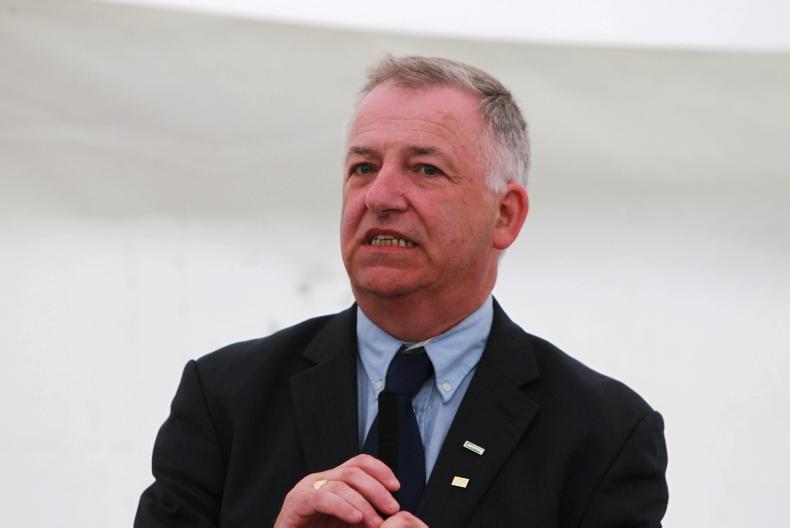
Measures to stabilise and reduce carbon emissions from the dairy sector must be voluntary for farmers and cannot be imposed, according to the chair of the new Food Vision Dairy Group Professor Gerry Boyle.
However, when asked about the type of mitigation measures that he foresees being used to reduce the sector’s carbon footprint, Prof Boyle said he hasn’t “ruled anything out at this stage”.
Prof Boyle was speaking following the Food Vision Dairy Group’s first meeting on Monday. The stakeholder group was announced last month by Minister for Agriculture Charlie McConalogue.
The new dairy group has been tasked with stabilising and then reducing the sector’s emissions and will need to provide a detailed plan to do this by the end of the second quarter of 2022.
The group is chaired by Prof Boyle, who is a former director of Teagasc, and comprises of representatives from the IFA, the ICSA, Macra na Feirme, the ICOS, Dairy Industry Ireland, Teagasc, the EPA and the ICBF.
No specifics
Following Monday’s first meeting, Prof Boyle said the group “didn’t get into any specific mechanisms” as to how the dairy sector could achieve emissions stabilisation and reduction.
He argued that there are “various pathways” towards achieving climate goals and said the “first challenge” will be to look at the potential of technology.
He said that if the technology designed to reduce dairy farm carbon emissions is fully rolled out and implemented, the sector would be “well on the way to achieving stabilisation”.
Prof Boyle also described the gains that can be made through “changing the nature of the fertiliser” farmers use.
Challenge
The former Teagasc director said: “What we need to do is create awareness amongst farmers of what is a very complex situation.
“The challenge with methane is that it goes to the centre of farmer livelihood. No other sector has that challenge.”
Encouraged
Commenting on Prof Boyle’s comments, Irish Creamery Milk Suppliers Association (ICMSA) president Pat McCormack said that he was encouraged by the “emphasis on the voluntary nature of any proposals” that might come from the dairy group.
McCormack said: “[The] ICMSA starts from a position that rejects State restrictions on our world-leading sustainable dairy sector, but we are prepared to give Prof Boyle the room to explore the options where those are based on incorporating the momentum that is already evident around science, genetics and change of practice.
“What we can’t have is uninformed and agri illiterate groups jumping in now and demanding that the science step aside in favour of their crude and self-defeating obsession with a simplistic [cattle] head count.”
Confident
Welcoming the first meeting of the dairy group, Minister for Agriculture Charlie McConalogue said he is “confident that working together we can stabilise and then reduce emissions from the dairy sector”.
He reiterated that the initial priority of the group should be to “produce a detailed plan by Q2 2022 to manage the sustainable environmental footprint of the dairy sector”.
“We want to ensure that we continue to have a sector that is vibrant and attractive to new entrants.
"We have to think about how we ensure that there is space for generational renewal and new entrants to the sector, or for those with marginal enterprises to improve viability, and space to encourage innovation and value addition.”
Read more
New dairy group cannot result in ‘something dressed up as quotas’
Measures to stabilise and reduce carbon emissions from the dairy sector must be voluntary for farmers and cannot be imposed, according to the chair of the new Food Vision Dairy Group Professor Gerry Boyle.
However, when asked about the type of mitigation measures that he foresees being used to reduce the sector’s carbon footprint, Prof Boyle said he hasn’t “ruled anything out at this stage”.
Prof Boyle was speaking following the Food Vision Dairy Group’s first meeting on Monday. The stakeholder group was announced last month by Minister for Agriculture Charlie McConalogue.
The new dairy group has been tasked with stabilising and then reducing the sector’s emissions and will need to provide a detailed plan to do this by the end of the second quarter of 2022.
The group is chaired by Prof Boyle, who is a former director of Teagasc, and comprises of representatives from the IFA, the ICSA, Macra na Feirme, the ICOS, Dairy Industry Ireland, Teagasc, the EPA and the ICBF.
No specifics
Following Monday’s first meeting, Prof Boyle said the group “didn’t get into any specific mechanisms” as to how the dairy sector could achieve emissions stabilisation and reduction.
He argued that there are “various pathways” towards achieving climate goals and said the “first challenge” will be to look at the potential of technology.
He said that if the technology designed to reduce dairy farm carbon emissions is fully rolled out and implemented, the sector would be “well on the way to achieving stabilisation”.
Prof Boyle also described the gains that can be made through “changing the nature of the fertiliser” farmers use.
Challenge
The former Teagasc director said: “What we need to do is create awareness amongst farmers of what is a very complex situation.
“The challenge with methane is that it goes to the centre of farmer livelihood. No other sector has that challenge.”
Encouraged
Commenting on Prof Boyle’s comments, Irish Creamery Milk Suppliers Association (ICMSA) president Pat McCormack said that he was encouraged by the “emphasis on the voluntary nature of any proposals” that might come from the dairy group.
McCormack said: “[The] ICMSA starts from a position that rejects State restrictions on our world-leading sustainable dairy sector, but we are prepared to give Prof Boyle the room to explore the options where those are based on incorporating the momentum that is already evident around science, genetics and change of practice.
“What we can’t have is uninformed and agri illiterate groups jumping in now and demanding that the science step aside in favour of their crude and self-defeating obsession with a simplistic [cattle] head count.”
Confident
Welcoming the first meeting of the dairy group, Minister for Agriculture Charlie McConalogue said he is “confident that working together we can stabilise and then reduce emissions from the dairy sector”.
He reiterated that the initial priority of the group should be to “produce a detailed plan by Q2 2022 to manage the sustainable environmental footprint of the dairy sector”.
“We want to ensure that we continue to have a sector that is vibrant and attractive to new entrants.
"We have to think about how we ensure that there is space for generational renewal and new entrants to the sector, or for those with marginal enterprises to improve viability, and space to encourage innovation and value addition.”
Read more
New dairy group cannot result in ‘something dressed up as quotas’






SHARING OPTIONS