



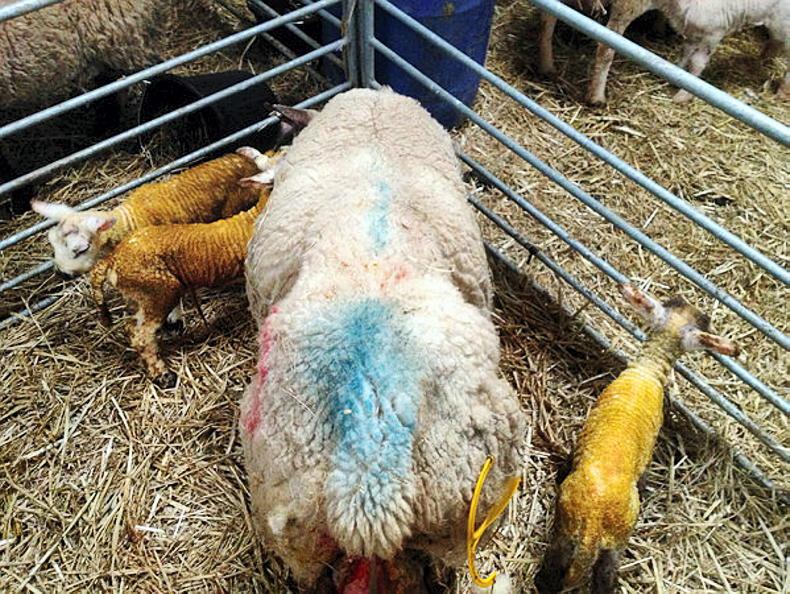
There has been more reports in recent weeks of prolapse issues on farms.
Most flocks will normally experience a few cases of prolapse, often in triplet- or quad-bearing ewes where the pressure for space from the growing fetuses means something has to give.
Where there are significant issues and cases exceed 1% to 2% in a flock, then there may be underlying factors at play.
Reports indicate that the relatively mild winter conditions in late 2021 following through to January left ewes in better body condition and this, combined with high dry matter forage on some farms, has given rise to greater issues.
Other factors
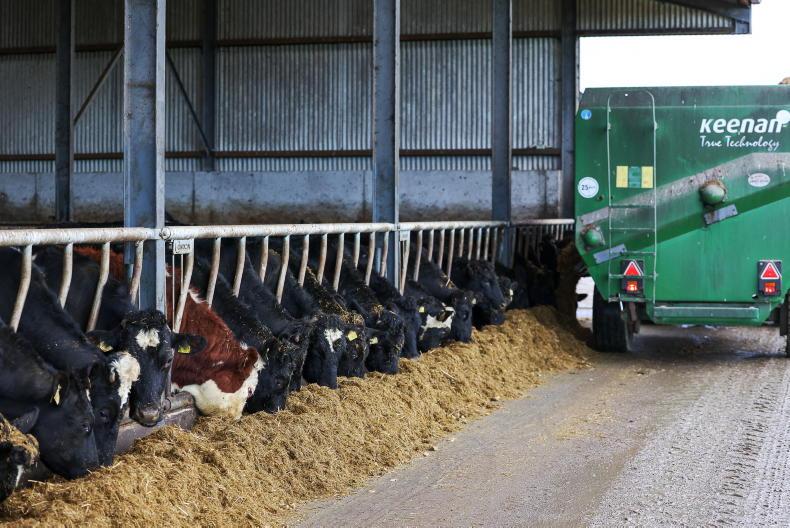
Other factors such as inadequate space at feeding barriers, a higher than optimum fibre content in the late-pregnancy diet and high litter sizes are all common contributors.
There is little that can be done regarding rectifying body condition in late pregnancy and the last thing that should be done is to overly restrict ewes, as this will only serve to trigger other ailments such as pregnancy toxaemia (twin lamb disease), milk fever, low milk yield, reduced birth weights, lambs with poor vigour, etc.
Some flocks experiencing significant issues have found letting triplet- and quad-bearing ewes outdoors for a period helps
Hence solutions should involve ensuring high-energy feeds are offered to ewes to meet nutritional requirements while restricting access to high-fibre feeds.
Splitting concentrate supplementation into a number of feeds, ensuring there is adequate space at feeding barriers and improving ewe exercise, where feasible, can help.
Some flocks experiencing significant issues have found letting triplet- and quad-bearing ewes outdoors for a period helps, with ewes receiving a nutritional boost from grass, relying less on supplementary feed and getting more exercise, which also seems to help.
Of course, this is not practical with big numbers, but may provide respite for a selection of ewes experiencing issues.
Lameness
Lameness in a flock can also trigger more cases, with ewes lying down for long periods, which puts increased pressure on vaginal muscles.
The same can be said of ewes grazing on steep inclines, with ewes tending to lie in an uphill position, meaning there is greater pressure on muscles.
There is also some train of thought that genetics could play a role, along with theories in some countries that docking tails too short will also weaken vaginal muscles.
Treatment route
The normal vaginal prolapse can generally be handled with relative ease through applying harnesses or suturing. The preferred treatment route depends on the severity of the prolapse.
For mild cases, applying a harness or using a rope to apply support similar to a harness will generally suffice. Where there is significant expulsion, then suturing will generally be required.
Administering an anti-inflammatory or painkiller may also be required to ease straining and forcing.
In serious cases, it is generally also advisable to administer either a long-acting antibiotic or a three- to five-day treatment programme to prevent secondary bacterial infection.
The risk of secondary infection will be heavily dependent on hygiene in the surrounding environment and the level of care taken when re-inserting prolapsed material.
The prolapsed material should be cleaned and, where required, washed with warm water before re-inserting.
Uterine prolapse
The much more serious problem, which occurs at a much lower rate but is linked with much higher levels of mortality, is uterine prolapse. There is no exact cause identified, but the factors above can all contribute.
It is not uncommon for a flock to experience an isolated case or cases in a given year and then not see a return in other years. The ailment consists of a ewe expelling the uterus and, in more severe cases, intestines.
The prognosis for treatment and recovery is poor. Veterinary treatment, where an anaesthetic can also be administered while suturing or a call on euthanasia can be made, is recommended.


SHARING OPTIONS