


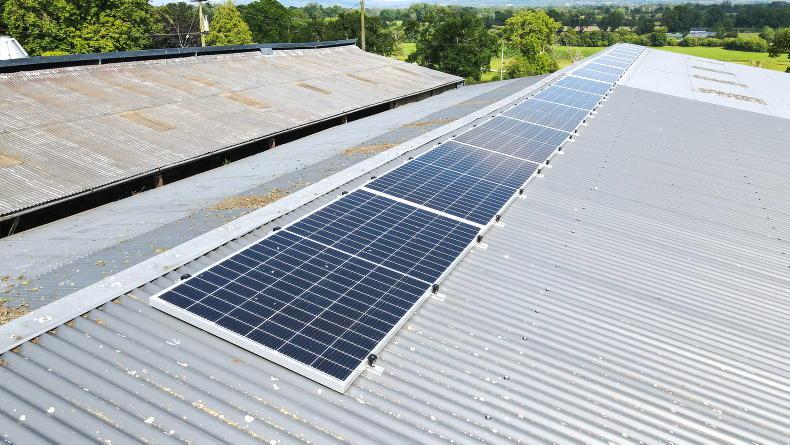
More poultry farmers would generate electricity from the roofs of their poultry houses should the Government put incentives in place that makes the investment worth their while, Irish Farmers' Association (IFA) poultry chair Nigel Sweetnam has said.
Sweetnam told the Irish Farmers Journal that the current supports in place do not provide poultry farmers with a sufficient incentive to justify the up-front investment needed to install solar panels, but added that payment for the surplus electricity generated would not necessarily be needed to sway farmers.
Instead, he offered the suggestion that a system of reverse metering be established, whereby farmers could supply surplus electricity into the grid and receive the same amount of electricity free of charge when their solar panels were not generating power.
“If I knew my annual consumption, I could install enough solar panels to supply my electricity needs. But when these solar panels are not producing, I should be able to get back the surplus electricity I fed into the system,” said Sweetnam.
“Poultry farms would produce electricity in peak times and would take back power when the demand is lower,” he explained.
Once-off investment
Sweetnam said that by making the once-off investment in renewable energy generation, poultry farmers could decrease their vulnerability to electricity and gas price increases, as have been seen over recent months and weeks.
“If the one-off cost was similar to what I would pay for energy bills over five to seven years, it would make the investment worthwhile,” he said.
The European Commission has recently announced a target of doubling solar and wind energy generation by 2025 as part of its plan to reduce the EU's dependence on Russian gas.
A rooftop solar energy generation plan is expected to be published this summer, in which Brussels will give guidance intended on directing member states towards this target.
Poultry litter
Poultry farmers would also benefit from an expansion of the criteria under which Targeted Agriculture Modernisation Schemes (TAMS) funding can be delivered to tillage farmers.
Should the Department allow tillage farmers to draw down TAMS cash to fund the construction of poultry litter storage facilities, poultry farmers could turn the €20/t cost incurred in the transport of litter to composting facilities into a revenue source, Sweetnam added.
As poultry litter cannot be spread on established crops, any litter generated after the spring sowing season would require storage facilities, should tillage farmers take in poultry litter as it is generated on farms.
TAMS-funded stores would allow this litter to be collected over the year and used as a source of nitrogen, phosphorous and potassium, reducing the tillage sector's dependence on imported chemical fertilisers.
The economic value of these nutrients in poultry litter is approximately €86/t, in line with current fertiliser prices, according to Sweetnam.




SHARING OPTIONS