At the first of its 2023 ‘Let’s Talk Organic’ webinars, Teagasc organic specialist Joe Kelleher outlined the costs that may face some farmers should they be required to build additional dry bedded accommodation, while also highlighting the options that farmers may have existing on farm.
The webinar spoke about Tadhg and Claire Halpin, new entrants to the organic farming scheme (OFS), and the accommodation they had on farm.
One of the sheds consisted of a four-bay lean-to type slatted shed, which the pair have decided to add a new dry-bedded shed to the rear to function as a lie-back area, with the existing slatted shed to be used for feeding.
Kelleher then detailed a proposed design for the new shed, which consisted of grafting on to the existing RSJs to the rear of the slatted shed, running an 8inx4in RSJ on the roof to give a shed depth of 7.5m, which would be bolted on to a new line of upright RSJs.
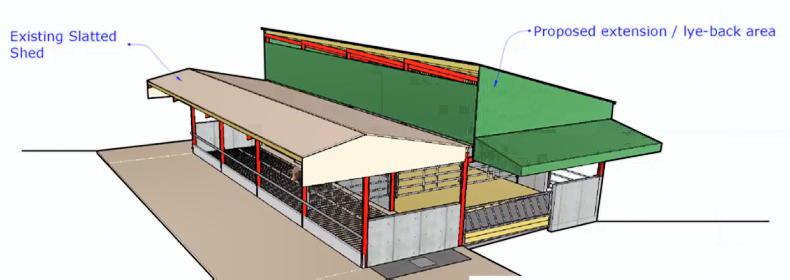
The proposed new lie-back area will cost just shy of €41,000 excluding VAT and without any grant aid taken into account. \ Teagasc
“Your 8inx4in girder is permissible to a span of 7.8m, so you are getting the best value for money here with a depth of 7.5m,” Kelleher explained.
Boarding
With the air inlet from the old slatted shed removed, Kelleher advised to create a new inlet by installing space boarding to the rear of the new dry shed, with an outlet at the ridge.
A one in 15 fall from the back wall to the slatted area would be required, as per Department guidelines, with Kelleher also noting that some farmers have opted in the past to sink the floor level of the dry area 300mm below the top of the slats to allow bedding to build up without it getting on to slats, although the top 300mm of the tank capacity would be lost due to the inlet pipes running from the dry area running this height below the tank wall.
Cost
To create this new dry bedded shed would cost €40,910 excluding VAT.
Minister for Agriculture Charlie McConalogue has confirmed that organic farmers will be able to avail of a 60% grant rate in the new On-Farm Capital Investment Scheme (OFCIS).
However, reference costs in the now-finished TAMS had lagged considerably behind the actual costs, with the above shed having a reference cost of €21,680.
At a 60% grant rate, €13,008 would be recouped by the farmer, leaving a net cost of €27,224.
In the Halpin’s case, the farm is set to receive circa €20,000 per annum from the organic scheme, which will greatly help in repayments on the build.
The new dry bedded area more than satisfies the minimum 50% bedded area that is a stipulation in the organic scheme.
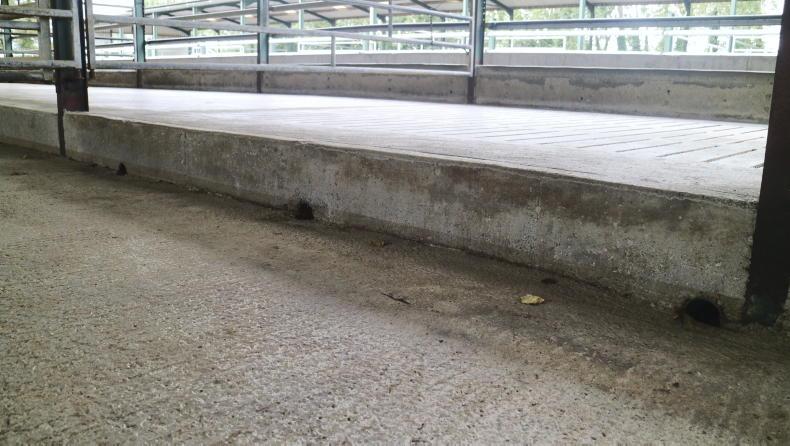
Sinking the bedded floor below the slatted area will allow for bedding to build up without getting onto the slats, although tank capacity is lost.
When talking about minimum area per livestock unit, the total floor area, including any slatted areas, are taken into account. Kelleher explained that the ‘4-5-6’ rule was a good rule of thumb regarding space requirements.
Weanlings up to 350kg require 4m², while cattle over 350kg require 5m² or a minimum 1m² per 100kg liveweight, with suckler or dairy cows requiring 6m² minimum.
The combined slatted and dry shed created above would be able to accommodate approximately 33 weanlings, 44 finished cattle or 37 suckler cows.
Utilising what’s already there
Kelleher encouraged farmers to explore the options available to them inside the farm gate.
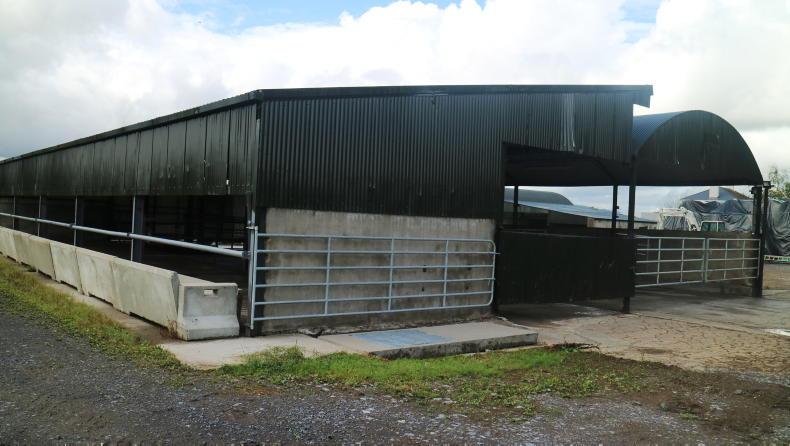
He highlighted how dry sheds away from slatted accommodation could be utilised "provided cattle has free access" and that soiled water from passages between sheds was collected.
While bedding slats or covering with a slotted or solid mat is not permissible, farmers can opt to remove slats and replace with solid slabs, which is expected to be grant aided at the 60% rate.
Kelleher also noted that some farmers had opted to use central feed passages as lie-back areas, removing the outer walls of the shed and replacing these with barriers for feeding.
At the first of its 2023 ‘Let’s Talk Organic’ webinars, Teagasc organic specialist Joe Kelleher outlined the costs that may face some farmers should they be required to build additional dry bedded accommodation, while also highlighting the options that farmers may have existing on farm.
The webinar spoke about Tadhg and Claire Halpin, new entrants to the organic farming scheme (OFS), and the accommodation they had on farm.
One of the sheds consisted of a four-bay lean-to type slatted shed, which the pair have decided to add a new dry-bedded shed to the rear to function as a lie-back area, with the existing slatted shed to be used for feeding.
Kelleher then detailed a proposed design for the new shed, which consisted of grafting on to the existing RSJs to the rear of the slatted shed, running an 8inx4in RSJ on the roof to give a shed depth of 7.5m, which would be bolted on to a new line of upright RSJs.
The proposed new lie-back area will cost just shy of €41,000 excluding VAT and without any grant aid taken into account. \ Teagasc
“Your 8inx4in girder is permissible to a span of 7.8m, so you are getting the best value for money here with a depth of 7.5m,” Kelleher explained.
Boarding
With the air inlet from the old slatted shed removed, Kelleher advised to create a new inlet by installing space boarding to the rear of the new dry shed, with an outlet at the ridge.
A one in 15 fall from the back wall to the slatted area would be required, as per Department guidelines, with Kelleher also noting that some farmers have opted in the past to sink the floor level of the dry area 300mm below the top of the slats to allow bedding to build up without it getting on to slats, although the top 300mm of the tank capacity would be lost due to the inlet pipes running from the dry area running this height below the tank wall.
Cost
To create this new dry bedded shed would cost €40,910 excluding VAT.
Minister for Agriculture Charlie McConalogue has confirmed that organic farmers will be able to avail of a 60% grant rate in the new On-Farm Capital Investment Scheme (OFCIS).
However, reference costs in the now-finished TAMS had lagged considerably behind the actual costs, with the above shed having a reference cost of €21,680.
At a 60% grant rate, €13,008 would be recouped by the farmer, leaving a net cost of €27,224.
In the Halpin’s case, the farm is set to receive circa €20,000 per annum from the organic scheme, which will greatly help in repayments on the build.
The new dry bedded area more than satisfies the minimum 50% bedded area that is a stipulation in the organic scheme.
Sinking the bedded floor below the slatted area will allow for bedding to build up without getting onto the slats, although tank capacity is lost.
When talking about minimum area per livestock unit, the total floor area, including any slatted areas, are taken into account. Kelleher explained that the ‘4-5-6’ rule was a good rule of thumb regarding space requirements.
Weanlings up to 350kg require 4m², while cattle over 350kg require 5m² or a minimum 1m² per 100kg liveweight, with suckler or dairy cows requiring 6m² minimum.
The combined slatted and dry shed created above would be able to accommodate approximately 33 weanlings, 44 finished cattle or 37 suckler cows.
Utilising what’s already there
Kelleher encouraged farmers to explore the options available to them inside the farm gate.
He highlighted how dry sheds away from slatted accommodation could be utilised "provided cattle has free access" and that soiled water from passages between sheds was collected.
While bedding slats or covering with a slotted or solid mat is not permissible, farmers can opt to remove slats and replace with solid slabs, which is expected to be grant aided at the 60% rate.
Kelleher also noted that some farmers had opted to use central feed passages as lie-back areas, removing the outer walls of the shed and replacing these with barriers for feeding.







SHARING OPTIONS