


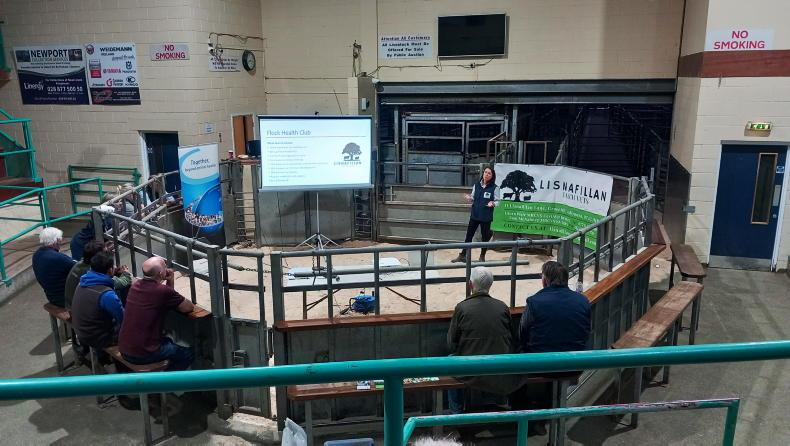
The body condition of ewes during the summer is a major factor that will influence fertility at tupping in autumn, a local vet has said.
Speaking at an event in Ballymena Mart on Monday, Christa McMordie from Lisnafillan Farm Vets urged farmers to regularly assess the body condition of ewes throughout the summer.
“If ewes are below target, it will take time to build up condition. It takes 10-12 weeks of grazing grass at 6-8cm high to gain a body condition score. That is equivalent to 10% of total body weight,” she said.
Farmers were told that the condition of ewes after weaning will affect both the quality and quantity of eggs that are released at tupping time.
McMordie said flushing ewes, by offering good-quality grass three to four weeks before tupping, can also help boost egg production.
However, flushing is unlikely to be beneficial if ewes are already overfat and, with overly thin ewes, it can potentially work too well if ewes end up carrying more lambs than they are able to rear.
After breeding, body condition should be maintained for 90 days and handling of ewes should be kept to a minimum for at least the first month of pregnancy, when embryos are being implanted.
Aside from nutrition, other factors that influence fertility include trace elements and the overall health status of ewes, particularly the presence of parasites.
McMordie advised farmers to get blood samples analysed to assess the trace element status of ewes in the run up to breeding.
“A lot of people are spending a fortune on doses and boluses that they don’t need, and they are maybe missing out on something else that they should be giving,” she maintained.
Worms and lameness
Lisa Weir from Lisnafillan recommended using faecal eggs counts to see if ewes need a worm drench before breeding and suggested it is likely that only thinner ewes will require treatment.
She pointed out that fluke is different to roundworms, as the presence of any fluke in ewes warrants a treatment.
Another health issue that can have a big impact on fertility is lameness, with Weir describing it as “one of the biggest financial drains on sheep farms”.
She urged farmers to treat lame ewes as quickly as possible, and recommends vaccinating all ewes with Footvax as a preventative measure.
The Ballymena-based vet said persistently lame ewes should be culled before breeding.
“You don’t need that hassle in your life,” Weir said.


SHARING OPTIONS