



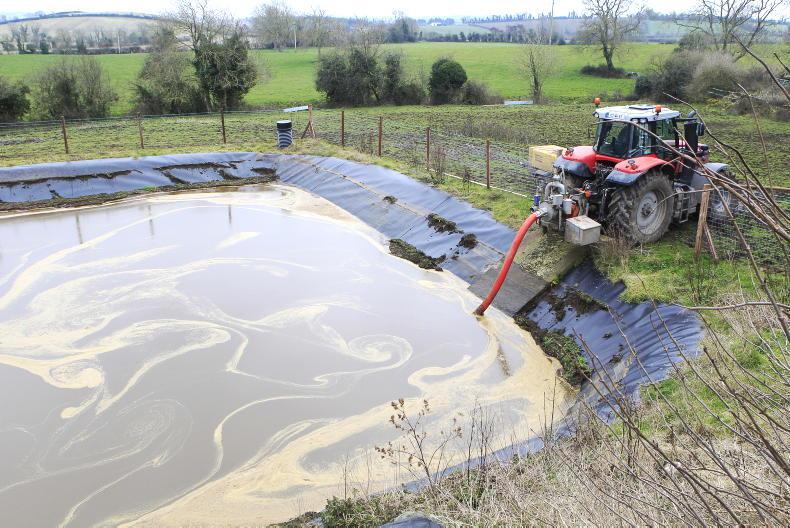
Recent studies by Teagasc and ifac have highlighted the slurry storage deficit that exists on many dairy farms. There is no doubt that when there is a capacity deficit in the storage of slurry, the available slurry may not be utilised in the most economic fashion. It also increases the risk of harmful nutrients entering waterways. Farmers with deficient storage capacity will be under enormous pressure to simply dispose of valuable slurry. This pressure will increase the likelihood of nutrient loss to water, resulting in deteriorating water quality.
The announcement of the new TAMS Nutrient Importation Storage Scheme is thus most welcome in the endeavour to ensure a continuation of the nitrates derogation. As Teagasc’s Pat Dillon, among others, has remarked, additional storage capacity enhances the potential replacement value of key nutrients and, at the same time, helps to reduce the nitrogen surplus on farms by reducing the use of chemical nitrogen.
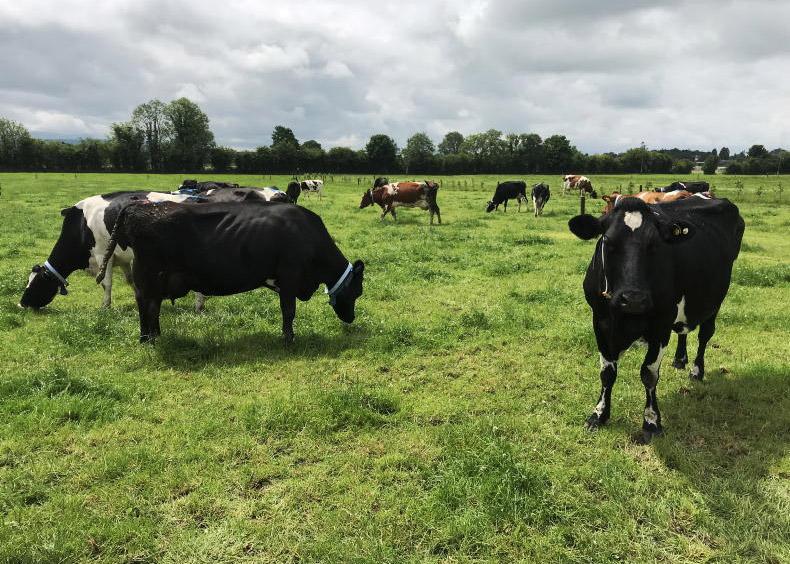
The emergence of a growing deficit in slurry storage on dairy farms is a consequence of greater production of manure by dairy cows. While this tendency implies an associated increase in the nutrient quantities contained in manure, it also implies that the quantity of methane generated from enteric fermentation and manure storage could increase.
Whether this will result in a calculated increase in methane will depend on if the so-called methane emission coefficients, determined for both factors in the National Inventory of Greenhouse Gases (GHG), will be revised upwards.
Teagasc has produced projections of the methane emission coefficients for enteric fermentation and manure management for dairy cows out to 2030. In 2025, the coefficients are estimated to be 126.4 and 18.4 respectively.
Teagasc projects an annual average increase in enteric fermentation, out to 2030, of 0.65% and 1.26% for manure management.
These trends are driven inter alia by the increased trend output of manure produced by cows on foot of higher milk yield and other factors. But any increase in slurry storage capacity runs the risk, in the absence of mitigation measures, of exacerbating the projected trend increase in the coefficient for manure management.
There are two potential sources that could increase methane emissions on foot of an expansion in the on-farm storage of slurry. Instead of farmers heretofore applying the surplus slurry to land, it will now be stored in pits thus leading to increased emissions.
But once slurry is stored, unless it is used quickly, either in land spreading or in anaerobic digestion (AD) units, in a short period of time methane emissions will arise in the absence of any mitigation measures.
This tendency will be exacerbated if the slurry is stored for longer periods when the ambient and manure temperatures are higher than during the winter months. This increase, according to the international evidence, can occur over very short time periods.
Any potential increase in methane needs to be incorporated into the National Inventory of Greenhouse Gases before this potential is recorded in the official national emissions statistics. It’s a source of annoyance to many farmers that potential sources of carbon sequestration, for example, are not recorded in the national inventory.
But the converse is also true, insofar as not all potential increases in GHGs are recorded in the national inventory and it is known that some of the sources that are recorded are not accurate. There can of course be both overestimation and underestimation.
This is because emissions are largely calculated based on the product of emissions factors and activity levels (livestock numbers, fertiliser use, etc) following the IPCC guidelines and are thus not directly measured.
Research
Teagasc research on the emissions factors for CAN and protected urea fertilisers found that the emissions factor for protected urea was 0.45 versus 1.5 for CAN which had been the default value in the national inventory prior to this research. This research resulted in a revision of the inventory for emissions associated with the use of chemical nitrogen on farms.
The calculation of the emissions factor for manure management will require further research to improve its accuracy under Irish conditions.
Recent work for the UK, which measured methane emissions from slurry storage on two dairy farms in Cornwall, has suggested that emissions calculations from manure storage, using the conventional IPCC estimation protocols, may be substantially under-estimating emissions, by a factor close to three times. To the extent that methane from manure management may be understated at present, or, if the increase in slurry storage capacity were to lead to an increase in methane emissions, there is a strong case for the deployment of proven slurry storage mitigation measures for manure management.
In a period when many dairy farmers will be increasing their storage capacity, it would be an opportune time for them to also consider investment in methane mitigation. Several mitigation options could be considered, including, aeration, acidification and the slurry additive GasAbate produced by a team at the University of Galway.




SHARING OPTIONS