



Ireland and the EU must make farming more attractive by recognising the emotional, cultural, and identity aspects of working on the land – not just economic incentives.
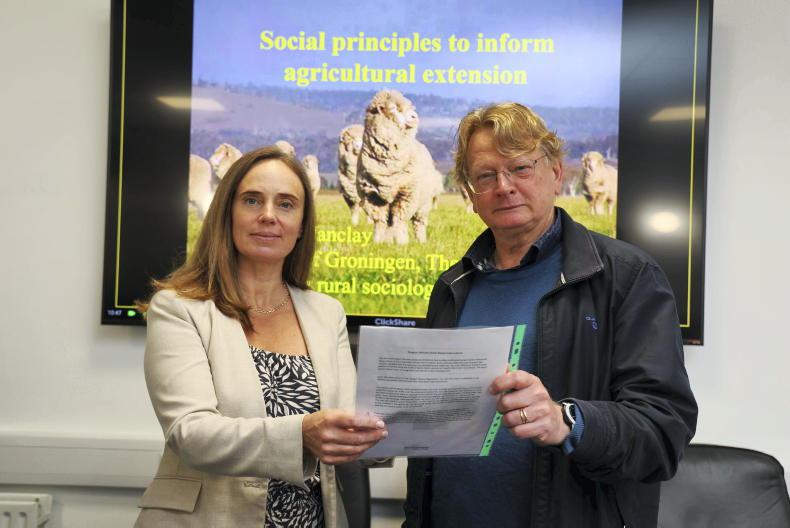
This was the take-home message for Teagasc sociologist Áine Macken-Walsh following a Teagasc seminar in Athenry which was addressed by Professor Frank Vanclay of Groningen University in the Netherlands.
Australian-born Vanclay told the seminar that sustainability for many farmers “means staying on the farm” and the “desire to hand the farm to one’s children.” Emotional ties and identity are crucial for farmers, Vanclay maintained, and he contended that policy should therefore address the meaning of farming, not just income or land access.
The views expressed on succession by Vanclay were broadly similar to those contained in a recent European Commission communication on the future of CAP which highlighted concerns regarding ageing farmers and youth disengagement, Macken-Walsh said.
In terms of generational renewal, the EU communication called for a “whole-of-society approach” and a policy mix across different areas and responsibilities, many of which lie within national and regional competences.
Interestingly, the communication noted that member states “have potential to develop strong levers in their national toolbox that could facilitate generational renewal, including through retirement schemes and tax incentives”.
However, Macken-Walsh questioned the effectiveness of retirement schemes, pointing out that family farming involves and relies on youth, older farmers, farm women and whole families.
Whole-family approach
“Policies that focus on getting old farmers ‘out’ and young farmers ‘in’ often do not sit well with families as these policies do not reflect the whole-family, collaborative approach that farming relies on,” she explained.
“Farming is a continuous process from generation to generation that involves the work, commitment and dedication of farmers of all ages and genders – owners and non-owners,” Macken-Walsh added.
“Greater recognition of these people could leverage greater knowledge, innovation and diversity for agriculture, positively benefiting the sector, and its future attractiveness to more people,” she maintained.
“Rather than tax incentives targeting the transaction of farm transfer alone, a wider focus on what makes farming attractive for all in the here and now is needed,” the Teagasc sociologist pointed out.
“Younger farmers see their mothers’ and fathers’ day-to-day lives in farming – that largely shapes their view on how attractive farming is as a life choice for them, not just the financial aspects of legally transferring the farm,” she claimed.
Macken-Walsh welcomed the shift in thinking on CAP which the Commission’s recent communication indicated, and that this changed positioning appeared to mirror many of the views expressed by Vanclay.
“The European Commission’s Vision for the EU’s agri-food system in 2040 and Frank Vanclay’s 2004 paper Social Principles for Agricultural Extension are from very different contexts — one a high-level policy vision for the future of European agriculture, the other a sociological treatise on extension in Australia,” Macken-Walsh explained.
“Yet, there are significant synergies and cross-overs between the two documents, especially in how Vanclay’s insights could operationalise the aspirations of the EU’s ‘vision’ document,” she added.
Macken-Walsh noted that addressing structural barriers was also a critically important consideration in both Vanclay’s presentation and the EU communication.
“Structural interventions – such as land access, affordable capital, tailored support for different farming styles – are essential. Support should be differentiated according to styles of farming, rather than one-size-fits-all solutions,” Vanclay claimed.
The Commission, in co-operation with member states, is to bring forward a generational renewal strategy this year. This strategy will provide recommendations for the policy response and measures needed at the EU, national and regional levels.




SHARING OPTIONS