



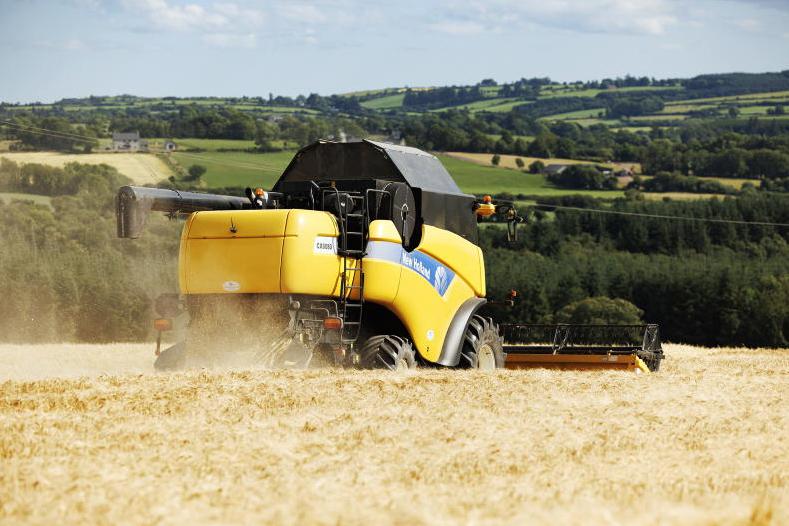

Harvest is well underway across the country and while farmers’ main focus at present is to get crops cut, they are also looking at grain prices on offer with disappointment.
Winter barley has performed well, but hasn’t broken any records. Winter wheat looks to have good potential, but again there is unlikely to be any record-breaking crops. Oats are consistent and offer some high-value markets.
Spring crops are a different story however. Spring barley is our biggest crop at 115,300 hectares and most of these crops are looking average at best, with many poor crops out there. While there are good crops out there, there are also a lot of poor crops and very few great crops.
Analysis
The Irish Farmers Journal carried out analysis to see where crop profits may land this year. We used a number of possible grain prices based on what is being offered at present and where price could go, up or down. We also used the 10-year average yield of these crops from the CSO (Table 5), the reported average winter barley yield and Teagasc’s estimated total variable costs for 2025 (Table 6).
From this data, we calculated possible profits from the three main crops being grown in Ireland winter and spring barley and winter wheat, all of which were priced as feed grains, their main market. The figures are based on grain income, so straw would be another income from the crop, added in afterwards. To be clear, we do not know where harvest prices will land. These figures are only to give an indication. Each farmer will also have different costs and payments which they need to take account of themselves.
Winter barley
Winter barley has generally yielded well, but has not been outstanding. Across the country the average yield is probably around 9.14t/ha (3.7t/ac) and there is a wide range in yield from under 2t/ac to over 4t/ac.
Using Teagasc’s variable costs of €1,648/ha and taking the average yield at 9.14t/ha (3.7t/ac) as reported by agronomists you can see how profits look at the different prices.
If we take a price of €195/t, this is the current base price of €185/t plus a €10/t spending bonus, then farmers are set to make a profit of €134.30/ha (€54/ac) on the grain from their winter barley.
If a farmer does not get that €10/t co-op bonus then the profit goes down to €42.90/ha (€17/ac).
Winter wheat
Using the 10-year average winter wheat yield at the current price you would have an average 10-year yield of 9.9t/ha (4t/ac). This figure is not too far off what agronomists are predicting from crops in 2025.
At the current base price for winter wheat of €195/t plus a €10/t co-op bonus, farmers would be set to make €298.50/ha (€121/ac) on their winter feed wheat grain. If a merchant does not meet that co-op bonus then a farmer would make €199.50/ha (€81/ac).
Spring barley
The 10-year average yield for spring barley is 7.3t/ha (3t/ac). However, this looks like the maximum yield predicted at present with many crops predicted to yield around the 6t/ha mark (2.5t/ac).
The profit at the 10-year average yield at €195/t would be €86.50/ha (€35/ac), while the profit at €185/t would be just €13.50/ha.
In reality, though, there are a lot of 6t/ha (2.5t/ac) crops or less out there. With Teagasc costs at €1,337/ha and income at €1,110/ha and a price of €185/t, the grower is down €227/ha. This would mean there would be no profit. The crop would have performed at a loss.
There is no indication of what Boortmalt intends to pay for malting barley at present and some growers are looking at contracts of 2t/ac, so the advantage of malting barley this year is small for those growers. Tirlán and Dairygold suppliers have not seen any hit to their contracts this season, which is good for their incomes.
Straw
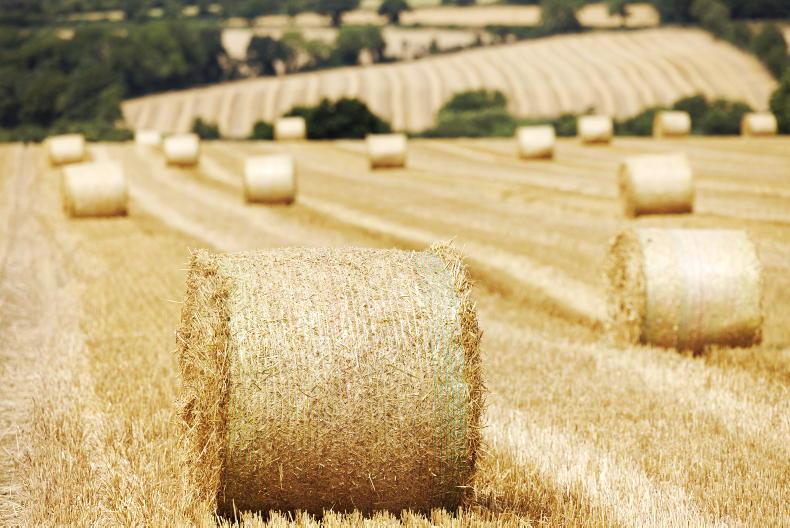
Straw in most cases is the farmer’s profit. Farmers can receive €250/ha from the Straw Incorporation Measure and so if they are not getting paid this amount from bales, after costs are taken out, then they should really be chopping their straw and ensuring that they get that €250/ha payment as income.
Land rental
It should be noted that these figures are all before land rental, so farmers renting land need to take this off the figures.
This probably means that all profit is gone once land rental is taken into consideration, even at the lower end of the payment scale, for all three crops.
Support
While other sectors have been in trouble payments have been provided.
The Government is now looking at a sector in trouble and a target to increase tillage area.
So far the Government has failed to meet its target to increase tillage area to 360,000ha by 2025, not to mind the target to reach 400,000ha by 2030.
The 2025 tillage area is at approximately 344,000ha.
The Minister for Agriculture Martin Heydon has said that he will not be able to outline what support tillage will get until after the budget.
The Government formed Food Vision Tillage group’s report outlines a need for a tillage expansion and sustainability scheme and immediate tillage supports.
However, more land will be lost if details of a support payment and a tillage expansion scheme are not announced in the coming weeks.
Cover crops are being planted. Oilseed rape will be planted in August and winter cereals will be planted from mid-September on. An announcement is needed soon to reduce the risk of another drop and to take stress off farmers.
The outlook for grain incomes this season is bleak. Our biggest crop, spring barley, looks like it will do well to break-even on many farms. The tillage sector is in serious trouble and yet the silence is deafening.
Does Government realise that its target to increase tillage area to 400,000ha is now embarrassing?
It can’t continue to call it a target if they choose to ignore it. A target is something you work towards. The Minister for Agriculture, Martin Heydon, recently told the Irish Farmers Journal that the media catastrophise the figures in relation to tillage area. In reality, people are leaving tillage.
They’re renting out their farms, exiting farming or moving to part-time farming. There are many stories behind the numbers. Table 4 shows grain prices for the past 10 years and Table 6 shows shows variable costs and how they have increased.
The figures laid out in this article describe numerous scenarios in relation to yield and price. In reality, some of the prices may be a bit optimistic given the current state of markets, but we are not going to be accused of low-balling Irish grain either. It should also be said that we never know what will happen in markets and prices could increase.
The figures for spring barley are stark and if farmers are down €227/ha on spring barley crops then there will be little to entice them to grow more.
Meanwhile, feed mills have bought up product until next spring. Irish grain, produced to high standards and without some of the chemicals or technologies used on the imported grain, is a secondary product. I heard a recent quote from a farmer on grain: “It’s like the wool, nobody wants it.”


SHARING OPTIONS