



What is appropriate assessment? Appropriate assessment (AA) is a form of environmental assessment required under the habitats directive in respect of any plan or project (possibly a farm or a group of farms) which may have any implications on European sites.
European sites comprise of special areas of conservation (SACs) and special protection areas (SPAs).
In summary, there is a requirement that every plan, project (eg a farm or derogation farms in a sub-catchment) must undergo an assessment of its implications for any European site before consent for the project (continue with derogation farms in a sub-catchment) is given.
Consent for the plan or project can only be given after determining that it will not adversely affect the integrity of the SACs or the SPAs in view of the conservation objectives of that site.
It is unclear at what level AA will be required but the Minister has suggested to us that water catchments and sub-catchments will be subject to AA, not individual farms.
Screening for assessment
In order to determine if the assessment is required, a screening process must be carried out for all applications – called Stage one screening (Stage one AA).
Stage one AA
The key question at this stage is to identify the plan or project (possibly farms in derogation within a particular catchment or sub catchment area) which is to be assessed and whether that plan or project (farms in derogation) is likely to have a significant effect, either individually or in combination with other plans on European sites (SPA’s, SAC’s) in view of objectives.
If the answer is no, the decision is recorded and no further steps are taken. If the answer is yes, then a full assessment (Stage two AA) is required.
Stage two AA
We have to assume that in this context, all sub-catchments will move to Stage 2 AA because the trigger for screening is low. The ‘possibility’ or chance that farms or a combination of farms could have an impact is enough.
If Stage two AA is triggered, then it is necessary to prepare a Natura Impact Statement (NIS). Mitigation measures taken on farm to try and reduce nutrients entering water may be taken into account (eg slurry storage, etc). An AA conclusion statement is created.
This statement will include detail of mechanisms through which measures can be secured, implemented and monitored. If it is considered that residual effects remain, then the plan might have to go to Stage three AA, a process called Alternative Solutions.
Stage three AA
Alternative solutions; this plan would assess alternative ways the plan could proceed without adverse impact on the European site in question.
Each alternative solution must be assessed as a detailed proposal.
Criteria such as economic criteria cannot be seen as overruling ecological criteria.
Stage four AA
No alternative solutions; If no alternative solutions are possible or alternatives are worse for the environment, then the plan can be considered to be necessary for the imperative reasons of overriding public interest (IROPI).
Economic reasons (eg these farms will lose money unless they have derogation) won’t be enough here. It would seem logical that the impact of all farms in the sub-catchment could be considered as part of Stage two AA.
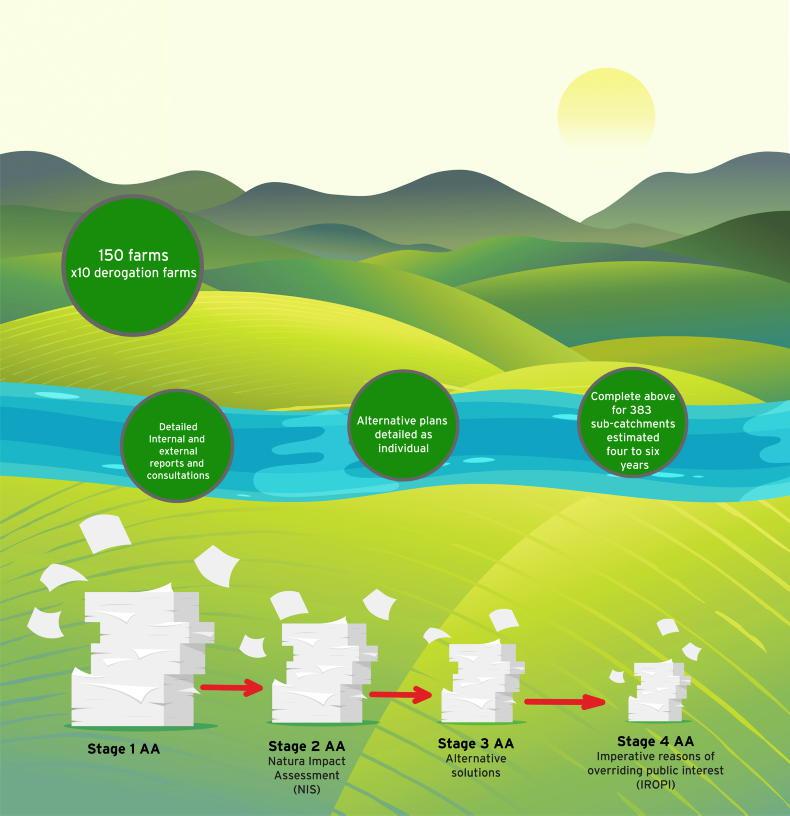
For example, if there are 50 farms in a sub-catchment and 10 are in derogation, the consultant completing the Stage two AA cannot ignore the impact the 40 farms not in derogation could have. Evidence is required at each stage.
These plans are open to challenge as all must be recorded with a high level of evidence.
Note:
This article is an interpretation of a note on Appropriate Assessment prepared by Tom Flynn Senior Counsel, who represented IFA in the High Court Challenge taken by An Taisce against the Nitrates Action Plan including the derogation. It is prepared as an explanation of what an Appropriate Assessment might look like in the absence of details which are not available at this moment from the Department. However, the Minister has provided some context to try and explain what he hopes will happen and that is included in this article.






SHARING OPTIONS