Farm income – or more accurately the lack of it – is well recognised as one of the biggest barriers to farm succession in Ireland.
A well-planned and well-executed succession plan would see a gradual transfer of management control and farm assets from one generation to the next over a period of years.
In reality, it is mainly only dairy farms that can generate enough income for two families, the parents approaching retirement, and the successor, often with their own young family to support.
While drystock farms are experiencing a welcome bump in income in 2025, this is an outlier year. They more typically rely heavily on CAP payments to sustain them, and many drystock farms are also supplemented by an off-farm income.
But farm income is a much longer-term concern for older farmers. Numerous studies have shown that fears about income post-retirement are a major reason why older farmers delay transferring the farm.
Many farmers fail to qualify for a State pension and therefore are forced, economically, to continue to farm past their non-farming peers’ retirement age.
Research by Maynooth University and Teagasc found that Ireland’s PRSI system means many farmers are unlikely to have the necessary contributions to qualify for the full State pension (contributory) unless they have worked outside of the farm for a considerable period.
They also found that farmers’ spouses and partners may be similarly affected.
On top of that, means testing for the non-contributory State pension pose major problems for farmers, researchers Michael Hayden, Bridget McNally and Anne Kinsella highlighted.
Means-testing rules for the non-contributory State pension result in low-income farmers with even a small holding of land can fail to qualify, leaving them faced with working long into their retirement years, becoming dependent on family members in their old age, or forced to sell land to provide an income.
And private pensions are few and far between in the farming community.
Ifac’s Irish Farm Report 2025 found that 22% of over 1,000 Irish farmers it surveyed had no private pension in place, with 39% of tillage farmers being without a private pension.
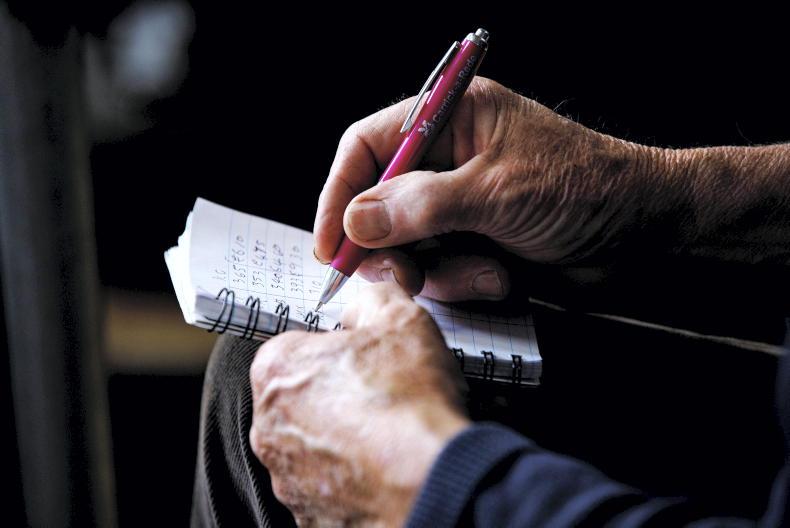
A buyers taking notes at Kilmallock Mart. \ Donal O'Leary
The accountancy firm warned that for many farmers, pensions are seen primarily as a way to reduce tax bills rather than as a safeguard for their future.
“This short-term view often comes at the expense of long-term security,” its head of financial planning Martin Glennon wrote in the report.
“The reality is that pensions should be more than just a tax tool, they are a foundation of financial independence. When used correctly, they can protect a farmer’s lifestyle in retirement and give them the breathing space to make better decisions about their land and legacy.”
Of the 1,035 farmers surveyed, 22% said they had no private pension in place, 12% said they were unsure whether their pension would provide them with an adequate income in retirement and 22% said they were not confident it would.
Only 34% of farmers surveyed were somewhat confident they would have enough pension income, and just one in 10 were fully confident that their pension income would be sufficient.
So what’s the solution to the pension problem?
The Maynooth and Teagasc researchers warned that the lack of pension access by farmers “has the potential to threaten the sustainability of farming in Ireland and further compounds the problems surrounding generational renewal”.
They advised that Ireland’s pension system must change to allow farmers to pay for the security of a contributory State pension.
This, they said, would make farm transfer decisions less financially pressurised and less driven by fear of income vulnerability in old age.
It was also suggested that the Government could provide a supplementary payment to farmers who are eligible for a State pension, in return for committing to transferring the farm. This would give farmers some certainty about their income after transferring the farm. It was suggested that the proposed State pension top-up would be only paid to farmers who did not have a private pension, as a way of targeting the support to lower-income farmers.
Farm income – or more accurately the lack of it – is well recognised as one of the biggest barriers to farm succession in Ireland.
A well-planned and well-executed succession plan would see a gradual transfer of management control and farm assets from one generation to the next over a period of years.
In reality, it is mainly only dairy farms that can generate enough income for two families, the parents approaching retirement, and the successor, often with their own young family to support.
While drystock farms are experiencing a welcome bump in income in 2025, this is an outlier year. They more typically rely heavily on CAP payments to sustain them, and many drystock farms are also supplemented by an off-farm income.
But farm income is a much longer-term concern for older farmers. Numerous studies have shown that fears about income post-retirement are a major reason why older farmers delay transferring the farm.
Many farmers fail to qualify for a State pension and therefore are forced, economically, to continue to farm past their non-farming peers’ retirement age.
Research by Maynooth University and Teagasc found that Ireland’s PRSI system means many farmers are unlikely to have the necessary contributions to qualify for the full State pension (contributory) unless they have worked outside of the farm for a considerable period.
They also found that farmers’ spouses and partners may be similarly affected.
On top of that, means testing for the non-contributory State pension pose major problems for farmers, researchers Michael Hayden, Bridget McNally and Anne Kinsella highlighted.
Means-testing rules for the non-contributory State pension result in low-income farmers with even a small holding of land can fail to qualify, leaving them faced with working long into their retirement years, becoming dependent on family members in their old age, or forced to sell land to provide an income.
And private pensions are few and far between in the farming community.
Ifac’s Irish Farm Report 2025 found that 22% of over 1,000 Irish farmers it surveyed had no private pension in place, with 39% of tillage farmers being without a private pension.

A buyers taking notes at Kilmallock Mart. \ Donal O'Leary
The accountancy firm warned that for many farmers, pensions are seen primarily as a way to reduce tax bills rather than as a safeguard for their future.
“This short-term view often comes at the expense of long-term security,” its head of financial planning Martin Glennon wrote in the report.
“The reality is that pensions should be more than just a tax tool, they are a foundation of financial independence. When used correctly, they can protect a farmer’s lifestyle in retirement and give them the breathing space to make better decisions about their land and legacy.”
Of the 1,035 farmers surveyed, 22% said they had no private pension in place, 12% said they were unsure whether their pension would provide them with an adequate income in retirement and 22% said they were not confident it would.
Only 34% of farmers surveyed were somewhat confident they would have enough pension income, and just one in 10 were fully confident that their pension income would be sufficient.
So what’s the solution to the pension problem?
The Maynooth and Teagasc researchers warned that the lack of pension access by farmers “has the potential to threaten the sustainability of farming in Ireland and further compounds the problems surrounding generational renewal”.
They advised that Ireland’s pension system must change to allow farmers to pay for the security of a contributory State pension.
This, they said, would make farm transfer decisions less financially pressurised and less driven by fear of income vulnerability in old age.
It was also suggested that the Government could provide a supplementary payment to farmers who are eligible for a State pension, in return for committing to transferring the farm. This would give farmers some certainty about their income after transferring the farm. It was suggested that the proposed State pension top-up would be only paid to farmers who did not have a private pension, as a way of targeting the support to lower-income farmers.
SHARING OPTIONS