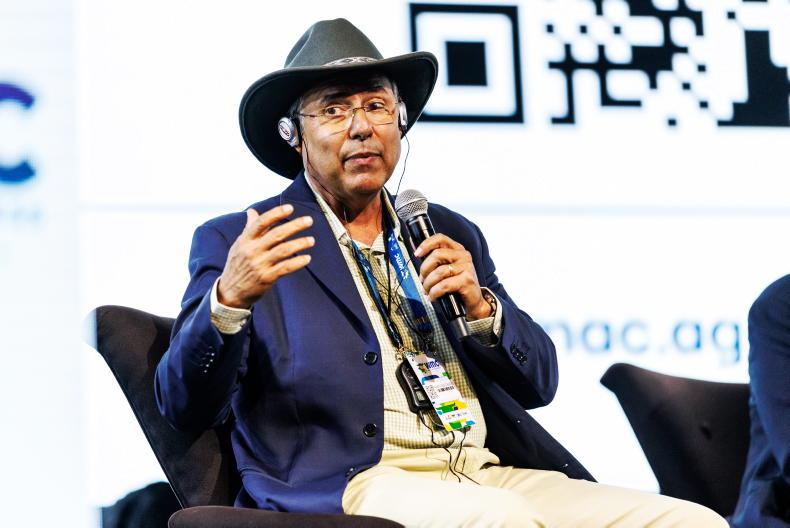
Francisco Castro, Brazilian Farmers Organisation, speaking on the Food Geopolitics panel at the World Meat Congress (WMC) taking place from 28 to 30 October in Cuiabá, Mato Grosso, Brazill. \ Philip Doyle
ADVERTISEMENT
One of the papers presented at the World Meat Congress looked at modelling the effects of growth hormone use on the environmental and economic sustainability of Brazilian beef production.
The background to the study was that Brazil’s beef systems account for 14.9% of global beef production; therefore, given climate change concerns, they see a need to reduce environmental impacts while maintaining economic viability. Thiago Bernardino de Carvalho compared the animal performance of groups of animals implanted with synthetic hormones versus groups with no hormones.
“Implants offer the opportunity for Brazilian beef producers to demonstrate their dedication to improving environmental and economic sustainability through improved productivity,” he said.
ADVERTISEMENT
The research showed that animals that were implanted with growth hormones had a reduction in finishing age of between two and six months, a reduction in emissions of 16%, an increase in carcase weight of between 6-9% along with an increase in profitability of between 18-34%.
The cost of the hormones ranged from $1.16/head (€1/head) for young calves to $2.91/head (€2.50/head) for feedlot finishers.
Register for free to read this story and our free stories.
This content is available to digital subscribers and loyalty code users only. Sign in to your account, use the code or subscribe to get unlimited access.
The reader loyalty code gives you full access to the site from when you enter it until the following Wednesday at 9pm. Find your unique code on the back page of Irish Country Living every week.
CODE ACCEPTED
You have full access to the site until next Wednesday at 9pm.
CODE NOT VALID
Please try again or contact support.
One of the papers presented at the World Meat Congress looked at modelling the effects of growth hormone use on the environmental and economic sustainability of Brazilian beef production.
The background to the study was that Brazil’s beef systems account for 14.9% of global beef production; therefore, given climate change concerns, they see a need to reduce environmental impacts while maintaining economic viability. Thiago Bernardino de Carvalho compared the animal performance of groups of animals implanted with synthetic hormones versus groups with no hormones.
“Implants offer the opportunity for Brazilian beef producers to demonstrate their dedication to improving environmental and economic sustainability through improved productivity,” he said.
The research showed that animals that were implanted with growth hormones had a reduction in finishing age of between two and six months, a reduction in emissions of 16%, an increase in carcase weight of between 6-9% along with an increase in profitability of between 18-34%.
The cost of the hormones ranged from $1.16/head (€1/head) for young calves to $2.91/head (€2.50/head) for feedlot finishers.
If you would like to speak to a member of our team, please call us on 01-4199525.
Link sent to your email address
We have sent an email to your address. Please click on the link in this email to reset your password. If you can't find it in your inbox, please check your spam folder. If you can't find the email, please call us on 01-4199525.
ENTER YOUR LOYALTY CODE:
The reader loyalty code gives you full access to the site from when you enter it until the following Wednesday at 9pm. Find your unique code on the back page of Irish Country Living every week.
SHARING OPTIONS