



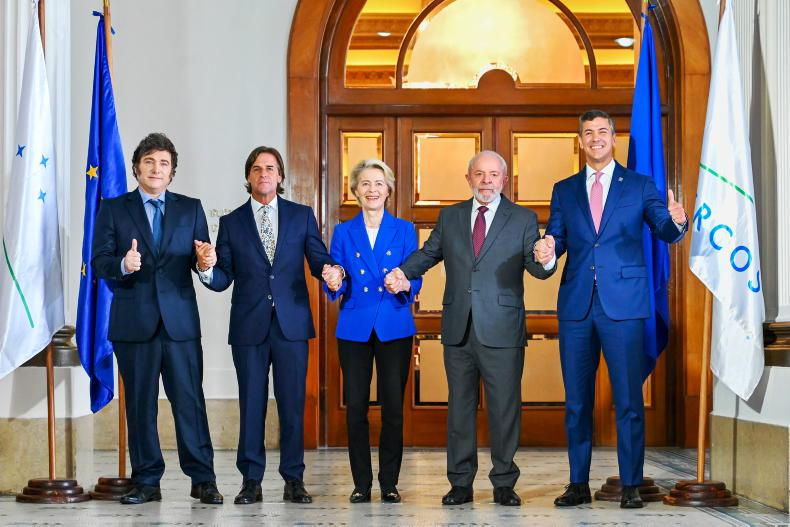
It is now expected that heads of state will be asked to vote on the Mercosur trade deal at the European Council meeting on 18/19 December in Copenhagen under the Danish Presidency.
If a qualified majority in favour is secured, European Commission President Ursula von der Leyen is likely to travel to a meeting of the Mercosur countries the following day to sign the deal. The final decision on the deal will rest with the European Parliament who are expected to vote on it sometime in the first half of 2026.
While there is vocal opposition from several MEPs, it is still thought that there will be a comfortable majority in Parliament for the deal.
Protests
Copa-Cogeca, the umbrella body for EU farm organisations and cooperatives in the EU, are holding a briefing on the implications of Mercosur for a number of sectors of agriculture on Thursday 13 November in Brussels.
The ICSA will protest outside the Dail on the same day. A spokesperson for the Dept of Foreign Affairs told the Irish Farmers Journal: “The Government is carefully assessing the EU-Mercosur package in its entirety to understand if our concerns with the agreement have been adequately addressed.”
France wavering
With it looking increasingly likely that the EU heads of state will ratify the deal when they meet in Copenhagen next week, France, which had been considered the leader of opposition to the deal, appears like it is coming on board.
President Macron seemed to indicate as much when he spoke during his attendance at the COP30 leaders gathering last week in Brazil. He appeared to suggest the safeguard clauses would be adequate instead of the mirror clauses they had previously insisted on.
This has caused consternation in France where acting agriculture Minister, Annie Gene has attempted to qualify the president’s remarks.
On X, formerly Twitter, she gave an update on what she described as “France’s red lines” saying that “even if there has been some progress, it’s not enough”.
The president of FNSEA, the main French farmers organisation, was scathing in his criticism of President Macron.
He said: “By choosing this moment and this place to extend a hand to Mercosur, the President of the Republic is signalling his break with French agriculture. We will not allow our model, our jobs, or our sovereignty to be sold off.”
Momentum building
Despite farmer protests, the momentum seems to be with getting approval for the Mercosur deal. Italy is now thought to be willing to give its support while Poland, which was strongly opposed because of the 180,000 tonne poultry meat quota, has been having second thoughts.
The recent intrusion by drones into its airspace has had the effect of nudging them towards support for the deal to demonstrate solidarity with the wider EU. As for France, the absence of a government means that the thoughts of the acting agriculture minister are very much secondary to those of the president. If he follows through in line with his remarks in Brazil last week, then they too could support the deal despite the protests of French farmers.
If all the other member states are aligned in support for the deal, the Irish position doesn’t matter as to form a blocking minority a minimum of four member states representing 35% of the EU population is required.
That leaves the European Parliament as the last chance for blocking the deal. The feeling is that despite vocal opposition from several MEPs, the simple majority required is likely to be achieved when it comes to the vote. If the heads of state vote for the deal, we can expect MEPs from the same political parties to have the party whip applied.



SHARING OPTIONS