



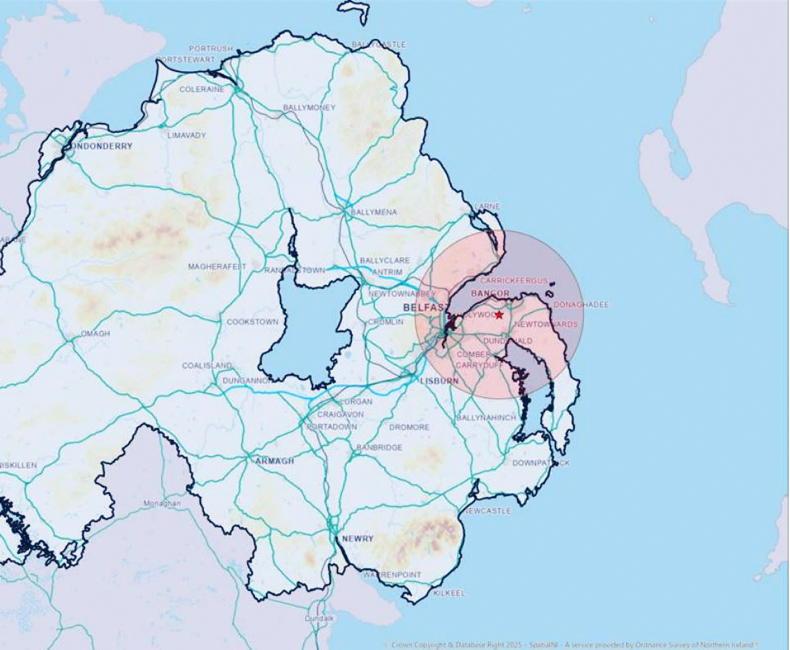
Department of Agriculture, Environment and Rural Affairs (DAERA) vets are investigating a suspected case of bluetongue virus (BTV) at a holding near Bangor, Co Down.
Two cows at the farm have been tested and DAERA has said the results indicate they are positive for the disease.
While the virus does not have any effect on people or food safety, it can have a devastating impact on animals infected and trade.
Following disease protocols, the animals on the premises will be humanely put down, while a 20km temporary control zone (TCZ) has been introduced effective from 9pm on Saturday 29 November.
This will place a ban on movement of all susceptible species (cattle, sheep, goats, deer and llamas/alpacas) on or off premises within the TCZ , while officials carry out further investigations.
Moves direct to slaughter are permitted under a general licence available on the DAERA website.

DAERA minister Andrew Muir said while the suspect cases are of great concern, it is essential all producers impacted by the control measures play their part in limiting the potential for further spread of the disease.
Minister Muir said: "While there was always a potential for bluetongue to arrive here, given its prevalence in [Britain] and the EU, we must now do all we can to protect our livestock and limit the spread of the disease.
“That is why, as a result of the disease control framework for the virus we launched in June, DAERA has moved rapidly to ensure disease control measures are put in place. Members of the public should be reassured the virus does not have any impact on people or food safety.”
All necessary steps
He added: “My officials are taking all the necessary steps to protect the agri-food industry. I urge everyone in the industry to play their part as well and especially appeal to those in the temporary control zone to follow the restrictions.
"My department is working closely with all stakeholders, including colleagues in [Britain] and the Republic of Ireland, to monitor the situation.”
Unwelcome news
Minister for Agriculture Martin Heydon has described the news from Northern Ireland as unwelcome.
"My thoughts are first and foremost with the affected farm family and those farmers in the locality who will be worried about their own herds now," he said.
"This development has potentially serious implications. If the disease becomes established in one part of the island, it will be that much easier for it to spread, with consequences for animal health and welfare and financial and emotional stress for farmers.
"However, I must emphasise that bluetongue does not have any implications for human health or food safety.”
Minister Heydon continued: “I will be engaging closely with minister Muir on this and ensuring that we continue to take a collaborative and supportive approach, building on the very close relationships already in place on animal disease control north and south.”
Minister Heydon said that because bluetongue is spread by midges, disease spread is much less likely in the winter and early spring months.
"I am taking firm action now to carry out enhanced and targeted surveillance to find the disease, if it is here," he said.
The action will include:



SHARING OPTIONS