



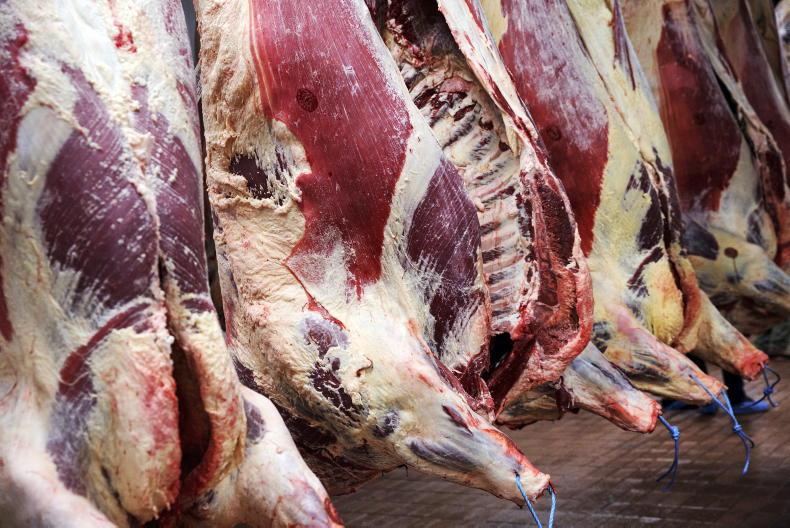
The national kill dropped a massive 213,057 head in 2025, one of the biggest reductions in the last number of decades.
All categories of stock saw a decline in numbers in 2025, with cows seeing the biggest drop, down 93,964 head on the previous 12 months.
Current forecasts for 2026 would point to a further reduction in the national kill for the next 12 months, but that will be a lot lower.
Indications suggest that it will be in the region of 45,000 to 55,000 head in 2026, so while the reduction will not be as drastic in 2026, the decline in numbers will continue.
The trade has gotten off to a slow start in 2026, with most factories dropping quotes by another 10c/kg this week.
There does appear to be a little more appetite for cows this week, with a number of processors anxious for well-fleshed cows for the manufacturing trade.
There also appears to be a north-south divide, with southern factories adopting a take-it-or-leave-it approach when it comes to quotes, while factories further north are more eager to seal deals.
Bullocks are working off a €7.00/kg base price in most locations, with heifers working off a €7.10/kg base price. As always, there is more going for regular customers and those dealing with larger numbers.
Cow trade
The cow trade has also eased a little, with R grading cows now being priced at €6.80/kg to €6.90/kg.
U grading cows are still trading at €7/kg to €7.10/kg, while O grading cows are being bought for €6.60/kg to €6.70/kg.
P+3 cows are back a little further, with some factories trying to purchase P+3 cows at €6.20/kg to €6.30/kg.
Bulls have probably held the best out of all categories of stock, with R grading bulls still coming in at €7.25/kg and U grading bulls at €7.40/kg.
Specialised bull finishers have been able to squeeze a little more out of some processors. Under-16-month bulls are working off a €7/kg to €7.10/kg base price to go on the grid.
UK pressure
Beef consumption remains under pressure in the UK, with the latest retail supermarket purchasing data from Worldpanel by Numerator for the 12 weeks prior to 30 November 2025 pointing to a 7.1% decline in beef volumes purchased.
Steaks saw an 8.4% drop in volume and roasts saw a 13.9% drop in volume purchased.
Stewing beef was the only beef category to record a rise, up 2.5% year on year. Ready-to-cook meals also saw growth during the 12-week period.
Quotes across the water remain steady this week, with R4L bullocks hovering around the 650p/kg (€7.80/kg incl VAT). Supplies of finished cattle remain tight, with cows in particular demand.
China safeguards
Further afield, the news that China will implement a series of quotas and new tariffs on beef imports is a big concern for countries such as Australia, which has been exporting record volumes of beef to China in recent months.
Australia was working off a 12% tariff once quotas were filled, but this tariff will now move to 67%, which will greatly inhibit exports.
This new tariff rate is expected to kick in from mid-2026 onwards once the tariff-free quota of 206,000 tonnes (t) is used up. Australia exported 272,000t of beef to China in 2025.
Brazil exports
Meanwhile, beef exports from Uruguay to the EU rose by 40% in 2025. Frozen beef shipments amounted to 21,579t, while chilled product came in at 31,137t.
The Netherlands and Italy were the two largest importers of Uruguayan beef into the EU in 2025.
In 2025, Brazil exported 107,547t of beef to the EU, up 73% year on year. Brazilian beef exports broke all records in 2025, surpassing the 3m tonne mark and increasing by over 500,000t on the 2024 figure.



SHARING OPTIONS