


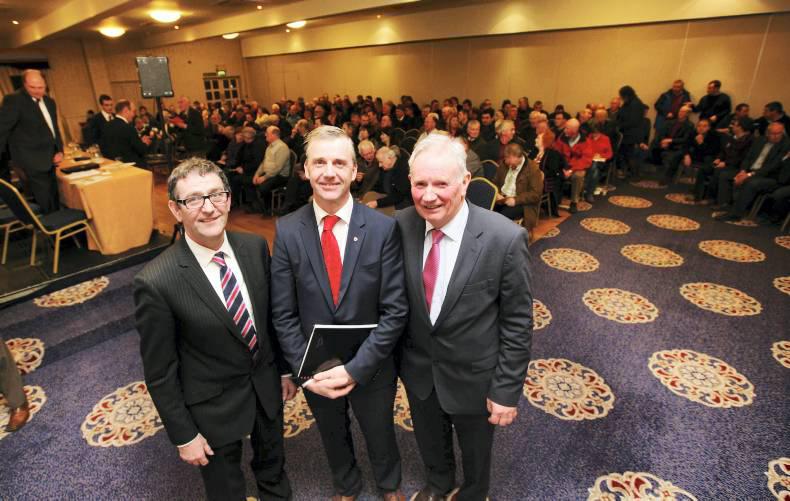
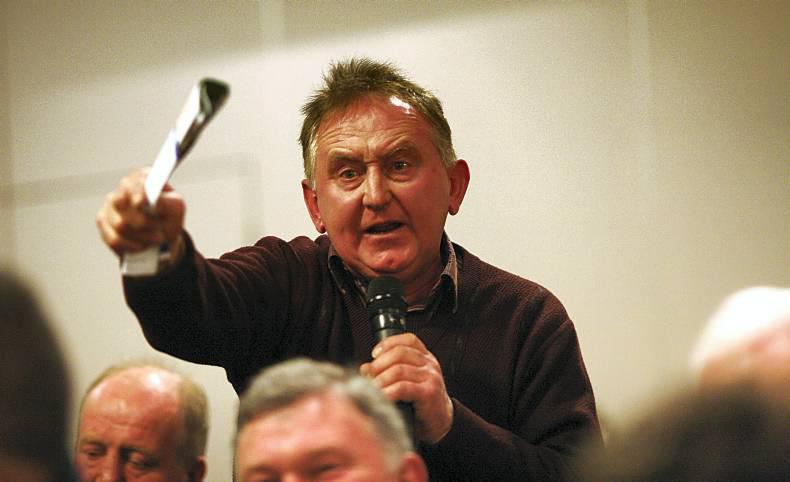
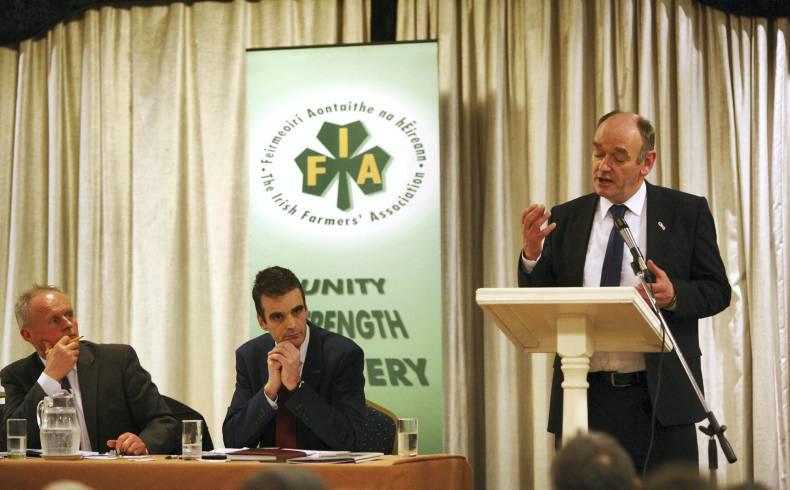
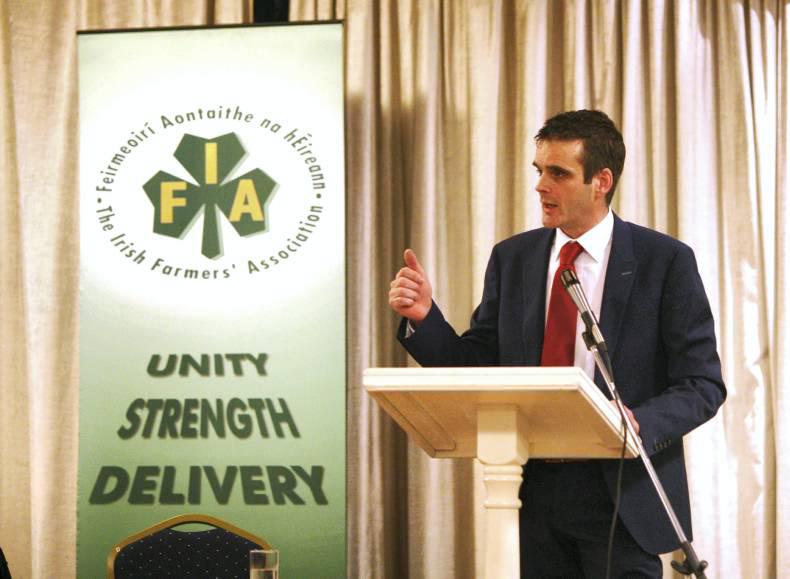
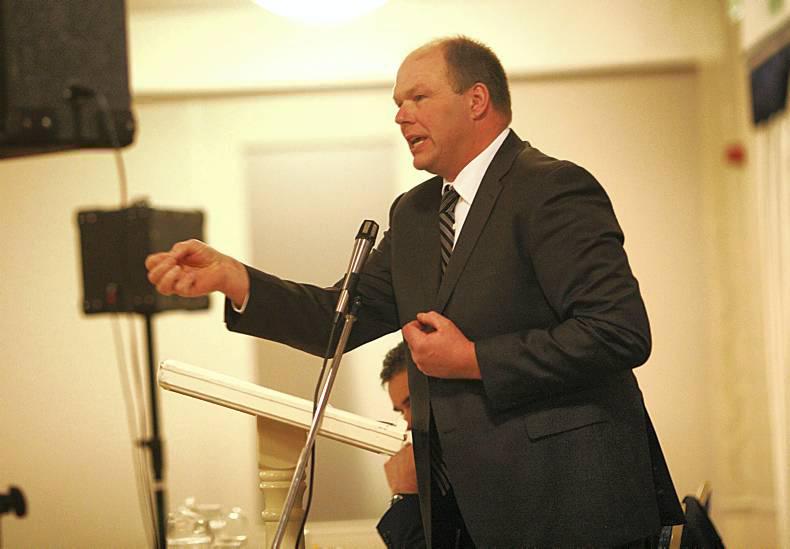
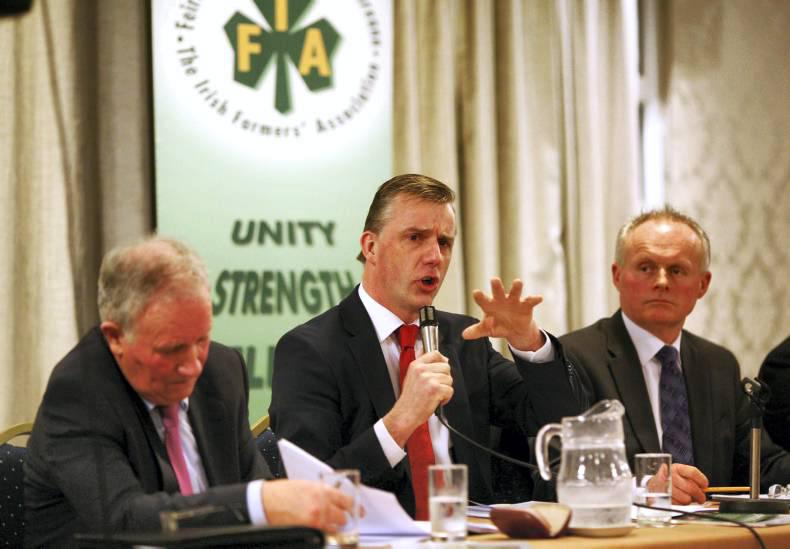
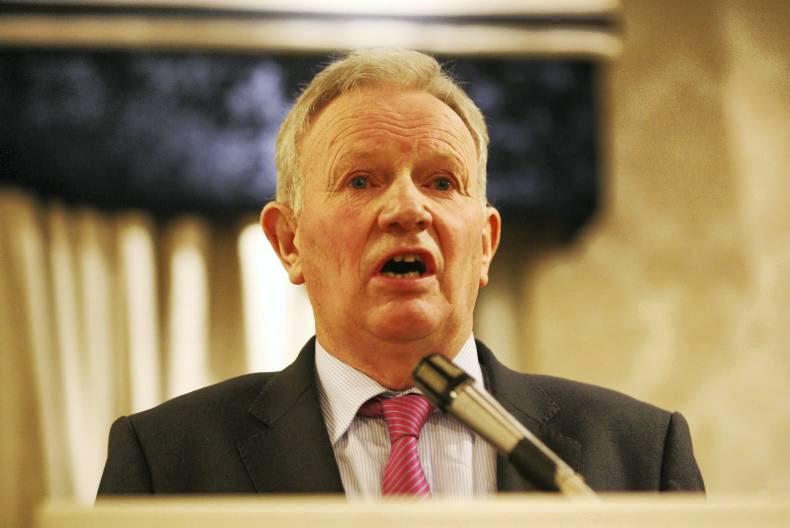
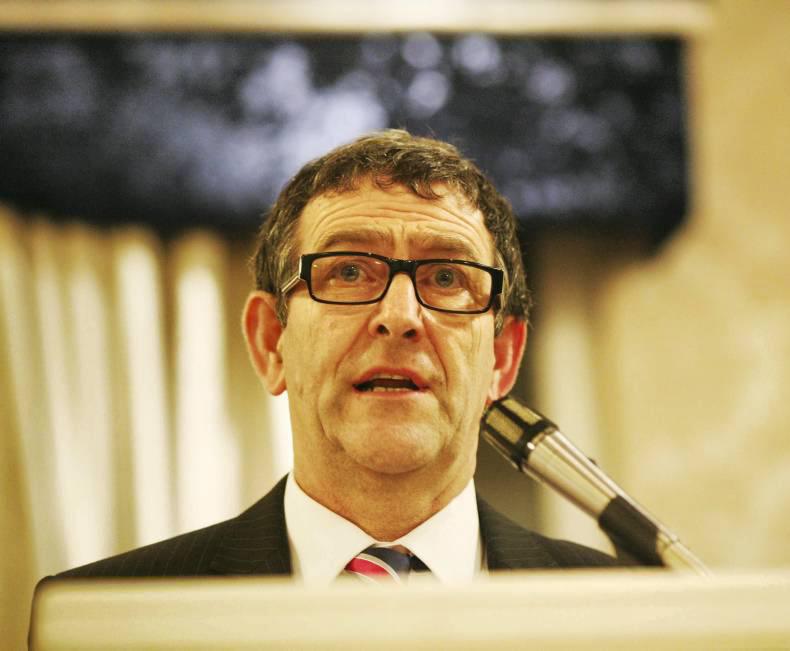
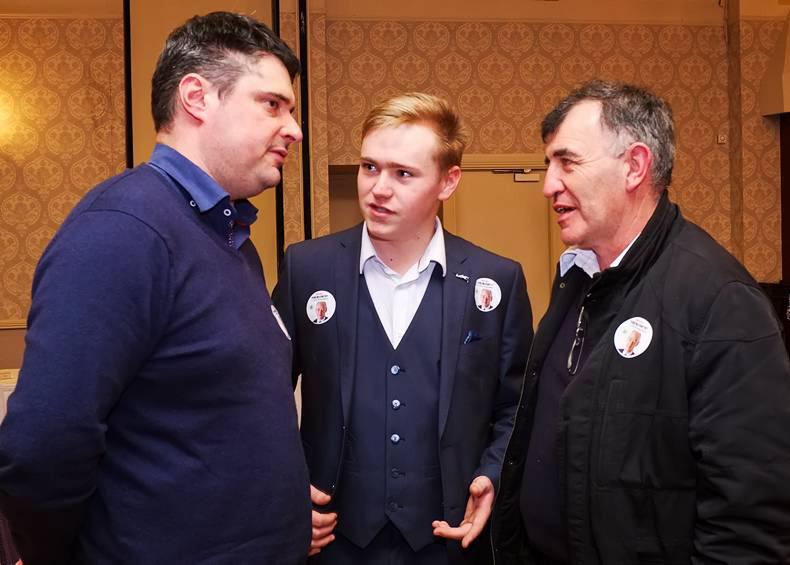
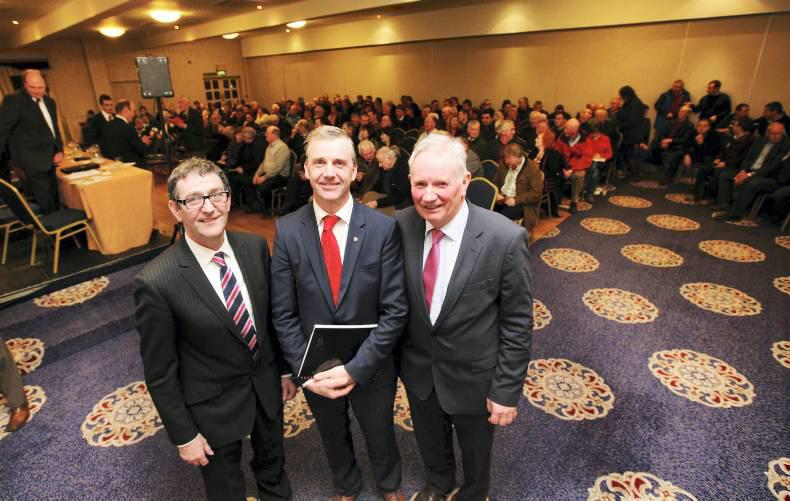
FBD Insurance posted annual losses of €85m on Monday and this did not fall on deaf ears among the participants to this Friday's IFA election hustings in Mullingar, Co Westmeath.
Presidential candidate Flor McCarthy was first to raise the issue in his introduction when he said: "There are people here who are part of the old regime, people who were appointed to the board of FBD" while the insurance company was losing its way. Although he did not name his rival, Flor's remark was obviously directed at Joe Healy, who sits on the board of Farm Business Developments. This is not the insurance company but the original farmer co-op behind FBD which is still a major shareholder in the insurer.
A member of the audience later asked if the candidates if they held any shares in FBD, adding that the proud company seemed to be "on its last legs".
Joe disclosed his director's fee at Farmer Business Developments which is €3,597 exactly. He defended the co-op's recent decision to buy hotels and other property assets to salvage the insurance company: "It was a balancing act because we wanted to safeguard the insurance company - the only Irish insurance company," he said while others were receiving capital from their owners overseas.
Henry Burns praised the company for the service it has offered farmers over the years, but warned: "We need to push hard for a competitive service though. We can't pay for the mistakes through increased premiums."
His performance, however, hinged on the numerous questions asked by beef farmers and Henry scored a point when announcing that the IFA had struck a deal with the Department of Agriculture to have inspectors monitor grading and trimming inside beef factories.
The earlier part of the night saw candidates for deputy president grapple with questions focused on governance and salaries at the top of the IFA. Yet the atmosphere was very quiet and none of the anger palpable at some earlier hustings manifested itself in Mullingar this Friday.
23.20pm
Time for final summaries - if Flor McCarthy appeared subdued in earlier answers, he seizes this as his chance to shine! His speech is impassioned and makes the best possible used of the 60 seconds allowed.
This wraps up our live blog for tonight, thanks for following us.
23.13pm
The last questions relate to beef grading, the live trade to the UK ("We used to have English farmers buying heavy stores but they are gone") and the risk of Brexit.
Flor says the bulk of our exports are going to the UK and we need to encourage the British to stay within Europe. A Brexit "would be disastrous". One way of doing this would be to cut red tape: European Commissioner Phil Hogan is always talking about simplification and reduced penalties, but little has happened yet. "The inspector must become our friend," Flor says.
Joe, too, stresses the importance of export routes to the UK, whether Britain or Northern Ireland.
On grading, he says that being above or below the cut-off point imposed by the factories for weight limits means the factory can get 46kg of beef for free: "We cannot accept that." "When we agreed to the grid, there was no mention of weight limits. Now they bring them in when it suits them," he adds.
Henry says that solutions to the lack of live trade to the UK are partly in Brussels: there isn't really a single market for livestock - too many restrictions to trade. "We cannot say we have free competition until we have a real single market," he says. He places the debate on a political level, because everything else is ready, down to boats for live exports to the UK.
On grading, he says the system was based on science and intended to reward the best beef farmers, but "the weight limits mean we're not getting that". He adds that the IFA has now agreed with the Department of Agriculture that their AOS in beef factories would soon inspect grading and trimming as "honest brokers in the middle" - we knew there were discussions about this, but if confirmed by the Department, this would be big news.
On Brexit, Henry says he has already talked to farm organisations in Britain to encourage them to campaign for EU memership.
23.00pm
A member says he remembers when the NFA was fundraising to start FBD. But in recent years shares went as low as 30c. FBD seems to be on its last legs. He asks the candidates: "Do you hold any shares?"
Flor says he doesn't have shares in FBD but he cares for that company: "How did it go so wrong?" He says we need transparency across all farming businesses and insurance is one of them. Although he says FBD has been a lifeline to farmers, he adds that we cannot support the company through increased premiums.
Joe explains that he sits on the board of Farm Business Developments, the farmer co-op shareholder in FBD Insurance. "I was nominated to represent farmers on that board," he says, adding that he gets paid €3,597 as a director.
"It was that board that bought the hotels" off FBD Insurance, Joe says. "It was a balancing act because we wanted to safeguard the insurance company - the only Irish insurance company," while others were receiving capital from their owners overseas.
Henry remembers that FBD was the only way for his father to get reasonably priced insurance. But it has since become "distracted". Recently, it focused on farmers again. "We do need them in the future, we need their competition. We need to push hard for a competitive service though. We can't pay for the mistakes through increased premiums," Henry says.
22.46pm
Second question from a woman tonight: "Under the Fair Deal scheme, at the moment if a person has to go into a nursing home, their total assets are taken into account and 7.5% of that per annum is charged. We are agitating for farms and other small businesses to be treated as productive assets and protected. There is no farm that can withstand that."
Henry says a farmer can have €1.5m in assets but make only €15,000 in income and this needs to be taken into account. The farm assets need to be separated because "they are the tools of our trade".
Joe says the five-year rule has to be done away with. Regarding productive assets, he notes that Micheal Martin previously promised to remove them from the calculation and he hopes this will happen. But he adds there are other ways to be explored too, including better home care packages.
Flor says farming assets "have to be a no no" in the Fair Deal scheme, as well as the five-year rule.
22.44pm
Levies again: one farmer asks for a clear answer - will the candidates abolish them or not?
Henry says levies must become fairer to reflect the various income levels of different farmers.
Joe says he would love to see the levies abolished. But can the organisation deliver for its members with a cut of 36% to 38% of its income? "If there can be a fairer way to deliver that amount of money, I would live to go down that road." But so far he has been in meetings where beef finishers were trying to move the levies away from beef, farmers with larger farms advocated for a fee per person, etc.
Flor says "we need a well-funded organisation" and raises the prospect of increased membership fees if levies are abolished. In any case, transparency must be improved and farmers should know exactly where their money is going.
22.43pm
A member says the IFA lost its listening power on the ground. Under Pat Smith, "you felt there was a higher power", especially during the 2014 beef protest.
Henry says that there was clearly interference from Pat Smith in the last beef protest, but he regrets that some members of the executive council agreed with him to call off the protest "and some were not aligned with their own county".
Joes says it was indeed a very short beef protest. If you go to protest, you stay until we get a result, not until a pre-ordained time to let lorries go through.
22.40pm
Flor is speaking last in answer to questions and is giving very short answers tonight. Is he afraid people are tired of listening after long answers from Joe and Henry? It looks like a missed opportunity for him.
22.31pm
A local farmer says: "There was a small gathering of farmers in this hotel recently and we remarked that there were no new members. The IFA is haemorrhaging members." He also highlights the number of people dying in farm accidents and asks the candidates about their priorities for farm safety, as regulations are very protective of wildlife but not of farmers. He references the Charlie Hebdo editorial on the commoditisation of food and farmers brought to the attention of Irish readers by the Irish Farmers Journal recently.
Joe says we can talk about prices, but to a family who has lost a member to a farm accident it doesn't mean anything anymore. He adds that when prices are low people are under more pressure to take risks. He suggests a form of payment and a PTO scrappage scheme to help with farm safety.
Henry says this may not be politically correct to say, but low income is a contributor to farm accidents and he gets a round of applause. He acknowledges that the HSA is the one body interested in farmers' welfare when inspecting farms, but this needs to be done in a spirit of partnership and education.
Flor highlights the case of slurry agitation and says this should be better covered by farm improvement grants.
22.28pm
The next question is about levies, where they come from and where they go. Sould all that not be published?
Joe says people didn't know the whole story with levies and they need to become transparent with all figures published including any fees taken by factories to collect the fees. He says the IFA gets €4.7m, €1.2m from that comes from the beef factories.
Henry says this has been an issue at meetings he's attended for four years and he commits to open a discussion if he is elected. But he warns that the alternative is to raise the money through membership fees. He says he is not prepared to let it become a contentious issue without resolution. "We need to draw a line under it."
Flor is committed to review the levies. He says even with them, there will be a financial shortfall as milk prices go down and now beef prices.
22.25pm
The candidates are asked about the beef quality assurance scheme, especially the 70-day retention rules.
Joe says it comes up every night at meetings: "The utter over the top, lack of common sense approach" of Bord Bia QA audits. We all accept that we need standards to export 90% of our beef, but a small issue with the records book doesn't accept the quality of the beef. At the moment you feel guilty until proven innocent. An example of common sense would be to calculate the 70-day rule across the last two farmers owning the animal if they are both quality assured.
Henry says: "We are fighting that all the way at the moment" and until conditions improve the IFA won't sign up to a new scheme. He says spreading the 70 days across two farmer is already allowed (take that, Joe) but some bonuses are lost in this case.
Flor says the system needs to become more farmer-friendly.
22.10pm
The second question is from a sheep farmer, who says although sheep and beef farming has both been identified as the weakest links in farming, a little is done for suckler farming but nothing for sheep.
All candidates back the €20/ewe premium unconditionally.
Flor adds that in all sectors we are producing under the cost of production, which is not sustainable.
Joe reminds the audience that he is a sheep shearer. "I was raised with pedigree sheep." He says the sheep sector illustrates the fact that the increase in exports has not resulted in increased income for farmers: "Any future Food Harvest type policy will need to ensure that there is a margin for farmers."
Henry Burns shows his experience of Brussels negotiations by explaining which countries were needed to forge an alliance on support payments in the past. He says sheep farmers are an example of efficiency in the face of low profitability, while supermarkets continue to build stores where "you could play football" and don't seem to suffer from profitability issues. This shows the need for increased regulation, he says.
22.05pm
The first question from the floor is about "the elephant in the room: the salary of the secretary general".
Flor says we all thought the SG's salary was indexed of that of the department. But over the last five years, the wages of the 65 other IFA staff were going down and the overall wage bill was going up so we knew only one was pushing it up. We now need all transparency: all wages will have to be known.
Joe says the problems seemed to set in in 2009 when civil servants' salaries decreased, but not that of the IFA SG. Contracts and the legal aspect of the new appointment will be important. Joe adds that he has a lot of experience in human resources management from his positions at Macra, Athenry Mart, etc.
Henry says the salary has to be set professionally. "You can't pick a figure out of the air." It has to be within the realm of reality on the market, for the person and the performance we expect, while being careful about pension aspects which ended up costing more than the salary the last time. On Pat Smith's salary, he adds: "The questions were asked, but the answers given turned out not to be the facts."
9.48pm
Henry Burns is the first candidate to get a round of applause mid-speech when he talks about flooding and the need to tackle the government head-on on lack of support with this issue.
He also says: "Every position I've had, I've been elected to. I'm not afraid of this election." Looks like who got into what position and how they got there may be a hot issue here tonight.
.@HenryBurnsIFA on the ABP-Slaney deal at the Westmeath #IFAelections hustings pic.twitter.com/GgtrUF5cJ1
— Farmers Journal (@farmersjournal) March 4, 2016
9.35pm
Joe Healy's introduction is a well structured analysis of all sectors, showing he knows the issues from beef to dairy, tillage, pigs and sheep. He hits the 10-minute brass bells and steals a few extra seconds.
.@joehealyfarmer speaks of all sectors, including his own dairy one #IFAelections pic.twitter.com/xQKfWjwmG3
— Farmers Journal (@farmersjournal) March 4, 2016
9.25pm
Flor McCarthy is first to speak and takes a direct swipe at Joe Healy without naming him: "There are people here who are part of the old regime, people who were appointed to the board of FBD" while the insurance company posted millions in losses.
@FlorMcCarthy1 is first to introduce himself to Westmeath voters in #IFAelections pic.twitter.com/VvjLZturDa
— Farmers Journal (@farmersjournal) March 4, 2016
9.17pm
Presidential candidats are taking to the stage now. Kenneth Bray says he will keep to a strict schedule: "We want to be out of here at 10:30pm or 10:45pm, it's Friday night and people have cows to calve."
9.13pm
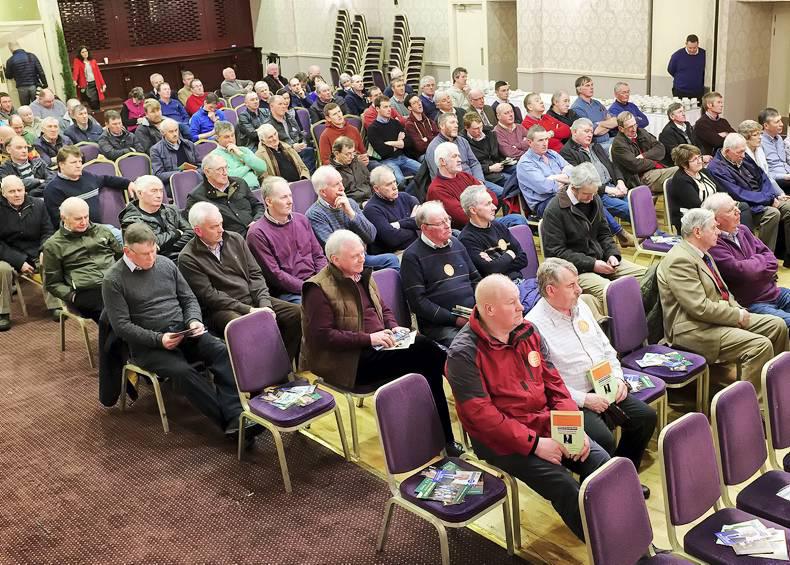
The room has filled up a little as deputy candidates wrap up with their closing statements, but this remains a quiet night so far: around 150 people and very polite questioning of the candidates and the organisation as a whole.
9.08pm
A rare female voice in these IFA debates: a member asks how the candidates will ensure the recent governance crisis doesn't happen again. Westmeath chair Kenneth Bray also asks for the qualities they will look for in the next secretary general.
Pat Farrell says the ideal SG would listen as well as deliver. To improve governance, he recommends that part-time farmers should be allowed to stand for IFA office and says nobody should have a job for life in the organisation.
Richard Kennedy says the Con Lucey report is a good start but the IFA needs to bring in a corporate governance expert to go further, right from the beginning. For secretary general: "I want somebody with an open mind, a hard worker and feel for farmers and farms," with a degree in agriculture.
Nigel Renaghan also wants to allow part-time farmers to stand for office. He says he has identified external experts to report to the executive council for governance reform. On the SG, the person should be qualified, but more importantly should support the president and the deputy: "If we want to do a protest, they should support us."
8.56pm
Two questions for the candidates: what will they do for the beef sector considering its low profitability, and how can they seem so surprised about the recent revelations when they have been chairing various committees for so long?
Richard says he hasn't been on the executive council since 2009, but before that committees could put forward policies and they were accepted. "What accepted since 2010 I take no responsibility for."
Nigel says there isn't much money in any sector at the moment - not only beef. "If the factories aren't getting the volume of cattle, you stand a chance," he says. Otherwise: "You're going to be screwed." He adds that live exports are the solution to manage volumes: "I'd like to see Friesian bull calves out of the country."
Pat says he goes back to the previous secretary general and there was no problem because he was delivering for farmers. But he was dissatisfied with Pat Smith and "things came to a head with the beef protest," which Farrell says should have started earlier. He also disagreed with the way Smith handled the letters Con Lucey sent when he left the IFA's audit committee, but cannot give details because a court case is looming between Smith and the IFA.
8.49pm
Two first questions from the floor are about the unity of IFA and how the candidates will address the crisis at the head of the organisation.
Pat Farrell says he was the one who raised issues with motions of no confidence and "the two other people running" did not.
Richard Kennedy says that when he was chairman of the dairy committee years ago, the committee's recommendations were always adopted by the council. He says whatever has changed since then should be reversed.
Nigel Renaghan stands up to wake up proceedings a little and gets more animated to answer this one. He says that past performance is the best indicator of what can be done here, and he has a track record on the poultry committee of coming when farmers were not united, bringing them together and achieving results.
8.39pm
No questions from the floor, so Kenneth Bray asks the first question himself: Why does the Teagasc profit monitor not take into account the cost of the farmer's own work? What would the candidates do about it? All three agree this should be changed and they would ask for a farmer's wage to be included in Teagasc's calculation for production costs if they sat on its board.
8.35pm
Westmeath IFA booked a 400-seat room tonight, but it is slow to fill. Only 100 taken so far.
8.33pm
The brass bell comes into action to end Richard's introduction and open questions to the floor.
8.32pm
Richard Kennedy describes himself as a "staunch IFA man" who was "apalled" by last year's revelations. He says the sole issue in this election is to restore trust in the organisation.
He takes an indirect swipe at livestock chairman and presidential candidate Henry Burns, even though they are not running for the same position: "I took place in factory blockades that were effective, unlike recent ones."
He references to the 1966 march and says we should be commemorating it this year, instead of picking the pieces of the organisation.
8.27pm
Pat Farrell reminds everyone of his role in bringing motions of no confidence in the previous secretary general and promises "full accountability" for the next SG, who will have only one focus: "farm incomes".
Pat mentions Teagasc as well and says that worked with them to make the science available to get €2m reduction in nitrate penalties for farmers.
He also talks about a fair share from retailers and suggests penalties for the Department of Agriculture when farm payments are late.
8.23pm
Nigel Renaghan is first to speak and maintains his focus on getting fairer share of prices for farmers as in previous meetings.
"I've proved what you can achieve by keeping farmers united," he adds.
Bray said in his introduction that the deputy president sits on the board of Teagasc and Nigel mentions it too. He says that €68m goes on pensions rather than on the day-to-day running of Teagasc and he will call on the government to claw back on that budget to spend it on frontline advice services for farmers.
8.19pm
Westmeath IFA chair Kenneth Bray says Westmeath has every type of farm and the candidates can expect questions from all directions.
He opens the proceedings with the deputy presidential candidates, with Nigel Renaghan speaking first followed by Pat Farrell and Richard Kennedy.
This loud brass thing will be used again: "Stick to the five minutes, I'll ring the bell," Bray warns.
8.13pm
It's proving difficult to get the crowd to take their seats tonight. Nigel Renaghan is walking down the corridors ringing a big brass bell to get everyone in.
8.00pm
We're in the Mullingar Park Hotel where the IFA election debate will start shortly. In the meantime, browse the photo gallery above to see pictures of the recent hustings in Mayo and south Tipperary.
The Irish Farmers Journal will continue to bring you live blogs of all debates where presidential candidates are present at Farmersjournal.ie and on the mobile app.
Westmeath Mullingar Park Hotel Fri 4 Mar
Sligo and Leitrim Bush Hotel, Carrick-on-Shannon Mon 7 Mar
Roscommon Abbey Hotel, Roscommon Tue 8 Mar
Donegal Clanree Hotel, Letterkenny Wed 9 Mar
Cavan Hotel Kilmore, Cavan Thu 10 Mar
Dublin White House, St Margarets Fri 11 Mar
Longford Longford Arms Hotel Mon 14 Mar
Monaghan Glencarn Hotel, Castleblaney Tue 15 Mar
Louth Dooleys Edmondstown, Ardee Wed 16 Mar
Laois Abbeyleix Manor Hotel
Deputy presidential candidates only, no live blog Mon 21 Mar
Kildare Keadeen Hotel - presidential debate only Mon 29 Feb
Meath Newgrange Hotel, Navan Wed 23 Mar
Offaly Tullamore Court Hotel Tue 29 Mar
South Tipperary Cahir House Hotel, Cahir Mon 29 Feb
Read more
Full coverage: IFA elections 2016


SHARING OPTIONS