


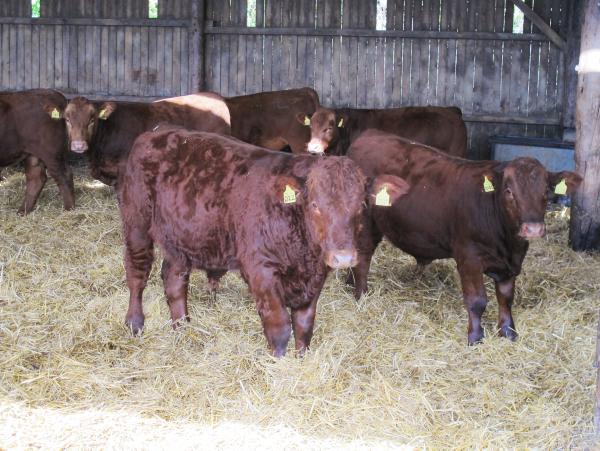
Last week saw the start of pilot Beef Data and Genomics Programme (BDGP) training courses. The courses are more intensive than those offered in the SCWS (Suckler Cow Welfare Scheme) and will be offered in Teagasc centres across the country in the coming months. Farmers partaking in the BDGP scheme are required to have the course completed by the end of October this year.
Teagasc will invite participants to attend courses through the year, and those invited are advised to attend the first course they are invited to as subsequent courses may be in less convenient areas.
One of the major benefits of the courses compared to those completed in the old SCWS is that they are much more comprehensive and evoke much more discussion from the attending farmers.
Approximately 24 farmers attended Friday’s training session in Mohill. Each had a printout of their BDGP €uroStar reports detailing the number of reference cows, the number of four and five stars needed by 2018 and the number required by 2020.
Data recording
Teagasc beef specialist James Keane said that one of the reasons for gathering more information is to create a more reliable index. He advised farmers to fill out the forms accurately, as poor accuracy of records will reduce the value of the figures.
Genotyping
On the issue of movement in €uro-Star ratings, Teagasc head of drystock Pearse Kelly said that ICBF has said to them that about 20% of stock bulls may move up and 20% may move down at each evaluation (these take place three times a year). He said that once the genomic results are fed back into the system it should improve the bulls’ reliability.
He advised farmers that when they are looking at a bull’s figures or at AI catalogues to ensure that the results they are looking at are from the most recent evaluation in December. He said that all animals will be re-evaluated in April, and the genomic results should be contained in the results at that stage.
Buying a bull or using AI
There was widespread discussion on the choice of buying a bull versus using AI. A quick workshop conducted by Pearse showed that approximately five farmers in the room had a bull that was over €100 on the replacement index, six had bulls between €50 and €100 on the replacement index and seven had bulls under €50 on it.
When they looked at the terminal index, 15 had bulls that were €100 or more on the index. One person had a bull that was €50 to €100 on the terminal index.
Pearse said: “That is telling us that that is where the industry has taken us at the moment; the breed societies and AI companies have steered us this way. Why? Because we are all customers and that is what we have been looking for – these terminal-type bulls.”
He said that the focus has moved on to bulls that are high on the replacement index in the past year or two. When asked from the floor why are their bulls falling down on the replacement index, he replied: “They are not falling down; they are doing exactly what you wanted them to do, which was to breed calves with good conformation and weight for age.”
This led to a wide-rangging discussion on how to comply with the replacement strategy in the scheme while keeping focused on producing high-quality weanlings. Several farmers felt that changing the bull was not an option for them, as the herd sizes were small and replacing the bull would be too costly.
Others looked at the possibility of continuing to use the terminal stock bull, while using some high replacement index AI sires to breed some replacements. Other farmers felt that the best option for them was to buy in high index replacement heifers.
Reliability
Another key area of discussion was on the reliability of animals on the index. The farmers in the room discussed the difficulties in buying a stock bull that is high on the replacement index.
They gave the example of one farmer whose bull was five stars on the old maternal index but is now only two stars on the new replacement index. Pearse explained that the index itself changed last August to rely more on maternal characteristics of the cow. He said that the most recent evaluation the farmers should be looking at is the December one.
Pearse underlined the need to look at the reliability of each animal on the replacement index. Those with lower reliabilities could possibly drop from where they are, but equally they could go up. He said that breeding from AI sires will give you a surer footing.
However, he did point out that there are a number of AI sires with high figures but lower reliabilities due to the lack of progeny on the ground. He said that where using genomic AI sires, to use a team of four to five bulls on cows, not just one.
He said that this will limit the risk of getting caught out by a bull’s ratings dropping.




SHARING OPTIONS