


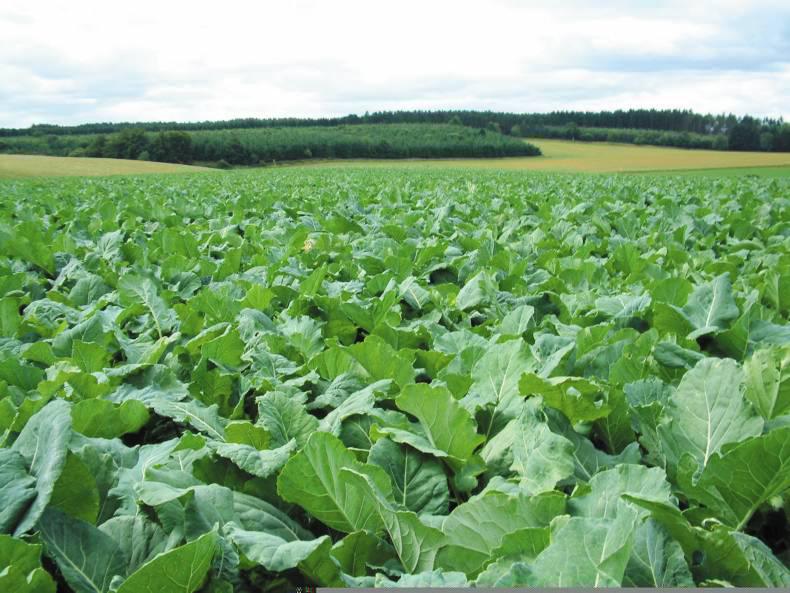
Many farmers planned to increase housing capacity this year, but with milk prices continuing to fall, a significant number of those farmers are re-considering. What are the options available to defer capital expenditure on housing?
At this stage of the year the only real options are fodder rape, stubble turnips and hybrid brassicas. The optimum sowing date for kale and swedes has passed. Because fodder rape and stubble turnips only have about half the yield potential of hybrid brassicas, this article will focus on the hybrid brassica and specifically on the variety Redstart, which is a kale/rape hybrid.
So what can we expect from a crop of Redstart sown this week? According to Mary McEvoy of Germinal Seeds, a crop of Redstart sown at the end of July or in the first week of August can expect to yield between 6t and 8t DM/ha of highly digestible green material with a crude protein of between 18% and 20% and metabolisable energy of 10-11 MJ/kg DM.
In the late 2000s, an extensive trial was conducted in Moorepark on out-wintering on fodder crops. The project mainly looked at the effect of out-wintering on youngstock performance under a variety of different crop and feed scenarios. To sum up the findings, they found that liveweight gains in out-wintered maiden heifers were comparable or better than those wintered indoors on good silage and 3kg of meal.
While dry cows were not used in the study, many farmers in Ireland and elsewhere routinely out-winter cows to good effect, provided that diets are balanced for minerals and vitamins and a source of fibre, such as silage, hay or straw is provided.
So what are the key considerations to sowing Redstart? Like all out-wintering crops, they will be grazed over winter when it’s cold and wet so pick a dry site and ideally a field that is due to be reseeded. Next is soil fertility, Mary says this is critical and she advises that a soil test should be taken before sowing. If planning on sowing Redstart this year, then time will probably be against you to get a soil sample taken and get results back before it’s too late for planting.
Soil pH must be above 5.8 but ideally between 6 and 6.7, so it’s probably safe to assume that up to 3t/acre of lime will be needed. Sticking with fertiliser, for high yields, three bags/acre of 10:10:20 or slurry equivalent is required at sowing and two bags/acre of CAN top dressing is required after the crop emerges, ideally in a split application.
Redstart requires a fine, firm seedbed much like sowing grass seeds. It can be broadcast or drilled into cultivated ground but it can also be direct drilled with a one-pass or similar machine. Some farmers prefer to direct drill as they feel ground isn’t as soft when grazing so less poaching is done than if the field was ploughed.
The seeding rate for Redstart is between 3kg and 4kg per acre, depending on the method used – broadcasting requires a higher seeding rate than direct drilling. Cost of seed is about €9/kg. Generally speaking, no sprays are required after sowing provided that the field was well burned off before cultivating as the Redstart will usually grow faster than and overpower any weeds. Watch for pests such as slugs.
Grazing
The crop can be grazed about three months after sowing. It should be introduced slowly to avoid any upsets and hay or silage should be available as an additional source of roughage. Some farmers will bolus animals before going on fodder crops to cover for minerals and vitamins. If not, the minerals must be got in some other way. Best practice is to graze in long narrow strips where each animal has plenty of feed space and have the silage bales laid out before the crop emerges so no tractors go on to the field during grazing.
To work out allocations, you need to estimate yield of the crop, intake of the animal and deduct any other feed coming in such as silage. To estimate yield, a representative sample of the field, one metre by one metre, should be cut and weighed and a sample taken for dry matter analysis. The total kg/DM in the square multiplied by 10,000 will give yield per hectare.
If a 7t DM/ha crop is grown, how many animals will this feed? Let’s presume 80% of this will be utilised, therefore 5.6t/ha is available to the herd. If a dairy cow eats 12kg of dry matter per day and 4kg of this is going to come from silage or hay, then she will eat 8kg of Redstart per day. For a 100-day winter, each cow will eat 800kg of Redstart, so a 5.6t crop will support seven cows per hectare or just over 2.83 cows per acre of Redstart over the winter. So 10.6 acres of Redstart would be required to feed 30 cows over the winter, presuming of course that 7t/ha is grown and 5.6t/ha utilised. Later-sown crops will not yield as well.
Cost/benefit
As mentioned at the outset, out-wintering could be a good option for those short of housing this year. But is it a runner for every farmer? While having a 7t crop of high-quality feed in the field for use over the winter is an attractive prospect for most farmers, we need to look at the costs along with the loss in grass production.
If Redstart is sown on fields that are earmarked for reseeding on 1 May, then there are nine additional months when the field is not growing grass (August to April, inclusive). On Curtins Farm in Moorepark, over 7.8t of grass is grown during this period. OK, that’s an average across a high-performing farm – fields destined for reseeding should be growing considerably less than average.
By sowing Redstart or other fodder crops you are effectively compressing what grass can provide in feed terms over an eight- or nine-month period into a shorter window when grass isn’t growing and where feed quality is not compromised.
Based on our calculations, the cost of growing an acre of Redstart, including all cultivation, seed and fertiliser costs, is about €314/acre or €776/ha (see graph). Based on utilising 5.6t/ha, this works out at a feed cost of 13.9c/kg DM utilised and it does not include the cost of putting land back into grass as it’s assumed that was a cost that was going to be incurred in any event as the field was earmarked for reseeding.
Some of the costs incurred in sowing Redstart will be offset in savings when sowing the grass seed in the following spring. For example, lime will probably not be required and nor will a second glyphosate spray. Another important consideration is choosing where to put the crop. If grown on the milking platform, and if only to be grazed by dry cows or youngstock, then the stocking rate on the milking platform will have increased and extra feed may be required to build up grass covers in the autumn and spring. Of course, some of the Redstart could be grazed by the herd to help offset this.


SHARING OPTIONS