


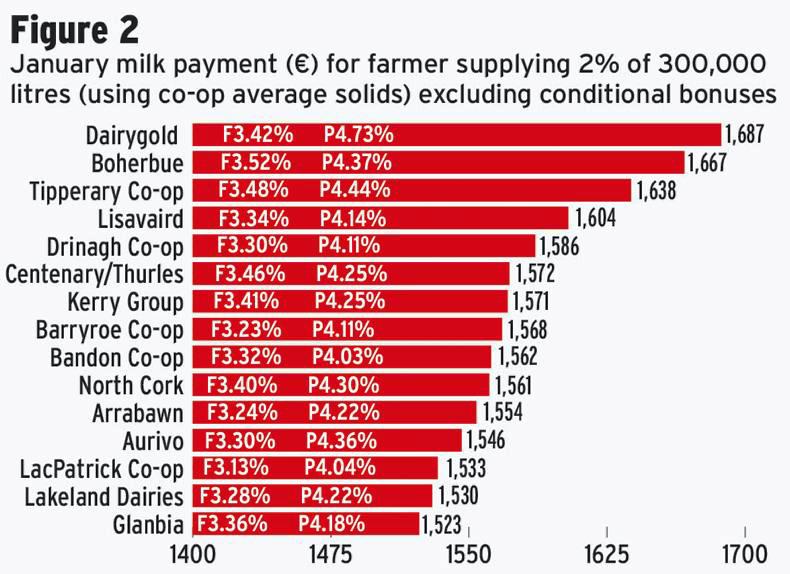
The four West Cork co-ops are out on front in the January monthly milk league, paying just over €3.50/kg milk solids.
Lisavaird had pulled away from the other three in December but they have come back to join their sister co-ops for January.
Lakeland was the other co-op to drop milk price for January. LacPatrick had an unconditional December year-end bonus and for January it has a 3c/l unconditional early calving bonus.
Division two holds those four milk processors paying €3.40 to €3.50/kg milk solids and includes LacPatrick, Arrabawn, Dairygold and the small north Cork processor Boherbue.
Division three has the majority of milk in the country between €3.30 and €3.40/kg milk solids (effectively less than 24c/litre base price excluding VAT). The big two, Glanbia and Kerry, are comfortably nestled in Division three. As explained previously, the Glanbia base price does not include any element of the fixed price available on a voluntary basis to Glanbia suppliers.
Remember, the monthly milk league excludes conditional bonuses.
The other big change for this January league table is the change in the base fat and protein percentages. In calculating milk solids, we use the percentages for fat and protein supplied in the year previously. In 2014 it was 3.43% protein and 3.99% fat. The percentages increased to 3.49% protein and 4.11% fat during 2015.
Global outlook
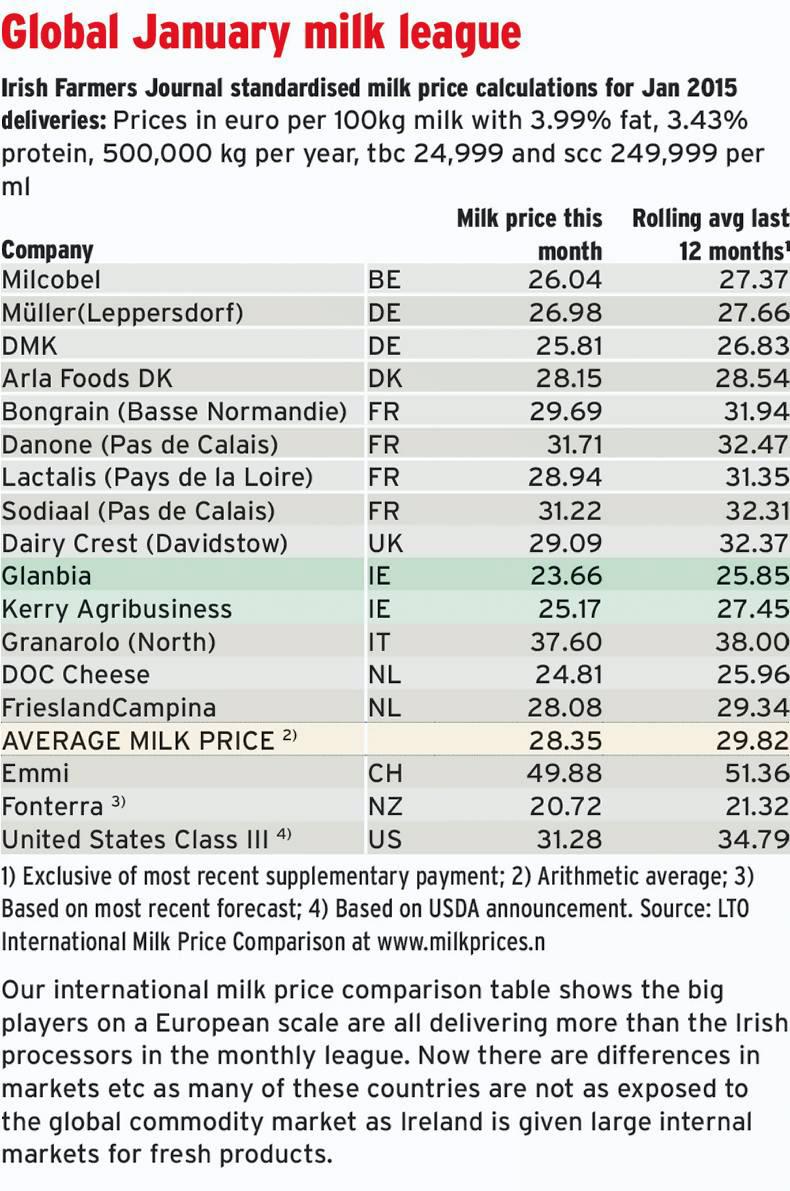
There hasn’t been that much change in the global dairy product price outlook. There was some good news last week showing increased powder buying from Chinese buyers and a stabilising of the GDT auction. The price of oil rising again should be seen in a positive light for those looking to increase product price.
This week New Zealand revised downward its farmgate milk price and effectively dairy farmers over there will be paid the equivalent of 17 c/litre, which is a long way from what they have been used to for the last 10 years.
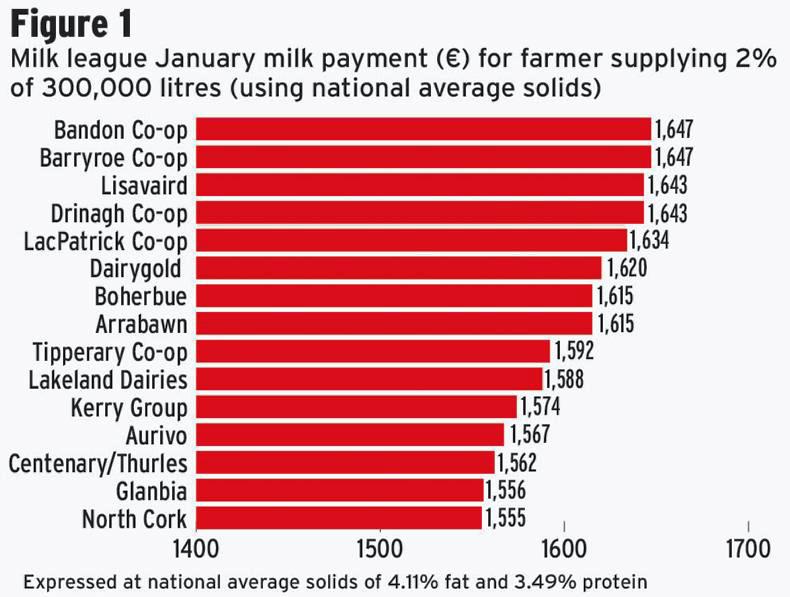
Figure 1 and 2
Figure 1 shows the difference in pay out between processors for the standardised litre at 3.49% protein and 4.11% fat supplied during January. It shows the difference in the milk cheque for a supplier with a normal seasonal spring supply curve (2% in January) for a farm that will produce 300,000 litres (66,000 gallons) in the year.
Effectively, this graph shows the price paid on a comparative milk solids basis, allowing a fair comparison between Irish processors. You can see this month there is only about €100 of a difference in the January milk cheque between the processors paying top price for January, Barryroe and Bandon, and North Cork, who are paying the lowest.
Market Comment Joe Collins, Ornua
Low oil prices affect supply and demand
During the past five years the oil price has fallen from $125 per barrel to below $30 in recent weeks (a 13-year low). While the oil price is not the sole determinant of dairy commodity prices it has a major influence. Regarding milk supply, falling oil prices dramatically lower farm input costs. Over 80% of global milk is produced from grain-fed cows. In turn, grain accounts for over 50% of dairy input costs in the US. Grain prices are weak on the back of increased harvests and poor returns from ethanol due to low oil prices. Low grain prices make it less attractive for farmers in some regions to lower milk production during times of low milk prices. On the dairy demand side, there are both positive and negative links for low oil prices. In developed regions such the US and Europe, low oil prices increase disposable incomes, which results in positive consumption growth as more consumers choose to eat out. However, low oil prices drive food deflation. In the more fragile developed economies, consumers tend to save a higher percentage of income and increase relative spend on non-food items. Over 30% of world dairy trade is imported by oil nations. The key players include Venezuela, Russia, the Middle East and Africa. Compared with developed regions, consumers in developing regions spend a higher percentage of their income on food. The collapse in oil price has had a major impact on buying power as local currencies are weakening, government food buying programmes are slowing, and income tax levels are increasing to offset low oil revenue. The result has been massive food inflation and reduced consumer buying power.
On balance, low oil prices drive milk supplies and are negative for dairy demand. While oil prices have rallied in from record lows in recent days to about $40 per barrel, an oil price in the range of $60-80 per barrel would be optimal as it would stimulate demand and dairy purchases in key countries.


SHARING OPTIONS