


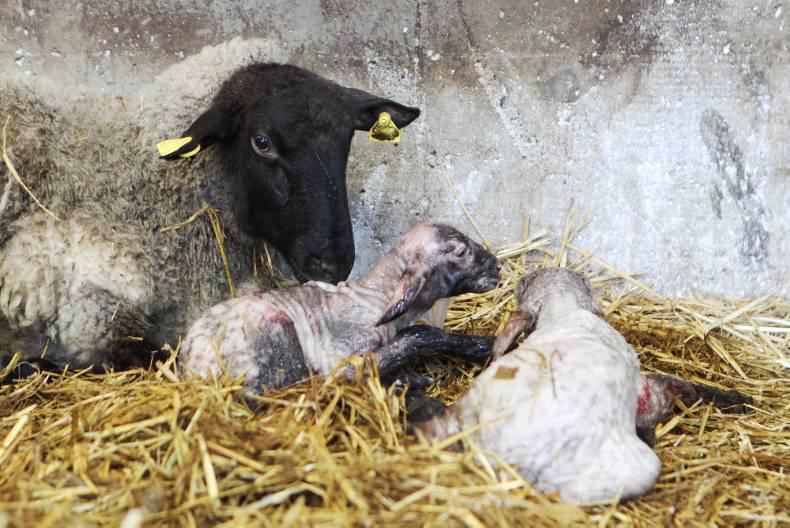
The majority of deaths in adult ewes and newborn lambs occur at lambing or during a newborn lamb’s life. These losses are costly and the aim must be to reduce all loses to the minimum.
High litter sizes will result in higher lamb mortality levels but with good management during and after lambing, it can be kept at acceptable levels. In lowland flocks with scanning rates of 180%, the aim should be to keep total losses from scanning to weaning below 13%.
About 4% of these deaths will occur before lambing, i.e. re-absorbed fetuses, abortions and stillbirths. Another 6% or 7% will occur during days of the lamb’s life and lamb mortality from turnout to weaning should be under 2%.
Flocks with lower scanning rates should aim to wean 90% of the scan rate, i.e keep mortality under 10%. Starvation/exposure accounts for almost 60% of all lamb losses that occur in the first week of life.
Inspecting lambs regularly in the first few days so as to ensure they are getting a sufficient supply of milk from the mother is crucial to minimise lamb mortality.
Particular attention should be given to small weak lambs born to young ewes or lambs from ewes that had a difficult lambing.
Ewes with lambs that are not thriving or ‘hardening up' should be kept in the individual pen or put in a small group, where they can be monitored and given the necessary treatments.
Indoor feeding post-lambing
Ewes should not be overfed immediately after lambing. The same pre lambing diet should be fed for the first 24 hours after lambing. If lambed ewes are being kept indoors for more than a week the feeding rate should be increased as the demand for ewes feed demand increases rapidly after lambing.
Twin suckling ewes will reach peak milk feed lambing. Severe underfeeding in early lactation will affect body condition can suffer some under feeding in early lactation as they can moblise body reserves to make up for the deficiency by ‘milking off their backs’.
These ewes can lose half a body condition score in early lactation without yield. The level of concentrate requirements for indoor fed ewes will depend on forage types and stage of lactation. With good quality roughage (70% DMD silage ad lib) twin suckling ewes will require 1.2kg of 18% CP ration for the first four weeks of lactation.
After four weeks of concentrate feeding, levels for indoor-fed ewes can be reduced gradually and eliminated by week seven or eight of lactation.
Letting ewes and lambs to grass
Lamb losses outdoors will be reduced by ensuring that newly lambed ewes going to grass are fully bonded to their lambs, have plenty of ‘suck’ and their lambs are healthy and thriving.
Move ewes and lambs out from the shed after feeding in the morning. Have treatments, such as tail ringing and castration done at least two hours before moving lambs indoors. Ideally, move in a small group of 20/25 lambs to a sheltered paddock, where the stock can be monitored for the first 24 hours.
Feeding ewes on grass
Where grass is plentiful (over 4cm) and ground conditions allow for good utilisation, there should be no need for concentrate supplementation to mid-season lambing ewes. If grass supply is scarce, twin rearing ewes will benefit from supplementation of concentrates for the first three or four weeks of lactation.
The rate to feed will be dependent on the amount of grass available and ground grazing conditions.
Research at the SAC in Scotland has found a significant terms of lamb thrive to feeding an undegradable protein source, such as soya bean meal, to lactating ewes.
Having ewes with young lambs’ congregating around feed troughs in wet conditions is one of the main predisposing coccidiosis in young lambs at about four weeks of age. Troughs should be moved regularly to avoid this.


SHARING OPTIONS