


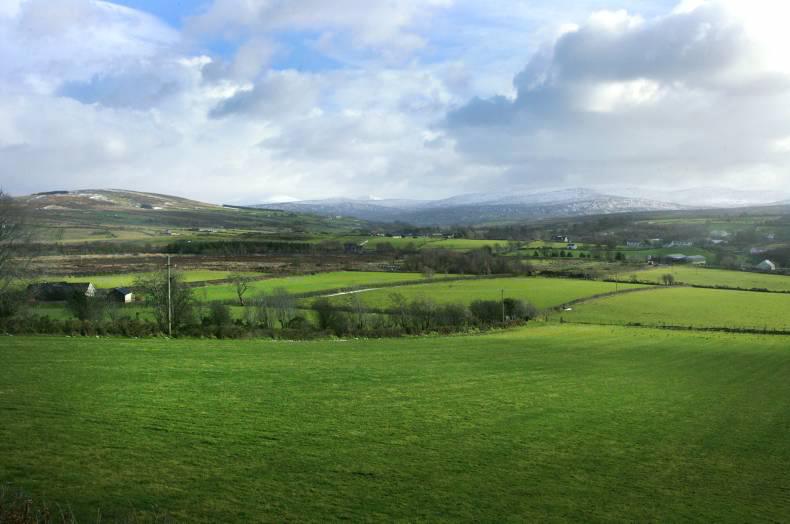
Decisions should be made over the next few weeks by new DAERA Minister Michelle McIlveen on potential sources of money for a payment to farmers in areas of natural constraint (ANC).
At present, the £20m scheme, currently paid to farmers in the Severely Disadvantaged Area (SDA) comes to an end in 2017 (the last claim was made on the 2016 Single Application Form). There is no budget provision beyond that date. However, at the Stormont agriculture committee meeting last week, officials outlined to MLAs potential funding streams for the future.
They include either funding a new scheme from within Pillar I CAP payments (direct payments to farmers) or taking money out of the Pillar I pot and using it to fund a scheme under Pillar II (Rural Development Programme). The problem is that these options effectively take money off all farmers to fund a scheme in the ANC.
Commenting during the meeting, Minister McIlveen’s party colleague Edwin Poots said there was “absolutely no prospect” of the DUP supporting a funding mechanism for ANC that used Pillar I.
That position is also widely supported by farming organisations responding to a public consultation on the issue released in February of this year. Instead, they prefer an option which would involve going directly to the Stormont executive for £20m per year to fund a future ANC scheme.
However, according to Dr Rosemary Agnew from DAERA, the problem with that approach is that the Department has been unable to demonstrate that an ANC scheme actually delivers value for money. The last two years of ANC payments are under “ministerial direction” not as a result of a business case which shows that the money is well spent.
DAERA would have to submit a bid for funding alongside bids from other parts of Government. “Our weakness in bidding for it is our inability to prove it would deliver value for money. I don’t know whether there is an opportunity to look at some other type of support in those areas if a bid fails. That is a decision for the minister,” said Agnew.
Member states have until 1 January 2018 to replace the severely disadvantaged area (SDA) map with newly designated maps showing areas of natural constraint (ANC).
The new mapping process is set out in EU regulation, and comes in two stages, the first using up to eight biophysical criteria based on soil, climate and slope. To be eligible, an area such as a townland or electoral ward must be constrained by at least one of these criteria. The second stage is to finetune the maps taking out any areas where the constraint has been overcome. To do that, DAERA has suggested using an economic activity measure based on gross value added per hectare. The result has been a number of potential maps depending on the assumptions and thresholds used, and put out to public consultation in February 2016. In general, most of the current SDA is mapped as ANC, but there are anomalies, with some SDA land omitted, and even some lowland taken in.
In their responses, both the Ulster Farmers’ Union and Belfast Hills Farmers suggest that the current SDA map should be left as it is. “The existing map has served NI well,” said UFU president Barclay Bell in the union’s consultation response.
However, at the Stormont agriculture committee last week, Rosemary Agnew from DAERA insisted that was not possible, and the Department has no option but to pursue with the re-designation process.
She also said that, in general, most stakeholders were supportive of defining maps down to electoral ward level, rather than to a townland – the “less bad option” responded Belfast Hills Farmers.
A third consultation released by the Department in February 2016 asked stakeholders for their views on whether a coupled payment, potentially in the beef and sheep sector, should be introduced for 2017 to 2019. If NI is to make a coupled payment in those years the European Commission must be notified by 1 August 2016, so a decision is required soon.
The general view of most stakeholders, including farmer representative organisations, was against a coupled payment, as it is not ‘‘new money’’ but funded by taking payments off all farmers which is then used to support particular sectors.
However, the Livestock and Meat Commission (LMC) and the body which represents meat processors, the NI Meat Exporters Association (NIMEA), both advocate a coupled payment related to sucklers. In their response, the LMC points out that suckler cow numbers are down 9% from 2012 to 2015. To encourage producers to record sire details when registering calves (something which is crucial if the industry is to make progress with livestock genetics), the LMC suggests that 8% of Pillar I money is used to provide a payment on each suckler calf properly registered at birth. An 8% payment would equate to approximately €101 per head.
The NIMEA suggests that 12% of Pillar I money is used to make a payment on suckler-bred calves, which equates to approximately €150 per head.
Despite the DAERA consultation focusing on the possibility of introducing coupled payments in the beef and sheep sector, the UFU took the opportunity to make a case for a coupled payment for protein crops such as peas and beans.The UFU argues that this would put farmers here on the same footing as growers in the Republic where a payment of €280/ha was made under a scheme in 2015. It would also encourage the use of protein crops in rotations and help meet the demand for protein from livestock farmers. But, for Minister McIlveen, the main issue will be whether introducing a coupled payment for protein crops creates a precedent that others might wish to follow at a later date.


SHARING OPTIONS