


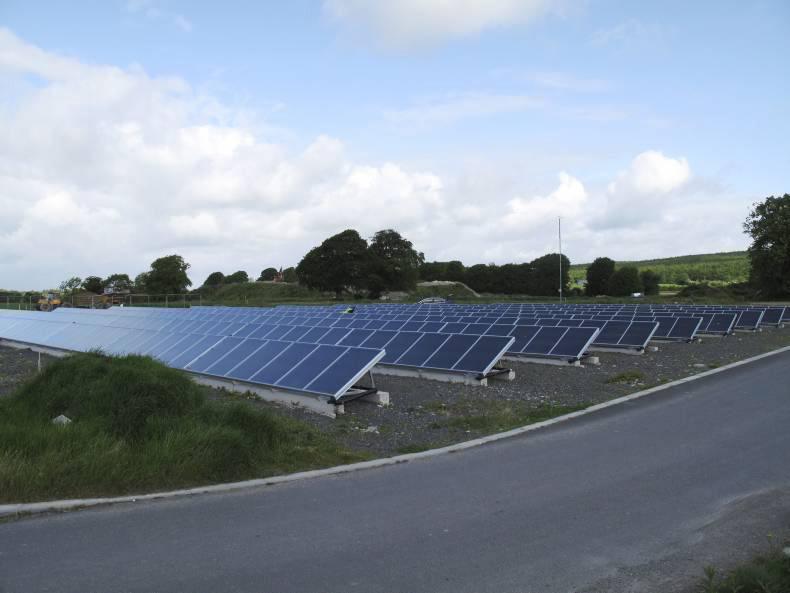
From 1 October 2016, the number of Renewable Obligation Certificates (ROC) allocated for every kilowatt hour (kWh) of electricity produced from solar photovoltaic installations under 50kW in size under the Northern Ireland Renewables Obligation (NIRO) will reduce from three to two.
Speaking at a renewable energy workshop in Omagh last month, CAFRE renewable energy technologist David Trimble said that photovoltaic systems were still an option for anyone considering an installation but he recommended that work begins on them soon.
Under current ROC values, the lower tariff in October will see a reduction from 11.73p/kWh to 7.82p/kWh in ROC payments for photovoltaic systems.
The NIRO will close to all new installations of non-wind renewable technologies from April 2017.
Planning permission is not required other than for large-scale, ground-mounted systems and a grid connection offer is not needed for small-scale installations. Instead, import-export meters are fitted by Northern Ireland Electricity (NIE) Networks.
“NIE Networks does not have to be contacted in advance of installation of systems up to 3.68kW, which in practice can be 4kW of panels, for a single phase electricity system and up to 11.04kW, or 12kW of panels, for a three-phase system,” Trimble said.
On the economics of solar systems, Trimble calculated that an average 1kW of panels has a payback of 4.9 years if all electricity generated is used on farm, at saving of 15p/kWh, and 8.3 years if all electricity is generated is exported to grid at 4.01p/kWh. “In reality, most farms will be somewhere in between the two examples,” he said.




SHARING OPTIONS