


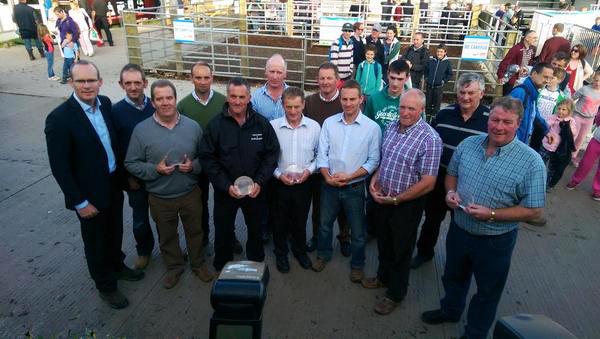
The awards, held in conjunction with Teagasc and the Irish Farmers Journal, aim to highlight the link between environmental sustainability and efficient beef production at farm level.
The winners were decided decided following a farm visit by the judging panel which includes Joe Burke, Bord Bia, Darren Carty, Irish Farmers Journal and Aidan Murray, Teagasc. They were:
Suckler to weanling: Tim Joyce, Turloughmore, Galway
Tim Joyce and his father Jackie farm in Ballinvoher, Turloughmore, Galway. Their batch of 2013 autumn-born calves were recently sold to Quinn International, with top-grade weanlings selling for €3.10/kg, while lesser quality or heavier types sold for €2.80/kg.
Tim’s aim is to produce top grade U+/E grading weanlings while avoiding any of the pitfalls associated with producing heavy muscled weanlings.
This is partly achieved by the strong passion for breeding and close scrutiny when selecting sires. Only proven sires are selected with high reliability figures with the potential risk of using test bulls seen as too great to take.
The 48-cow suckler herd is run on approximately 39ha of land (28ha owned and 11ha rented), with plans in place to increase to 60 cows calving in 2015 (store lambs are also purchased in autumn and finished the following spring).
Three quarter bred red Limousin cows are seen as the ideal cow to deliver consistency in calf quality from year to year.
Dairy calf to beef: William Morrow, Raphoe, Donegal
William Morrow runs a dairy calf to beef enterprise on 60ha (148 acres) in Raphoe, county Donegal. The enterprise consists of purchasing approximately 300 dairy-bred calves each spring and bringing them to slaughter off grass at 16 to 20 months of age.
William has experimented with many finishing systems and has previously finished Friesian bulls under 16 months of age and Angus heifers at 14 to 15 months of age (main limitation getting carcases over 220kg to 230kg without going over-fat).
Joining the Angus Producer Group Scheme three years ago brought a switch from finishing Friesian bulls to purchasing predominantly Angus bull and heifer calves.
This focus remains, although for the last two years Hereford calves have also been purchased. The 300 calves are purchased over a six-week period from mid-February through to April with an average of 50 calves brought in each week
Beef finishing: Pat Murray, Gorey, Wexford
Pat Murray runs a mixed beef and tillage farm in Pallas, Gorey, Wexford. The tillage enterprise totals 49ha, with barley, maize silage and fodder beet the main crops grown. The grassland area extends to about 40ha, with 200 cattle generally grazed over the summer months.
Cattle finished in the beef enterprise are top quality, with over 75% on average grading U, 20% R and the remainder grading E. Pat has a preference for purchasing high-quality cattle due to their potential for a high kill-out and performance on a high-energy grass or finishing diet.
The system has developed on the back of a good relationship with a local suckler farmer who supplies the majority of stock from his spring- and autumn-calving herds. This suits Pat because the background breeding, health status and previous veterinary treatments are known. Animals also settle quickly, with little setback in performance while autumn and spring calving suits finishing out of the shed or off grass. The same policy exists for all animals purchased, with a preference for farm to farm trading.
Suckler to beef: Jonny Greene, Maganey, Athy, Co Kildare
Jonny Greene’s suckler to beef (53ha) enterprise is run alongside a tillage enterprise operated in partnership with his father Nassau. Both systems complement each other to optimum effect.
For example, straw is used to bed cows and progeny in the 90-cow spring-calving suckler herd (includes first-calf heifers) and as such helps maintain organic matter, soil fertility and crop yields in tillage ground while home-grown cereals are used to finish male progeny as bulls and supplement the suckler herd.
The suckler herd has expanded in the last three years and is run with one focus – to achieve optimum breeding performance and maximise output.
Cow type in the herd is Salers and Salers cross and Jonny believes the breed is underrated by farmers, most likely contributed to by docility issues when the breed was first imported to the country.
The herd has achieved a calving interval of less than 365 days and 0.99 calves, or more, produced per cow in the last three years, with calving over a seven- to eight-week period. Jonny says a contributing factor to good breeding performance is zero tolerance for under-performing animals, with cows not in calf given no second chances.




SHARING OPTIONS