



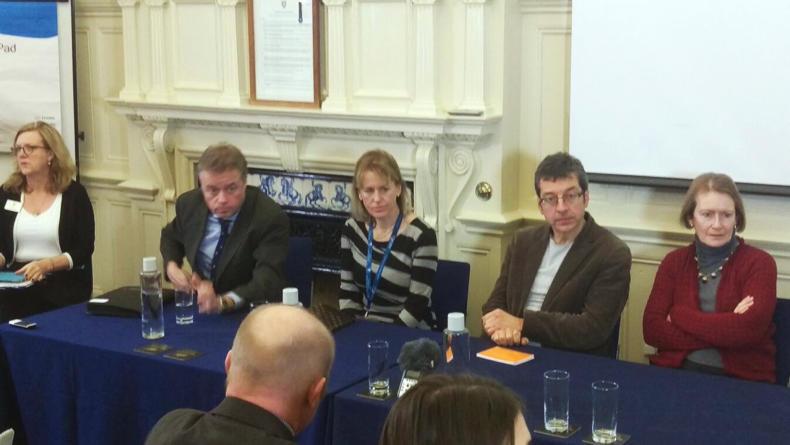
Representing the green lobby, George Monbiot, journalist, environmentalist and political activist, put forward radical proposals where money would be focused on environmental benefits and break the link with support for farming. He went so far as to say that some areas of the UK need to stop farming and should focus entirely on environmental benefits.
He also outlined three ways to make subsidies “fairer” for everyone. These are a rural hardship fund, which Monbiot says should not only be for farmers, a payment based on the provision of public goods and services such as care of the environment and a transitional fund to cater for new entrants.
He added that alongside this work needs to continue on bringing more equality into the food supply chain.
If a deal is not done with the EU, then lamb exports are facing a 51% tariff
NFU perspective
Representing farmers, NFU deputy president Minette Batters felt that until the trade deals with the EU have been finalised, it is very difficult to shape any future farming policy. “For instance, if a deal is not done with the EU within the two-year time period after Article 50, then lamb exports are facing a 51% tariff,” she said.
She did state that support would be from a single pot with an end to the two-pillar system. She also stated that coupled payments have no part to play in supporting farmers.
Dame Helen Ghosh, director general of the National Trust, is keen to seen mixed farming with focused support on upland farms which find it more challenging to get returns from the market. She advocated a policy which supported farmers who would enrich their farms environment through enhanced habitats, soils, wildlife and improved landscape. “What we want to see a thriving farming industry while restoring the environment,” she said.
We need to use public money to drive our businesses into a position where we don’t need it
Finally, Guy Poskitt, a carrot farmer and vice-chair of the NFU horticulture and potato board, was pushing for support payments to be channelled into grants to improve efficiencies. He argued that direct support should be phased out but warned this could take more than 10 years. “We need to use public money to drive our businesses into a position where we don’t need it,” he said.
Poskitt also strongly opposed the suggestion of capping farmers’ payments in the new policy. “Big businesses need money to thrive,” he told Monbiot, who highlighted the case of rich landowners, such as the Duke of Westminster, being in receipt of public money.
The panel session highlights the diversity in views for future farm policy in the UK. However, there are some emerging themes, moving away from direct payments based on farmed area or output and moving towards focused environmental outcomes.
Additional reporting by Amy Fitzgibbon


SHARING OPTIONS